Introduction
Modern factory floors are under mounting pressure on two fronts: the Manufacturing Institute projects 1.9 million manufacturing jobs will go unfilled by 2033, and warehousing turnover routinely exceeds 75%. Meanwhile, peak-season order volumes can spike 300–400% — a level manual processes simply cannot sustain.
These pressures have made automation a operational necessity, not a nice-to-have. AGV (Automated Guided Vehicle) industrial robots offer a practical answer — moving materials autonomously across factory floors without relying on scarce human operators.
This guide covers what factory managers need to know: what AGV robots are, how they work, the leading manufacturers and suppliers, and how to get started with flexible acquisition models including rental, leasing, and purchase options.
TLDR:
- AGV industrial robots autonomously transport materials across factory floors, addressing labor shortages and throughput demands
- Modern AGVs use LiDAR, SLAM, or magnetic tape navigation and integrate with WMS, MES, and ERP systems
- Leading manufacturers include VisionNav, AITEN, Toyota, KION Group, and Geek+, each covering different payload ranges and navigation types
- Factories can acquire AGVs through purchase, leasing, or rental (minimum 2 months), with free installation, training, and ongoing support included
What Are AGV Industrial Robots?
AGV (Automated Guided Vehicle) industrial robots are self-navigating vehicles used in manufacturing and warehouse environments to move materials, components, and goods without requiring a human operator. The term "AGV industrial robots" encompasses the broader family of factory-floor automation vehicles designed to replace manual forklifts and traditional material handling equipment.
What sets them apart is autonomous operation: AGVs follow pre-defined or dynamically calculated routes, eliminating the need for human drivers and enabling continuous material flow 24/7.
From 1953 to Today: A Proven Technology
AGVs aren't experimental. The first AGV was introduced in 1953 by Barrett Electronics—a modified towing tractor that followed a wire embedded in the factory floor. Today's systems have evolved considerably: modern platforms combine laser navigation, wireless communication, and onboard microprocessors to handle complex factory environments.
That evolution is now codified in formal standards. ISO 3691-4:2023 defines a "driverless industrial truck" as a powered truck designed to operate automatically, covering AGVs, autonomous mobile robots (AMRs), and automated guided carts. In the U.S., ANSI/ITSDF B56.5-2024 provides the safety guidelines governing these systems.
AGVs vs. AMRs: What's the Difference?
Both fall under "driverless industrial trucks," but the practical difference matters when you're choosing a system:
- AGVs follow a defined path using external references like magnetic tape or laser reflectors
- AMRs use natural navigation (SLAM) to map surroundings in real-time, allowing them to reroute and avoid obstacles without fixed infrastructure
When to choose which: AGVs work best for predictable, repetitive routes where installation cost matters. AMRs excel in dynamic, high-traffic environments where flexibility is critical.
How AGV Industrial Robots Work in a Factory
Understanding how these systems function helps you evaluate vendors, plan integration, and avoid costly specification mistakes.
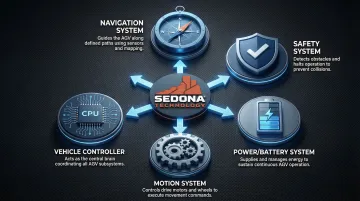
The 5 Core Components
Every AGV system consists of five essential elements:
- Navigation System - Determines position and route (magnetic tape, LiDAR, SLAM, or vision-based)
- Safety System - Laser scanners, proximity sensors, emergency stops, and speed reduction zones
- Power/Battery System - Lithium-ion batteries with automatic charging cycles
- Motion System - Motors, wheels, and lifting mechanisms for movement and load handling
- Vehicle Controller - PLC or software-based system managing speed, stability, and steering
Navigation Technologies: Trade-offs for Factory Settings
| Navigation Tech | Accuracy | Flexibility | Infrastructure Cost | Best For |
|---|---|---|---|---|
| Magnetic Tape | High (± 2 mm) | Low (fixed paths) | Low (adhesive tape) | Static, repetitive routes |
| Wire Guidance | High | Very Low | High (floor cutting) | Legacy systems |
| LiDAR / Laser | High (< 10 mm) | High (virtual paths) | Medium (reflectors) | Semi-dynamic environments |
| Vision / SLAM | Medium (± 10 mm) | Very High (dynamic) | Low (no infrastructure) | High-traffic, changing layouts |
Magnetic tape remains cost-effective for fixed, repetitive routes. LiDAR and SLAM are now the preferred choice for dynamic factory environments — they require no physical infrastructure on the floor and adapt as layouts change.
Integrating with Factory Systems
AGVs must connect directly with your existing factory software stack to deliver real value:
- Warehouse Management Systems (WMS) - For inventory tracking and task assignment
- Manufacturing Execution Systems (MES) - To coordinate with production schedules
- ERP Software - For real-time data updates across the enterprise
- Conveyor/Robotic Infrastructure - To hand off materials at workstations
Fleet management software ties these systems together — using APIs to assign tasks, manage traffic, and sync inventory in real time. Platforms such as Toyota's I_Site and Zebra's Symmetry handle multi-robot coordination across large facilities.
Safety Mechanisms: Operating Alongside Humans
ISO 3691-4:2023 and ANSI/ITSDF B56.5-2024 mandate strict safety functions:
- 360-degree collision avoidance systems using laser scanners
- Dynamic speed adjustment in pedestrian zones
- Emergency stop mechanisms with redundant braking systems
- Performance Levels (PLr) for braking and personnel detection
Compliance with these standards is a prerequisite for deployment. Request documented CE/TÜV certifications from vendors before finalizing any purchase — missing paperwork is one of the most common causes of delayed commissioning and failed safety audits.
Types of AGV Robots Used in Industrial Settings
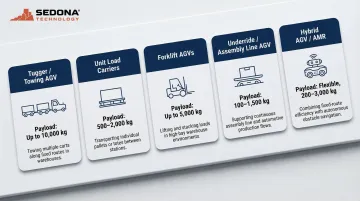
AGV selection comes down to four variables: payload requirements, floor layout, route complexity, and whether you're moving pallets, carts, or individual components. Getting this match right determines both ROI and operational fit.
Main AGV Categories
Tugger/Towing AGVs
- Pull multiple carts in train configurations
- Ideal for: Multi-stop milk runs in heavy manufacturing
- Payload: Up to 154,000 lbs (MasterMover PowerSteered)
Unit Load Carriers
- Transport individual totes, bins, or small pallets
- Ideal for: Assembly line feeding and kitting operations
- Payload: 200 kg to 1,000 kg (Geek+ M-Series)
Forklift AGVs
- Counterbalance: Heavy pallet transport and truck loading (Toyota CB18: 4,000 lbs)
- Stacker: Medium-duty storage and retrieval (Linde L-MATIC HD: 2 tons)
- Reach Truck: High-bay racking operations
Underride/Assembly Line AGVs
- Slide under carts and fixtures to transport them
- Ideal for: WIP movement between manufacturing stages
- Common in automotive and electronics assembly
Hybrid AGV/AMR Platforms
- Combine fixed-route efficiency with dynamic obstacle avoidance
- Ideal for: Facilities transitioning from manual to automated workflows
Compact Variants for Constrained Spaces
Beyond these standard categories, floor space constraints introduce another layer of selection criteria. Several manufacturers offer slim variants engineered specifically for narrow aisles and high-density racking:
- VisionNav VNSL14: 1.8m narrow aisle capability with 1.4-ton capacity
- Jungheinrich EKX 516a: 1,600 kg payload, lifts up to 13,000 mm in narrow aisles
- STILL MX-X iGo: 1,400 kg capacity, 14-meter lift height
If your facility already runs VNA (very narrow aisle) racking, verify aisle width tolerances before finalizing any AGV spec — even a 50mm difference can affect operational clearance.
Key Applications of AGV Industrial Robots in Manufacturing
Inbound Material Transport
AGVs receive raw materials and components from docking areas and deliver them to production line stations, replacing manual forklift runs and reducing delays. This eliminates bottlenecks at receiving docks and ensures materials arrive exactly when needed.
Assembly Line Replenishment
AGVs supply parts, sub-assemblies, and packaging materials to workstations on a just-in-time basis, keeping lines running without human intervention. Automotive supplier DENSO achieved a 48% reduction in process defects using Toyota AGVs for JIT delivery.
Kitting and Distribution
AGVs follow predetermined routes to deliver precise quantities of components to kitting stations, reducing picking errors and labor costs. MBK Industrie uses crawling AGVs to automate kitting cart flows, delivering spare parts directly to operators.
WIP (Work-in-Process) Transport
Moving partially assembled products between stages—from welding to painting to quality inspection—is standard practice in automotive, aerospace, and electronics manufacturing. Ampro's Nutrilite plant uses Dematic AGVs to transport raw materials and WIP through cleanroom environments, keeping automated traffic fully separated from manual drivers.
Industry Sectors Leading AGV Adoption
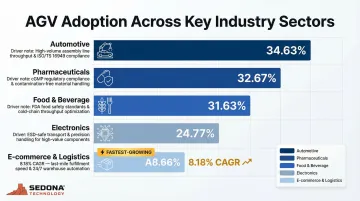
These applications concentrate in a handful of industries where precision, throughput, and compliance demand more than manual handling can deliver:
- Automotive — The largest segment at 34.63% of 2025 market revenue, driven by just-in-time assembly lines and heavy sub-assembly handling
- Pharmaceuticals — GDP compliance and FDA Drug Supply Chain Security Act (DSCSA) traceability requirements make automated, auditable transport essential
- Food and Beverage — AGVs support ISO 22000 food safety standards and operate reliably in low-temperature, high-cleanliness cold chain environments
- Electronics — Sensitive component transport integrated directly with automated assembly and testing equipment
- E-commerce/Logistics — The fastest-growing segment at 8.18% CAGR, handling peak-season order volume spikes of 300–400% without adding headcount
Top AGV Industrial Robot Manufacturers & Suppliers to Know
The AGV market includes global OEM manufacturers, regional integrators, and equipment suppliers who can source and deploy systems from multiple brands. Understanding the landscape helps factory managers evaluate vendors effectively.
Market Landscape
The North American AGV market is moderately fragmented, with the top five suppliers (Daifuku, Dematic, Toyota, Jungheinrich, Swisslog) holding roughly 45-50% of revenue. Chinese entrants like Geek+ are disrupting that share with aggressive pricing, pushing incumbents toward software and service differentiation.
Cautionary Note: Vendor stability matters. Zebra Technologies acquired Fetch Robotics for $290M in 2021, then announced in late 2025 it was winding down or selling its AMR division. Protect investments by demanding long-term service level agreements (SLAs) and prioritizing vendors with proven financial stability.
Leading Manufacturer Profiles
Toyota Material Handling
- Product Lines: Core Tow Tractors, CB18 Forklifts, Key Carts
- Navigation: LiDAR, Magnetic Tape
- Differentiators: Deep integration with Toyota ecosystem, I_Site fleet management, global service network
- Best For: Automotive and heavy manufacturing with established Toyota equipment fleets
KION Group (Linde/STILL)
- Product Lines: L-MATIC, R-MATIC, STILL iGo neo, EXV iGo
- Navigation: Natural Feature (Laser), SLAM
- Differentiators: Premium European engineering, hybrid manual/auto operation, advanced 360° safety
- Best For: High-precision environments requiring CE certification and European safety standards
VisionNav Robotics
- Product Lines: VNSL Slim, VNR Reach, VNST Pallet Stackers
- Navigation: 3D Laser SLAM, Vision
- Differentiators: High-bay racking (up to 11m), narrow aisle (1.8m) capabilities, CE certified
- Best For: Space-constrained facilities with high-density racking
AITEN Robotics
- Product Lines: APe Series, MP10s
- Navigation: 3D SLAM, Stereo Camera
- Differentiators: Compact modular design, dual-mode manual/auto switching, CE certified for EU
- Best For: Facilities needing flexible manual override capabilities
Geek+
- Product Lines: M-Series (Moving), F-Series (Forklift)
- Navigation: Laser SLAM, QR Code, Vision
- Differentiators: E-commerce and 3PL focus, highly scalable goods-to-person ecosystems
- Best For: High-volume distribution centers and e-commerce fulfillment
What to Look for When Evaluating Manufacturers
When shortlisting vendors, verify:
- Product range breadth - Can they handle your full range of payloads and applications?
- Navigation technology - Does it match your floor layout and traffic patterns?
- Software integration capabilities - Can they connect to your WMS, MES, and ERP systems?
- Industry certifications - CE, ISO 3691-4, ANSI/ITSDF B56.5 compliance documentation
- Global service network - Local support availability for maintenance and troubleshooting
- Track record - Case studies in similar factory environments
The Role of Regional Equipment Suppliers
Sedona Technology LLC offers sales, rental, and leasing of industrial robots — including free installation, training, and ongoing support. For factories that aren't ready to engage directly with large OEMs or make an outright purchase, regional suppliers like Sedona offer a more accessible path to deployment.
Key advantages:
- Flexible acquisition models (rent starting at 2 months, lease, or buy)
- Bundled support reduces deployment risk
- Local service and faster response times
- Multi-brand sourcing options
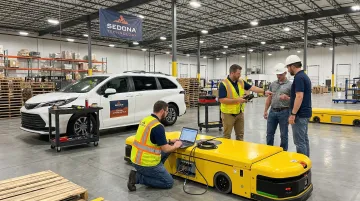
Before full deployment: Request a site assessment or pilot program from any shortlisted supplier — it's the fastest way to validate fit before committing to a full rollout.
How to Choose and Acquire the Right AGV Solution for Your Factory
Step 1: Assess Your Needs
Before contacting vendors, evaluate:
- Current material flow bottlenecks - Where do delays occur most frequently?
- Floor layout constraints - Aisle widths, ceiling heights, traffic patterns
- Payload and throughput requirements - Weight, volume, and frequency of moves
- Existing system integrations - WMS, MES, ERP platforms currently in use
- Workforce readiness - Staff training needs and change management considerations
Step 2: Understand Acquisition Paths
| Purchase (CAPEX) | Leasing | Rental (OPEX) | RaaS | |
|---|---|---|---|---|
| Best for | High utilization, available capital | Preserving capital long-term | Seasonal demand, pilots | Proving ROI before scaling |
| Typical terms | 30% at order, 40% delivery, balance on commissioning | 3–5 year agreements | 2-month minimum (e.g., $575/mo for KEENON S100) | Pay per task (e.g., per pallet moved) |
| Pros | Lowest total cost over 5+ years | Spreads costs, predictable budgeting | Minimal commitment, test before scaling | Zero CAPEX, vendor maintains equipment |
| Cons | High upfront cost, maintenance responsibility | Higher total cost than purchase | Higher per-month rate, stock-dependent | Long-term costs can exceed purchase |
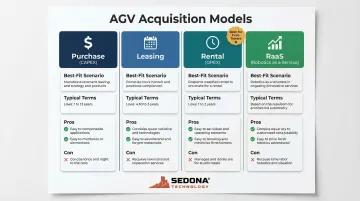
Whichever path you choose, the financial case is strong: documented installations show payback in as little as 8 months in high-labor-cost regions, with most manufacturers reporting ROI within 18 months.
Step 3: Prioritize Post-Sale Support
Post-sale support — software updates, maintenance, staff training, and integration assistance — is frequently the deciding factor between a successful rollout and a costly one.
Verify what's included before signing:
- Free installation and commissioning
- Comprehensive staff training (not just a manual)
- Ongoing technical support (response times, availability)
- Software updates and security patches
- WMS/MES/ERP integration assistance
- Spare parts availability and lead times
Companies like Sedona Technology LLC include free installation, training, and ongoing support with all rental and purchase options, reducing deployment risk for factories new to automation.
Frequently Asked Questions
What is the difference between an AGV and an AMR?
AGVs follow pre-programmed or fixed routes using external references like magnetic tape or laser reflectors, while AMRs use onboard sensors and real-time mapping (SLAM) to navigate dynamically. AMRs offer more flexibility for changing environments, but AGVs are often more cost-effective for predictable, repetitive factory routes.
How much does an AGV industrial robot cost?
Entry-level unit load carriers start around $25,000–$50,000, while heavy-duty forklift AGVs can exceed $100,000 depending on payload capacity and navigation technology. Rental options (from $575/month for 2+ months) and leasing significantly reduce upfront cost barriers.
Which industries use AGV robots the most?
Automotive leads with 34.63% of market revenue, followed by pharmaceuticals, food and beverage, and electronics. E-commerce and logistics is the fastest-growing segment (8.18% CAGR), driven by same-day delivery pressure. Each sector relies on AGVs for a distinct compliance or throughput need.
Can AGV robots operate 24/7 without human supervision?
Yes. Modern AGVs run continuously using lithium-ion batteries and opportunity charging — automatically docking during idle time to recharge. Once the system is set up and commissioned, day-to-day operation requires little to no human involvement.
How long does it take to implement AGV robots in a factory?
Simpler magnetic tape systems can be operational in a few weeks; complex multi-robot LiDAR/SLAM deployments typically take several months. Key variables include floor preparation, WMS/MES/ERP integration, safety certification, and staff training.
What safety standards should AGV industrial robots meet?
Reputable AGVs comply with ISO 3691-4 (driverless industrial trucks) and ANSI/ITSDF B56.5 (U.S. standard), which require 360-degree laser scanners, obstacle detection, emergency stops, and documented Performance Levels (PLr). Ask vendors for CE/TÜV certification documentation before purchasing.