
Introduction
Robot lawn mowers have evolved from niche gadgets into mainstream yard tools, offering fully automated, quiet, wire-free mowing that saves hours of manual labor each season. The appeal is clear: set a schedule, let the robot work, and return to a consistently trimmed lawn without lifting a finger.
The market, however, is crowded. Options span wildly different price points—from under $900 to over $5,000—and yard-size requirements vary just as dramatically. Overspending on features you don't need, or picking a model that can't handle your terrain, are easy mistakes to make.
This guide covers the top robot mowers of 2026, tested across different yard types and sizes, with a breakdown of cutting capacity, navigation tech, and slope handling to help you find the right fit.
Key Takeaways
- Robot mowers cut 2–3 times per week in short sessions, mulching clippings as they go — they're not built for overgrown lawns
- Navigation technology—satellite/RTK, camera vision, LiDAR, or boundary wire—separates budget models from premium ones
- For large yards (0.5+ acres), prioritize RTK or satellite navigation with long battery life
- Top picks: Husqvarna 450X EPOS (large yards), Segway Navimow X390 (best overall), Eufy E15 (easiest setup), Ecovacs Goat A3000 (mid-range), Gardena Sileno City (budget)
- Prices range from under $900 to $5,000+; matching the model to your yard size is where the savings actually come from
What Is a Robot Lawn Mower and How Does It Work?
Robot lawn mowers are battery-powered autonomous mowers that use onboard sensors and navigation systems to cut grass on a programmed schedule. When the battery runs low, they automatically return to a charging dock when battery runs low.
Navigation Types in 2026 Models
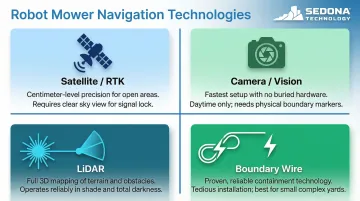
Four main navigation technologies define the market:
Satellite/RTK (Real-Time Kinematic): Achieves centimeter-level precision using GPS signals corrected by a local reference station. Best for large, open areas with clear sky visibility. Requires 160-degree sky view and fails under dense tree canopy.
Camera/Vision-Based: Uses dual cameras and AI to differentiate grass from non-grass surfaces. Fastest setup (under 20 minutes) but cannot operate at night and requires physical boundaries like fences or sidewalks.
LiDAR (Light Detection and Ranging): Creates 3D spatial maps using spinning lasers. Excels in heavy shade and under tree cover where GPS fails, working in complete darkness.
Boundary Wire: Older, established system requiring physical wire staked around the yard perimeter. Tedious installation but highly reliable for small, complex yards with heavy tree cover.
The Mulching Model
Unlike traditional mowers, robot mowers cut tiny clippings continuously and leave them on the lawn. Grass clippings are 80–85% water and decompose rapidly, returning up to 25% of your lawn's fertilizer needs back to the soil.
That continuous-cutting model only works when grass stays short. A few practical requirements come with it:
- Pre-mow to normal height before the robot's first run
- Mow regularly throughout the growing season — skipping weeks causes overgrowth the robot can't handle
- Expect reduced performance after heavy rain or growth spurts
Best Robot Lawn Mowers of 2026: Picks for Every Yard Size
These five models were selected based on navigation reliability, cutting performance, ease of setup, app quality, obstacle handling, and value for their target yard size. Each pick covers a distinct use case — from compact city lots to sprawling multi-acre properties.
Husqvarna Automower 450X EPOS — Best for Large Yards
Husqvarna has built robot mowers since the mid-1990s. The 450X EPOS represents their flagship satellite-navigated line, using EPOS (Exact Positioning Operating System) for precise GPS-based virtual boundaries with no wire needed.
Standout features:
- Covers up to 2.5 acres with outstanding obstacle avoidance
- Supports multiple mowing zones (front and back lawn)
- Overhanging blade design cuts close to edges
- Anti-theft GPS tracking and IFTTT support
- Quiet 50–60 dB operation
Main drawback: Requires clear satellite line-of-sight—not suitable for heavily tree-covered areas.
| Specification | Details |
|---|---|
| Max Coverage Area | 2.5 acres (108,900 sq ft) |
| Navigation Type | Satellite (EPOS) — no boundary wire required |
| Cutting Height | 0.75–2.15 in |
| Max Slope | 45% |
| Battery Runtime | 210 min run / 60 min recharge |
| Price | ~$5,900 |
Segway Navimow X390 — Best Overall Performance
The Navimow X390 brings Segway's engineering expertise to lawn care with RTK beacon technology achieving centimeter-level accuracy. It covers up to 2.5 acres per day and features 4G cellular connectivity for remote areas without strong Wi-Fi.
Standout features:
- Fastest and most capable mower in real-world testing
- Spiked wheels for traction and excellent self-recovery when stuck
- Thorough edge-cutting with long-lasting battery
- Completed full test lawn and neighbor's lawn on one charge
Minor limitation: Camera system can misread broad, flat leaves as obstacles, but navigation and terrain handling are class-leading.
| Specification | Details |
|---|---|
| Max Coverage Area | 2.5 acres per day |
| Navigation Type | RTK + 4G cellular; no boundary wire |
| Cutting Width | 9.3 in |
| Noise Level | 60 dB |
| Battery Runtime | 240 min |
| Key Features | Rain sensor + anti-theft |
| Price | ~$4,499–$5,000 |
Eufy E15 — Best for Ease of Use and Small–Medium Yards
The Eufy E15 is a wire-free camera-based mower that maps lawns using visual sensors rather than an RTK beacon. This eliminates ground installation and makes it one of the fastest mowers to set up—under 20 minutes to first mow in testing.
Standout features:
- Plug-and-play experience like a robot vacuum
- Self-mapping and scheduling with minimal setup
- Highly efficient cutting with minimal missed patches
- GPS tracking included
Key limitations:
- Does not operate at night (relies on visual data)
- Cannot set virtual no-go zones without physical property boundaries
| Specification | Details |
|---|---|
| Max Coverage Area | 0.2–0.3 acres (up to ~13,000 sq ft) |
| Navigation Type | Camera + vision sensors; no wire or RTK beacon |
| Cutting Height | 1–3 in |
| Max Slope | 18° |
| Battery Runtime | 90–110 min |
| Price | ~$1,000–$1,400 |
Ecovacs Goat A3000 LiDAR — Best Mid-Range Pick
The Goat A3000 uses dual LiDAR sensors for precise wire-free yard mapping, real-time obstacle detection, and navigation — no RTK antenna required.
Standout features:
- A 12.99-inch cutting width — widest on this list — for faster mowing passes
- Fast mowing speed for medium-sized lawns
- Can straddle lawn edges for cleaner cuts
- Extremely quiet at 62 dB with speedy recharge cycle
Weak point: The LiDAR system can miss sharp 90-degree corners during initial mapping.
| Specification | Details |
|---|---|
| Max Coverage Area | 0.75 acres (32,670 sq ft) |
| Navigation Type | Dual LiDAR; no wire or RTK required |
| Cutting Width | 12.99 in |
| Max Slope | 27° (50%) |
| Battery Runtime | 118 min |
| Connectivity | Bluetooth + Wi-Fi app |
| Price | ~$2,999 |
Gardena Sileno City — Best Budget Pick for Small Yards
The Sileno City is Gardena's entry-level robotic mower designed for compact residential lawns. It's the most affordable mower on this list, operating on a traditional boundary wire system for yards under 5,400 square feet.
Standout features:
- One of only a few robot mowers available under $900
- Whisper-quiet motor (57 dB—quietest on this list)
- Bluetooth scheduling via companion app
- Reliable cutting on flat-to-gentle slopes (up to 35%)
Trade-offs: No GPS or Wi-Fi, no remote steering.
| Specification | Details |
|---|---|
| Max Coverage Area | 0.06 acres (~2,700–5,400 sq ft) |
| Navigation Type | Boundary wire |
| Cutting Width | 6.3 in |
| Noise Level | 57 dB (quietest on list) |
| Connectivity | Bluetooth only |
| Price | ~$649–$859 |
Small Yards vs. Large Yards: Choosing the Right Robot Mower
Robot mowers are rated by maximum coverage area, but you should always buy for your actual mapped lawn area—not total property size. Obstacles, slopes, and irregular shapes reduce effective coverage significantly. As a rule, apply a 20–30% size-up buffer: a 0.5-acre lawn warrants a mower rated for at least 0.65–0.75 acres to avoid overextending the battery.
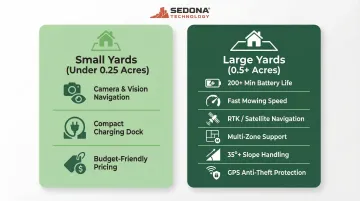
What Matters Most for Small Yards (Under 0.25 Acres)
- Camera-based or vision navigation — no boundary wire to install
- Compact charging dock that fits smaller outdoor spaces
- Budget-friendly pricing — RTK and satellite models often over-serve (and overcharge) this segment
Most homeowners in this category will find better value in camera-based models like the Eufy E15 or boundary-wire models like the Gardena Sileno City.
What Matters Most for Large Yards (0.5 Acres and Above)
- 200+ minute battery runtime to cover expansive areas in a single cycle
- Fast mowing speed to reduce total time per session
- Satellite or RTK navigation for accuracy across open areas without wire hassles
- Multi-zone support for separate front and back lawn scheduling
- Slope handling rated to at least 35° for varied terrain
- GPS tracking and anti-theft features — more important as mower value increases
How We Chose the Best Robot Lawn Mowers
Selections are based on hands-on testing data from WIRED, CNET, PCMag, and Reviewed. Each mower was evaluated for minimum one month of real-world use across:
- Setup complexity and time to first mow
- Navigation accuracy and consistency
- Obstacle avoidance and recovery
- Edge cutting quality and missed patches
- App usability and connectivity
- Battery consistency across multiple cycles
Common Buyer Mistakes These Criteria Prevent
- Max coverage area looks good on paper — slopes and obstacles shrink it fast, leaving patches unmowed
- Wire-based models can take 4–6 hours to install in complex yards, a cost most buyers don't factor in
- A 65 dB mower run at dawn will upset neighbors; no Wi-Fi means no remote scheduling or monitoring
Navigation reliability, edge performance, firmware support history, and price-to-value ratio all shaped the final picks below.
Conclusion
The "best" robot lawn mower depends on yard size, terrain complexity, and setup effort you're willing to invest. The Husqvarna 450X EPOS and Segway Navimow X390 lead for large properties, the Eufy E15 excels at simplicity, and the Gardena Sileno City delivers real value for compact lawns.
Prioritize navigation technology and coverage area match over brand name alone. Factor in long-term costs like blade replacement (every 6–8 weeks), winter storage, and any cellular subscription fees before making a final decision.
Frequently Asked Questions
What is the best robotic lawnmower on the market?
As of 2026, the Husqvarna Automower 450X EPOS and Segway Navimow X390 consistently rank highest for performance and reliability across independent tests. The best choice depends on yard size and whether satellite or RTK navigation is preferred for your terrain.
Are robot lawnmowers worth it?
A mid-tier $1,500 robot mower can break even against a standard $65/week U.S. lawn service in under 14 months. They're most cost-effective for homeowners who currently pay for regular lawn care or have large yards that are time-intensive to mow manually.
Do robot lawn mowers actually cut grass?
Yes, robot mowers cut grass effectively using a mulching approach with small spinning blades designed for frequent, light cuts. They cannot handle long or overgrown grass—lawns should be pre-mowed to normal height before first use.
How much land can a robot mower handle?
Coverage ranges from under 0.1 acres for budget models to 2.5 acres per day for premium satellite-navigated models like the Segway Navimow X390 or Husqvarna 450X EPOS. Match the mower's rated capacity to your actual mapped lawn area, not total property size.
How much does a commercial robot mower cost?
Commercial-grade robot mowers for parks, sports fields, or resort grounds typically start around $5,000 and can exceed $20,000 depending on coverage area and autonomy level. Leasing or rental options can reduce upfront costs significantly.
What is the life expectancy of a robotic mower?
Most quality robot mowers last 5–10 years with proper maintenance, including annual blade replacement, winter storage indoors, and keeping charging contacts clean. Battery packs typically degrade after 3–5 years and can usually be replaced.