Introduction
Service robots are already working restaurant floors, cleaning hotel lobbies, and moving inventory through warehouses — handling tasks that once required a full human shift. According to the International Federation of Robotics' 2025 report, nearly 200,000 professional service robots were sold in 2024, marking a 9% year-over-year increase driven largely by businesses seeking operational efficiency and cost savings.
The drivers are straightforward: labor shortages, rising operational costs, and the demand for consistent 24/7 performance make automation an increasingly practical choice — especially for roles involving repetitive, physically demanding, or coverage-gap-prone tasks.
This article covers what service robots are, the main types available today, real-world examples across industries, and how to choose the right one for your operation.
Key Takeaways
- Service robots autonomously handle repetitive or physically demanding tasks outside traditional factory settings
- Personal service robots cover home use; professional service robots handle commercial applications
- Key types include cleaning robots, delivery robots, customer-facing robots, and warehouse logistics robots
- Deployments across hospitality, food service, retail, and warehousing help cut labor costs and improve consistency
- Selection depends on environment, task requirements, budget, and vendor support
What Are Service Robots?
A service robot is a machine designed to perform useful tasks for humans—typically those that are repetitive, dangerous, physically taxing, or time-sensitive—outside of purely industrial manufacturing environments. According to the ISO 8373:2021 standard, a service robot is defined as "a robot in personal use or professional use that performs useful tasks for humans or equipment."
How They Differ from Industrial Robots
Industrial robots are fixed to production lines in factories, performing tasks like welding or assembly in controlled environments. Service robots are mobile, adaptable, and designed to work alongside humans in lobbies, aisles, kitchens, and warehouses. The distinction isn't based on mechanical design—it's about where the robot operates and who it serves.
That operating context also shapes how service robots are built to behave. They run on scheduled routines, respond to real-time obstacles, and in many cases operate 24/7 with minimal human intervention. To navigate unpredictable spaces safely, they rely on sensors like LiDAR, cameras, and SLAM (Simultaneous Localization and Mapping)—the same core technologies used in autonomous vehicles, now scaled for commercial floor use.
Types of Service Robots
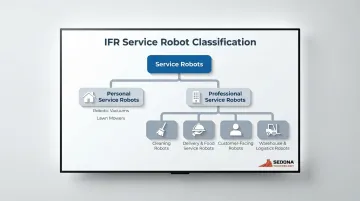
The International Federation of Robotics recognizes two primary classifications: personal service robots (used in domestic or individual settings) and professional service robots (used in commercial, industrial, and institutional environments). Most businesses focus on professional service robots, which further divide into functional subtypes. Most businesses focus on professional service robots, which further divide into functional subtypes. Here's how each type works in practice.
Cleaning and Maintenance Robots
Cleaning robots are autonomous machines that handle floor scrubbing, vacuuming, sanitizing, and general maintenance tasks on programmed schedules or in response to detected conditions like spills.
These robots shine in high-traffic facilities — running overnight shifts, maintaining consistent output regardless of hour, and freeing janitorial staff for the detail work that actually requires human judgment. A few practical constraints to know upfront:
- Most models are task-specific (a scrubber won't vacuum)
- Require an initial environment mapping or setup phase
- Perform best in structured spaces with predictable layouts
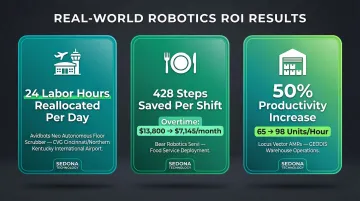
At Cincinnati/Northern Kentucky International Airport, deploying the Avidbots Neo robot reallocated 24 labor hours per day, letting a three-person overnight crew shift focus to high-touch sanitization areas instead of floor scrubbing.
Delivery and Food Service Robots
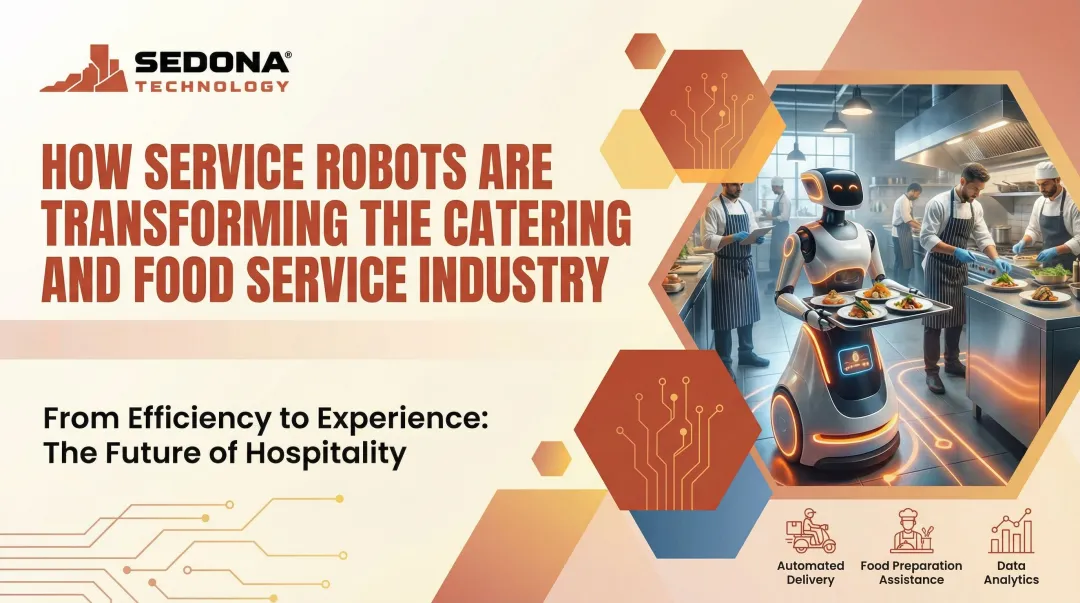
Food service and delivery robots move meals, beverages, or goods between fixed points — kitchen to table, hotel kitchen to guest room — using sensors and mapping technology like LiDAR and SLAM to navigate crowded, dynamic spaces.
The core value is reallocation: servers spend less time running food and more time on guest interactions that actually drive satisfaction. That said, these robots work best in environments with clear, consistent pathways — complex floor layouts or unpredictable foot traffic can chip away at efficiency.
A 2022 pilot study at Front Porch senior living communities found that Bear Robotics' Servi robot saved servers an average of 428 steps per shift and cut monthly overtime costs from $13,800 to $7,145 — while 58% of staff reported more quality time with residents.
Customer-Facing and Guidance Robots
Customer-facing robots interact directly with people, providing information, directions, check-in assistance, or product demonstrations in settings like hotel lobbies, malls, airports, and retail stores. They often feature screens, voice interfaces, and in some cases emotional recognition.
They're most effective as a first line of response — handling the volume of repetitive wayfinding and inquiry traffic that would otherwise bottleneck front-desk staff during peak hours. That said, they're not built for nuance. Complex problems, emotionally sensitive conversations, and service escalations still belong with people. Regular content updates and maintenance are also ongoing requirements worth factoring into deployment planning.
Warehouse and Logistics Robots
Warehouse robots—including Autonomous Mobile Robots (AMRs) and Automated Guided Vehicles (AGVs)—move goods, manage inventory, and support order fulfillment in warehouses, factories, and distribution centers. AMRs navigate via dynamic mapping, while AGVs follow predetermined paths.
The gains here are measurable and well-documented: faster pick rates, fewer movement errors, and a significant reduction in the miles warehouse staff walk each shift. The tradeoff is a heavier upfront integration lift — the environment needs to be reasonably organized and mapped before deployment pays off. These systems also work best alongside warehouse staff, not as a wholesale replacement.
At a GEODIS facility in Dallas, Locus Vector AMRs increased picking productivity by 50% — from 65 units per hour to 98 — while reducing the physical strain of pushing 200-pound carts.
Real-World Applications of Service Robots
Service robots are being deployed across a wide range of commercial environments. The most successful applications share a common thread: they replace high-frequency, low-complexity tasks so human staff can focus on higher-value work. The International Federation of Robotics reports that Robot-as-a-Service (RaaS) fleet deployments surged 31% in 2024. Businesses are increasingly choosing subscription models to avoid large upfront purchases — and the numbers reflect it.
Hospitality and Hotels
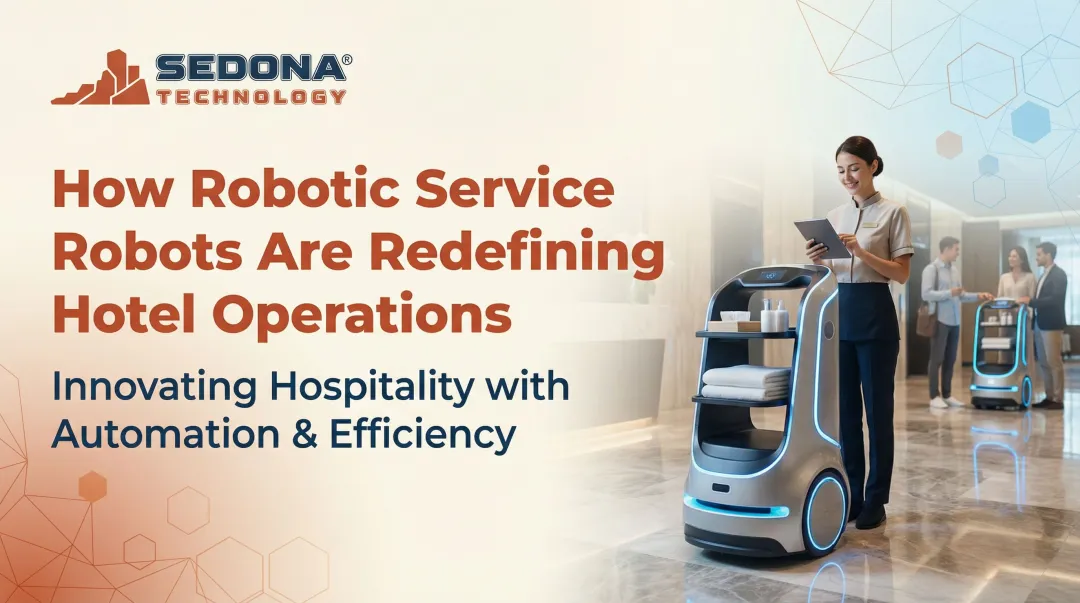
Hotels deploy service robots for room service delivery, luggage transport, lobby cleaning, and guest information assistance. These robots help reduce front desk wait times, maintain cleaning schedules overnight, and deliver amenities without requiring additional staff on late shifts.
Sedona Technology supplies service robots built for hotel environments, including the KEENON BUTLERBOT W3 — a contactless room delivery robot with automatic elevator integration. Rental starts at $575/month (2-month minimum), with free installation and training included, so properties of any size can deploy without disrupting their existing operations.
Restaurants and Food Service
Restaurants and cafes use delivery robots to ferry dishes between kitchen and tables, bus empty plates, and interact with diners—particularly effective in high-volume or fast-casual settings where speed and turnover rate directly impact revenue.
In 2024, global hot pot chain Haidilao saw its daily table turnover rate climb from 3.8 to 4.1 after integrating Keenon robots and automated broth-mixing machines. The broth machine alone covered the work of three staff members — a meaningful offset at a time when labor costs had reached 33% of revenue.
Retail, Malls, and Airports
Retail environments and high-traffic public spaces use service robots for floor cleaning, customer guidance, security patrol, and inventory scanning. In airports and malls, guidance robots handle high volumes of visitor queries that would otherwise require multiple stationed staff members.
Shelf-scanning robots like Simbe's Tally achieve 98% on-shelf availability and drive a 2% annual sales lift by automating tasks that previously consumed 30+ hours of manual labor per week — recovering revenue that quietly disappears through out-of-stock gaps.
Warehouses and Industrial Settings
Autonomous mobile robots in warehouses and factories help move materials between stations, support production lines, and assist with inventory tasks. These environments benefit from robots' ability to operate on predictable routes during both staffed hours and overnight shifts.
Key operational advantages in these settings include:
- Continuous material transport between production stations without shift gaps
- Consistent inventory cycle counts without pulling floor staff off other tasks
- Overnight operation on fixed routes with no supervision required
Key Benefits of Using Service Robots
Service robots deliver measurable gains across three areas that matter most to operations managers: productivity, labor allocation, and worker safety.
- Consistent output around the clock — Robots perform repetitive tasks with the same precision at 2am as at 2pm, eliminating variability from fatigue, distraction, or training gaps.
- Workforce reallocation, not replacement — By handling low-engagement tasks, robots free staff to focus on customer interaction, complex decisions, and skilled work.
- Reduced occupational injury risk — Robots take on physically demanding work such as heavy lifting and floor scrubbing. For context, warehousing already carries an injury rate of 4.1 cases per 100 full-time workers involving days away from work, according to 2024 BLS data.
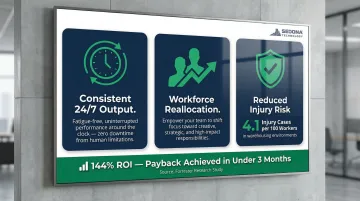
The ROI follows quickly. A commissioned Forrester Total Economic Impact study on Locus Robotics found a 100% increase in picks per hour and a 144% ROI with payback in under three months.
One Safety Caveat Worth Knowing
That said, robots don't eliminate all injury risk — they shift it. A 2025 George Mason University study found that while severe injuries dropped 40%, non-severe repetitive strain injuries rose 77% due to the faster pace of human-robot picking workflows.
Operators should implement mandatory task rotation and ergonomic interventions to offset these new strain hazards before they become a pattern.
How to Choose the Right Service Robot for Your Business
Start with Environment and Task Fit
Identify which specific tasks in your operation are repetitive, time-consuming, or creating staffing challenges. The right robot isn't the most advanced one — it's the one that solves the right problem in your specific environment. Map out your floor plan, identify bottlenecks, and determine whether tasks are truly repetitive or require human judgment.
Evaluate Operational Factors
Consider these elements before shortlisting any system:
- Layout of your space (open floor vs. narrow corridors)
- Hours you need coverage (daytime only vs. overnight autonomous operation)
- Whether the robot needs to interact with customers or operate in the background
- Existing infrastructure (Wi-Fi coverage, elevator access, charging station locations)
Assess Total Cost of Ownership and Acquisition Model
Beyond purchase price, factor in installation, training, maintenance, and downtime costs. Look for providers that offer flexible acquisition options — sales, rental, or leasing — with support built in rather than billed separately.
Sedona Technology, for example, includes free installation and training across all three models, with rental periods starting at just two months. That flexibility makes it practical to pilot a robot before committing to a long-term investment.
Plan for Integration and Staff Adoption
Service robots work best when staff understand their role alongside the robot. Before deployment, map out a clear onboarding plan:
- Who programs the robot?
- Who monitors it?
- How is performance tracked?
- How will you communicate the robot's purpose to staff?
Selecting a robot for novelty alone is a common misstep. Workflow fit — not flashy features — is what determines whether the investment pays off.
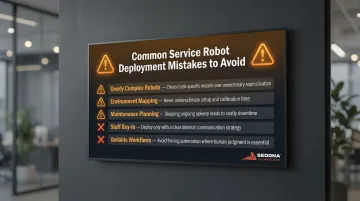
Common Mistakes to Avoid
- Choosing an overly complex robot when a simpler task-specific model would suffice
- Underestimating setup time for environment mapping
- Skipping ongoing maintenance planning until something breaks
- Deploying without staff buy-in or a clear communication plan
- Forcing automation into highly variable workflows that require human judgment
Conclusion
Service robots are practical, commercially proven tools available across a wide range of types and applications that map directly to the real challenges businesses face in hospitality, food service, retail, and logistics. With nearly 200,000 professional units sold in 2024 and a 31% surge in Robot-as-a-Service deployments, the market has moved well beyond experimental pilots into active, everyday use across multiple industries.
The right robot depends less on hype and more on a clear understanding of your operational needs, your environment, and the support your provider delivers. Businesses that map workflows carefully, bring staff into the process early, and choose partners with hands-on support tend to see faster returns — not just in labor efficiency, but in how consistently their operations perform when demand peaks.
That's where thoughtful selection makes the difference.
Frequently Asked Questions
What are some examples of service robots in real life?
Food delivery robots, floor-cleaning robots, autonomous mobile robots in warehouses, and customer guidance robots in malls are all common commercial deployments today. These systems handle tasks like transporting meals, scrubbing floors, moving inventory, and directing visitors.
What are the two types of service robots?
The International Federation of Robotics classifies service robots into personal service robots (used in domestic settings, like robotic vacuums) and professional service robots (used in commercial settings like hospitality, healthcare, retail, and logistics). Most businesses focus on professional service robots.
How are service robots different from industrial robots?
Industrial robots are fixed-location machines built for manufacturing tasks like welding and assembly. Service robots, by contrast, are typically mobile, designed to operate in human environments, and handle a broader range of tasks alongside people.
Can service robots operate without human supervision?
Many service robots are fully autonomous, capable of running scheduled tasks, navigating obstacles, and even self-charging without human oversight. Most systems also support manual override and remote monitoring for added control when needed.
What industries use service robots the most?
Hospitality, food service, healthcare, retail, and warehousing/logistics see the highest adoption, driven by labor availability challenges and the high volume of repetitive tasks where automation is a natural fit.
Do service robots replace human workers?
Service robots are designed to work alongside human staff, handling repetitive, physically demanding, or low-engagement tasks. This frees employees to focus on higher-value work that requires judgment, skill, and personal interaction.