This article explores the types of service robots reshaping food service, their measurable benefits, real-world applications, adoption challenges, and practical guidance for businesses considering robotics. Whether you run a small café or manage a hotel dining operation, understanding how robots can augment your workforce is no longer optional—it's essential for staying competitive.
Key Takeaways
- Service robots handle food prep, dining room delivery, last-mile transport, and bartending across restaurants and hotels
- Operators achieve 20–25% labor cost reduction while redeploying staff to guest-facing roles
- Four robot categories lead adoption: serving (BellaBot, Servi), cooking automation (Flippy), outdoor delivery (Starship), and bar systems (Makr Shakr)
- Rental models starting at 2-month minimums let operators deploy robots without large upfront costs
What Are Service Robots in Catering and Food Service?
Service robots are autonomous or semi-autonomous machines designed to handle specific tasks in food preparation, service, or delivery. Unlike traditional kitchen equipment that requires constant human operation, these robots navigate independently, make decisions based on sensor data, and execute repetitive tasks with minimal supervision.
The food robotics market reached $1.81 billion in 2023 and is projected to hit $6.81 billion by 2030, representing a 20.6% compound annual growth rate. That growth is being driven by two converging pressures: persistent labor shortages in food service and the rise of Robotics-as-a-Service (RaaS) models that make deployment affordable without large upfront costs.
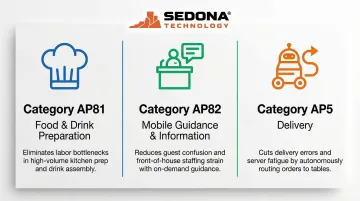
Understanding which robots fit which roles starts with how the industry categorizes them. The International Federation of Robotics identifies three distinct types:
- Food and drink preparation (AP81): Robots handling cooking, mixing, and assembly
- Mobile guidance and information (AP82): Reception and concierge robots in hospitality settings
- Delivery (AP5): Autonomous systems transporting food within venues or for last-mile delivery
Each category targets a different pain point — from back-of-house labor gaps to front-of-house guest experience — which is why operators increasingly deploy more than one type.
Types of Service Robots Reshaping the Food Industry
Serving and Waiter Robots
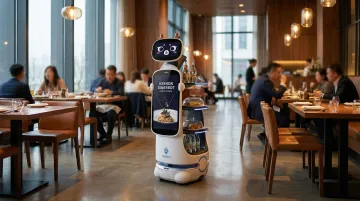
Serving robots act as autonomous food runners, navigating dining rooms to deliver dishes and clear tables. These machines absorb the physical burden of carrying heavy trays, allowing human servers to focus on guest interaction.
Leading models:
Pudu BellaBot is built for high-volume environments, with Skylark Group deploying 3,000 units across 2,000+ stores in Japan as proof of enterprise-scale reliability. Key specs:
- 40 kg payload across four trays
- Dual SLAM navigation (visual + laser)
- 12–24 hour battery life with hot-swappable batteries
Bear Robotics Servi handles 66 lbs across two trays and one bus tub. Key specs:
- LiDAR navigation with near-zero blind spots
- Navigates aisles as narrow as 55–65 cm
- Validated through national rollouts at Denny's and Chili's
Both systems return to charging stations autonomously and alert staff when human intervention is needed — maintaining service speed during peak hours without added physical strain.
Cooking and Food Preparation Robots
Back-of-house automation targets the most dangerous, repetitive, high-turnover tasks — specifically deep frying and pizza assembly.
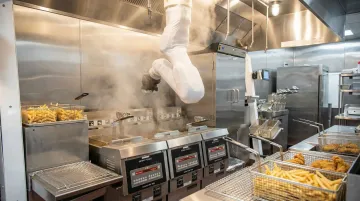
Miso Robotics Flippy 2 automates fry stations with consistent temperatures and cook times. White Castle committed to installing Flippy in 100 locations, redeploying fry cooks to drive-thru hospitality roles in the process. Key specs:
- Processes 100+ baskets per hour
- Increases order speeds by 15–25% by eliminating kitchen bottlenecks
Picnic Pizza System targets stadium, theme park, and university environments where volume consistency is non-negotiable. Key specs:
- Assembles up to 100 pizzas per hour with a single operator
- Handles sauce distribution, cheese application, and topping placement with modular precision
Both systems maintain NSF/ANSI 169 compliance, with automated cleaning modes and grease-resistant interfaces that reduce contamination risk compared to manual processes.
Delivery and Runner Robots
Autonomous delivery robots have proven effective in geofenced environments like university campuses and urban corridors — and are now scaling into mainstream last-mile networks.
Starship Technologies has completed over 9 million autonomous deliveries with a fleet of 2,700+ sidewalk robots globally. Their partnership with Uber Eats, expanding to the US by 2027, signals mainstream acceptance of autonomous last-mile delivery.
Kiwibot operates 1,200 robots across 50 US college campuses through a multimillion-dollar contract with Sodexo. The controlled campus environment provides ideal conditions for autonomous navigation while building consumer familiarity with the technology.
Nuro deploys street-legal autonomous vehicles for broader urban and suburban routes, with a 10-year Uber Eats partnership in California and Texas plus Domino's pizza delivery contracts.
The delivery robots market is projected to grow from $795.6 million in 2025 to $3.24 billion by 2030, representing a 32.4% CAGR driven primarily by food and beverage demand.
Bar and Beverage Automation
Where delivery robots solve the last-mile problem, robotic bartenders solve a different revenue challenge: queue abandonment during peak hours.
Makr Shakr's "Toni" features dual robotic arms managing up to 158 ceiling-mounted bottles. Key specs and deployments:
- 80–250 drinks per hour with millimeter-precision dosing
- Permanently installed on nine Royal Caribbean cruise ships as the "Bionic Bar"
- Sandbox VR venues in London and Birmingham (~2,500 drinks monthly)
- Lotte Duty Free at Singapore's Changi Airport
Millimeter-precision dosing eliminates over-pouring and inventory shrinkage. For high-traffic venues, that consistency also means fewer abandoned queues — a direct hit to revenue during surge periods.
Reception and Concierge Robots
In 2016, Hilton Worldwide and IBM piloted "Connie", the hospitality industry's first Watson-enabled robot concierge at the Hilton McLean in Virginia. Powered by IBM Watson APIs, Connie greeted guests, answered natural-language questions, and provided dining recommendations and directions to on-property restaurants.
While Connie was an early pilot, it established the framework for modern reception robots to actively route guests to hotel dining outlets and banquet spaces, demonstrating the intersection of AI-powered hospitality and food service operations.
Key Benefits of Service Robots for Food Service Businesses
Labor Cost Reduction
Average hourly earnings in accommodation and food services reached $22.39 by late 2025, while 47% of operators face difficult-to-fill openings. Robots directly address this pressure.
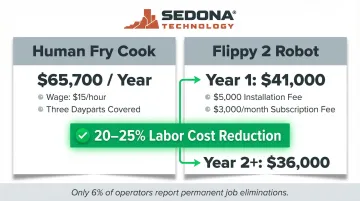
Restaurant robots yield typical labor cost reductions of 20-25% per location. For context, a human fry cook staffing three dayparts costs approximately $65,700 annually at $15/hour, while Flippy 2 costs $41,000 in year one ($5,000 install + $3,000/month) and $36,000 in subsequent years.
The National Restaurant Association's 2026 report shows only 6% of operators report that tech investments lead to permanent job eliminations. Robots enable workforce redeployment to higher-value roles — not headcount cuts.
Operational Consistency and Food Quality
Robots eliminate human error in portioning, cooking times, and recipe adherence. A burger-flipping robot maintains exact grill times regardless of rush hour or staff fatigue. Pizza assembly systems apply sauce and toppings with millimeter precision.
This consistency directly impacts customer satisfaction and reduces food waste from preparation errors. For multi-location operators, robots ensure identical output across all venues without relying on individual cook skill levels.
Increased Throughput and Speed of Service
Robots operate without breaks, at consistent speeds, and without performance dips during peak hours.
At The Modern Table (a UK case study), serving robots decreased service times by 40% and increased average table turnover from 1.8 to 2.5 customers per evening. This translates directly to higher revenue per square foot without expanding physical footprint.
Enhanced Guest Experience
Consumer sentiment toward robotic dining is generally positive but varies sharply by generation. A 2023 Deloitte survey found 60% of consumers are somewhat likely to order from a kitchen using robotic technologies, and 47% are comfortable with drone or driverless delivery.
The NRA's 2026 report puts that divide in stark terms:
- Gen Z: 53% are open to robot-delivered food
- Baby Boomers: just 21% share that comfort level
Operators should match robot visibility to their specific customer base before deploying front-of-house units.
Beyond efficiency, robotic bartenders and servers generate shareable moments that drive organic social media exposure. Human staff, freed from routine tasks, can focus on personalized service and upselling.
Hygiene and Food Safety
Robotic food preparation inherently reduces human contact with ingredients, lowering cross-contamination risk. The NSF/ANSI 169 standard governs special-purpose food equipment, establishing strict hygienic design and cleanability requirements.
Robots like Flippy 2 feature automated cleaning modes that maintain FDA Food Code compliance without depending on staff diligence. In environments where contactless service remains a customer expectation, consistent hygiene performance is a genuine operational differentiator.
Challenges of Adopting Service Robots (and How to Address Them)
High Initial Investment and ROI Uncertainty
Historically, upfront capital expenditure was a massive barrier. Purchase prices for serving robots range from $14,995 to $15,900, while specialized systems like Makr Shakr's "Toni" bar system cost approximately €99,000 (~$116,000).
The industry has responded with Robotics-as-a-Service (RaaS) models that shift investment from CapEx to OpEx. Miso Robotics leases Flippy for $3,000-$5,400 monthly, while Picnic's pizza system runs $3,500-$5,000 monthly. These rates fall significantly below the fully loaded annual cost of human equivalents.
Sedona Technology offers sales, rental, and leasing options with a minimum 2-month rental period—including free installation, training, and ongoing support. This structure allows operators to test ROI before committing to long-term investment, eliminating financial risk during pilot phases.
Integration with Existing Operations
Robots must fit into existing kitchen layouts, POS systems, and service workflows without disrupting operations. Miso Robotics notes that Flippy 2 is half the size of its predecessor and can be installed overnight, cutting installation downtime to a single shift.
Look for suppliers who provide comprehensive training and workflow consultation, not just equipment delivery. The most successful deployments start with operators mapping their specific bottlenecks before selecting robot types, rather than buying technology they don't need.
Staff Acceptance and Role Redefinition
Robots typically take over repetitive or physically demanding tasks—heavy tray carrying, continuous frying, late-night delivery runs—freeing human staff for guest engagement, complaint resolution, and supervisory roles. Job displacement concerns are understandable, but the evidence points consistently toward role redefinition, not elimination.
White Castle's deployment demonstrates this: fry cooks were redeployed to drive-thru "hospitality doors" to improve service speed, not eliminated. The key is communicating this vision clearly during implementation and involving staff in the transition process.
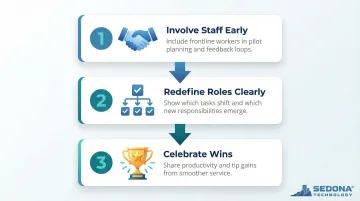
Successful operators frame the transition around three principles:
- Involve staff early — include frontline workers in pilot planning and feedback loops
- Redefine roles clearly — show exactly which tasks shift and which new responsibilities emerge
- Celebrate wins — share productivity and tip gains that result from smoother service
How to Choose and Get Started with Service Robots for Your Food Business
Assess Your Operational Needs First
Identify your biggest pain points before evaluating technology:
- High labor costs or chronic understaffing? → Serving robots or delivery bots
- Slow service during peak hours? → Kitchen automation or additional serving capacity
- Inconsistent food prep quality? → Cooking robots with programmed recipes
- Staff turnover in physically demanding roles? → Automate the hardest tasks first
Match robot types to specific needs rather than adopting technology for novelty. A busy pizza operation benefits more from a Picnic assembly system than a serving robot, while a fine-dining restaurant with complex plating needs different solutions than a quick-service venue.
Start with a Pilot Deployment
Begin with a single robot in one high-impact area—such as a serving robot on the dining floor or a fry station automation unit—before scaling. A trial period helps staff adapt, reveals integration issues, and builds the business case for wider adoption.
Their 2-month minimum rental period provides an ideal pilot window—enough time to measure impact on table turnover, labor costs, and customer satisfaction without a long-term commitment.
Document baseline metrics before deployment (average service time, labor hours per shift, customer complaints) so you can quantify ROI objectively.
Evaluate Total Cost of Ownership vs. Rental
Purchase considerations:
- Upfront cost: $14,995–$15,900 for serving robots
- Maintenance and software updates (ongoing)
- Potential obsolescence as technology evolves
Rental considerations:
- Monthly cost: $369–$575 depending on model
- Flexibility to upgrade or return
- Maintenance and support included
- Easier to test multiple robot types before committing
Those numbers inform the acquisition decision. Sedona Technology offers purchase, rental, and leasing options—all with free installation, training, and ongoing support. For restaurants, hotels, and catering businesses testing automation, rental eliminates the risk of expensive equipment sitting unused if the deployment doesn't fit your operation.
Look for Robots Designed for Multi-Function or Multi-Setting Use
Prioritize robots that serve across different parts of your operation and scale as needs grow. A serving robot that handles both food delivery and bussing provides more value than a single-purpose machine.
When evaluating options, consider whether a robot can:
- Adapt to different service styles (casual vs. fine dining)
- Operate across multiple venues (dining floor and banquet space)
- Handle varied payload types (plated meals, beverages, supplies)
The KEENON DINERBOT series from Sedona Technology ranges from compact models for small cafés to advanced multi-table systems for busy restaurants, so operators can match capability to current needs while keeping upgrade paths open as the operation grows.
Frequently Asked Questions
How much does a food service robot cost?
Food service robots range from approximately $15,000 for entry-level serving robots to over $100,000 for complex cooking automation or bar systems. Costs vary by robot type, payload capacity, and navigation sophistication. Rental and leasing options start at $369–$575 monthly, removing the need for large upfront investment.
What are examples of robots in the food industry?
Notable deployments include BellaBot (3,000 units at Skylark Group in Japan), Flippy (100 White Castle locations), and Makr Shakr's Toni bartender robot (nine Royal Caribbean cruise ships). Hilton's Connie concierge handles dining recommendations using IBM Watson.
What tasks can service robots perform in a restaurant?
Service robots cover a wide range of tasks:
- Delivering food to tables and bussing dishes
- Food prep and cooking (frying, pizza assembly)
- Bartending with precise pour and mix sequences
- Guest interaction — check-in, wayfinding, and dining recommendations
They navigate autonomously using LiDAR and SLAM, with many models capable of 24/7 operation.
Are service robots replacing human workers in food service?
No—robots primarily replace repetitive, high-volume tasks rather than full roles. Only 6% of operators report permanent job eliminations from tech investments. Most deployments redeploy staff to guest-facing or supervisory functions, such as White Castle moving fry cooks to drive-thru hospitality roles to improve customer service.
How long does it take to implement a service robot in a restaurant?
Many serving robots are operational within 1-3 days, covering site mapping and staff training. Miso Robotics notes that Flippy 2 can be installed overnight. Suppliers like Sedona Technology include installation and training at no extra cost.
Can small restaurants or cafés benefit from service robots?
Yes—compact serving robots ease the strain on small teams without requiring a full hire. Rental options starting at $369/month (2-month minimum) let small operators test ROI before making a long-term commitment.