Introduction
Delivery robots are showing up in dining rooms, hotel corridors, and city sidewalks — and for many operators, they're no longer a curiosity. They're a staffing solution. For restaurant owners, hoteliers, and food service operators, understanding where this technology is heading has real implications for cost control and day-to-day operations.
The numbers tell the story: full-service restaurant labor costs hit a median of 36.5% of sales in 2024, well above historical averages. Meanwhile, the accommodation and food services sector maintained an elevated 7.2% job openings rate in 2023, making it one of the hardest industries to staff.
Together, these pressures are pushing operators to rethink service models — and autonomous delivery robots are increasingly the answer they're landing on. This piece covers what's driving adoption, what the technology actually looks like in practice, and what to consider before bringing robots into your operation.
Key Takeaways
- Indoor serving robots bring food from kitchen to table, reducing staff workload and improving consistency
- AI-powered navigation allows robots to avoid obstacles, ride elevators, and operate autonomously
- Sidewalk delivery robots reached 2,000+ units across six major U.S. cities by late 2025
- Labor shortages, rising wages, and contactless service expectations are accelerating adoption
- Rental, leasing, and purchase options make robots viable for businesses of all sizes
Key Trends in Food Delivery Robots for Restaurants
Indoor Serving Robots Are Becoming a Dining Room Fixture
Indoor serving robots are autonomous units that carry food trays from the kitchen pass to customer tables. Brands like BellaBot, KettyBot, and Servi have deployed these robots in casual dining, buffets, and fast-casual chains worldwide.
The market is growing fast. The global robot waiter market was valued at $324.12 million in 2022 and is expected to grow at a CAGR of 35.14% to reach $1.97 billion by 2028. This growth reflects the restaurant industry's urgent need for automation to combat inflation and skilled labor shortages.
Major enterprise deployments prove the technology works at scale:
- Skylark Group: Deployed 3,000 Pudu BellaBots across 2,000 stores in Japan
- Chili's: Expanded Bear Robotics Servi robots to 61 locations across 8 states
- Denny's: Operates Servi robots in 15+ U.S. locations and 200+ in Japan
- Cafe de Coral: Uses Pudu KettyBot Pro across multiple Hong Kong locations
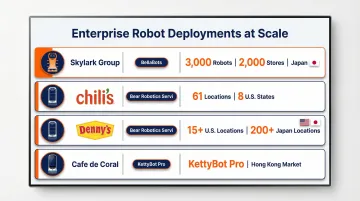
These deployments span casual dining, buffets, and fast-casual environments, demonstrating that indoor serving robots are no longer experimental—they're a proven, scalable solution for high-traffic restaurant chains.
AI and Autonomous Navigation Are Making Robots Smarter
Modern delivery robots use AI, LiDAR, cameras, and sensor fusion to navigate crowded dining rooms without human operators. Pudu's BellaBot uses both visual SLAM and laser SLAM positioning, with 3D RGBD depth cameras delivering obstacle avoidance in as little as 0.5 seconds.
Bear Robotics' Servi uses advanced LiDAR sensors and multiple cameras to power 100% self-driving capability, traveling stably in spaces as narrow as 55–65 cm with near-zero blind spot detection.
Real-world capabilities include:
- Navigating dynamic, crowded dining rooms with real-time obstacle detection
- Recognizing busy pathways and adjusting routes automatically
- Returning autonomously to charging stations when battery runs low
- Operating continuously without human intervention
Elevator integration unlocks multi-floor service:
Savioke's Relay+ robot uses a mechanically actuated elevator button pusher that eliminates the need for complex software integration with elevator control systems. The robot uses a vision camera to identify call buttons and physically pushes them, shortening deployment projects from 4+ months to just 4 hours. This breakthrough makes multi-floor restaurants and hotels far more accessible for robotic delivery.
Sidewalk Delivery Robots Are Expanding City by City
Outdoor delivery robots now operate on city sidewalks, serving restaurants through partnerships with major delivery platforms. In December 2025, Serve Robotics announced it had deployed more than 2,000 delivery robots, creating the largest sidewalk delivery fleet in the U.S. This expansion is heavily supported by multi-year agreements with Uber Eats and DoorDash.
Active metro areas with sidewalk robot deployments:
- Los Angeles: Koreatown, Downtown, Sawtelle neighborhoods
- Chicago: 14 neighborhoods, 100+ restaurants
- Miami: Brickell, Miami Beach
- Dallas-Fort Worth: Uptown, 22,000+ households
- Atlanta: Midtown, Downtown, 50,000+ residents
Each robot produces zero tailpipe emissions and replaces traditional delivery vehicle trips. Starship Technologies reported that since launching its emission-free service, 450,000 car journeys have been avoided, saving 137 tons of CO2 in Milton Keynes alone. This contactless, emission-free delivery benefit is a major driver of adoption in urban markets.
Robots Are Moving Into Hotels, Airports, and Malls
Food and item delivery robots are spreading beyond traditional restaurants into hotels, airports, corporate cafeterias, and mall food halls. For restaurant and hospitality operators, this breadth of real-world deployment means the technology is proven across a wide range of high-traffic environments—not just controlled dining rooms.
Hotel deployments:
Aloft Hotels deployed Savioke's Relay robot to deliver amenities and room service items directly to guest rooms, navigating hallways and elevators independently. Properties using the robot report a 25% reduction in front desk calls for amenity requests. At the Marriott Fort Lauderdale Airport, Bear Robotics' Servi was deployed as a busser in the restaurant, carrying food, drinks, and dirty dishes.
Airport and mall deployments:
Cincinnati/Northern Kentucky International Airport (CVG) uses fully autonomous Ottobots to deliver food and retail items to passengers in Concourse B. Minneapolis-St. Paul International Airport (MSP) utilizes a rolling droid called a gita that carries up to 40 pounds of food directly to gates. Any operator running a food service in a high-traffic venue—airport, mall, or hotel—now has working blueprints to follow.
What's Driving the Rise of Restaurant Delivery Robots
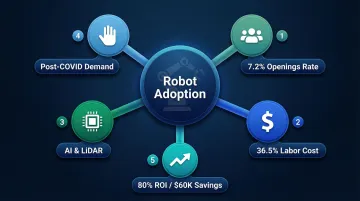
Five intersecting pressures are pushing restaurants toward delivery robots — and each one is getting harder to ignore.
Labor shortages and rising wages:
The foodservice industry struggles with high staff turnover and chronic difficulty filling roles. Full-service restaurant labor costs hit a median of 36.5% of sales in 2024, well above historical averages of 33%. The accommodation and food services sector maintained an elevated 7.2% job openings rate in 2023, making it nearly impossible to maintain full staffing. Operators are turning to automation to fill the gap.
Technology maturity:
AI, computer vision, and sensor hardware have reached a price-performance threshold that makes deployment practical. Robots can now navigate real-world environments reliably without expensive custom infrastructure. Technologies like laser SLAM navigation, 3D depth cameras, and sensor fusion let robots handle dynamic, crowded dining rooms without constant oversight.
Customer experience expectations:
Today's diners increasingly expect faster service and consistent delivery times. For routine food-running tasks, robots remove the variability that slows table turns and drags down satisfaction scores. Robots deliver food at the correct time and temperature every time, reducing complaints and re-fires.
Post-pandemic hygiene and contactless preferences:
COVID-19 permanently shifted customer comfort toward reduced human contact during food delivery. Robots offer a consistently contactless delivery experience that many guests now prefer, particularly for sidewalk delivery and hotel room service.
Cost efficiency and ROI:
Robots operate continuously without breaks, overtime, or benefits. An independent case study found that deploying Bear Robotics' Servi robot instead of hiring two part-time human aides delivered 80% ROI over three years, with total savings of $60,000. Capable of running up to 91 hours per week with no turnover or retraining costs, most units pay for themselves within the first year.
How Delivery Robots Are Reshaping Restaurant Operations
Operational Impact
Robots take over repetitive, high-frequency food-running tasks, freeing human staff to focus on guest interaction, upselling, and complex service elements. This directly improves both service quality and staff job satisfaction.
The consistency benefits are measurable, too. Food reaches tables at the correct time and temperature, reducing complaints and re-fires. By accelerating order delivery and table clearing, robots contribute to a 15–20% boost in table turnover rates — efficiency gains that translate directly to revenue growth without adding labor costs.
Workforce Impact
Robots are not eliminating restaurant jobs—they're changing the nature of work. Staff roles shift toward higher-value interaction tasks. In most documented cases, operators are redeploying labor rather than reducing headcount. Servers spend less time walking back and forth to the kitchen and more time engaging with guests, taking orders, and recommending menu items — the parts of the job that actually drive tips and repeat visits.
Key changes operators typically report after deployment:
- Reduced physical strain on floor staff from fewer kitchen runs
- Higher guest engagement scores as servers focus on hospitality
- Easier onboarding, since robots handle the most repetitive tasks
- Lower turnover, as the role becomes more rewarding
Business Impact
The business case goes beyond labor savings. The novelty factor drives social sharing and word-of-mouth, while operational efficiency improves margins. Following Pudu's BellaBot deployment across its Japanese locations, Skylark Group reported that 67% of customers were satisfied with the robots' presence — a signal that guests welcome the technology when it's designed with personality and reliability in mind.
Diners regularly film and share their robot interactions online, generating organic reach that a standard service model simply doesn't produce.
What Restaurants Should Know Before Getting Started
Key practical considerations when evaluating a delivery robot:
- Floor layout compatibility: Measure aisle widths, doorway clearances, and turning radius requirements
- Payload capacity: Ensure the robot can carry the weight and volume of your typical orders
- Battery life: Confirm operating hours match your service periods without frequent recharging
- Noise level: Test in your environment to ensure guest comfort
- Multi-level capability: If you operate across multiple floors, verify elevator integration support
Acquisition options:
Restaurants can purchase, rent, or lease delivery robots depending on their budget and commitment level. Providers like Sedona Technology include free installation, staff training, and ongoing support with all arrangements. Rental options start at $369 per month with a 2-month minimum — a practical way to pilot the technology before committing to a full purchase.
Total cost of ownership framework:
When evaluating robots, compare total cost of ownership against total labor cost offset:
- Calculate hourly wages, benefits, and training costs for the staff the robot would replace or supplement
- Factor in rental or lease payments, electricity, maintenance, and any software fees
- Account for productivity gains — table turnover typically improves 15-20%, and order errors drop
- Most operators reach positive ROI within 12-18 months
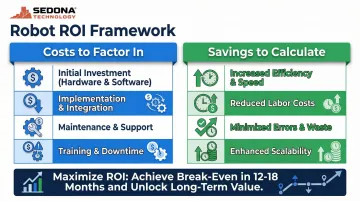
Run the numbers against your actual labor costs to see where the crossover point falls for your operation.
Future Signals: What to Watch in the Next 1–3 Years
Early indicators of where the industry is heading:
- POS and ordering systems are integrating directly with delivery robots, enabling fully automated order-to-table workflows with no manual handoff
- City-level regulations for sidewalk robots are expanding — 24 states had enacted Personal Delivery Device legislation as of 2023, with more expected to follow
- Manufacturer support networks are growing, making robot maintenance faster and less disruptive for operators
Three technologies are worth tracking closely as they mature:
- Fleet management software that coordinates multiple robots across different locations from a single platform
- Voice and gesture interaction, allowing robots to respond naturally to diners without requiring staff involvement
- Tableside checkout, where robots carry payment terminals directly to guests — eliminating the need for a server to return with a card reader
Near-term scenarios:
Within 1–3 years, mid-scale restaurant chains will begin standardizing robot deployment across locations. Sidewalk delivery robots could reach 10–20 U.S. cities as regulatory frameworks mature. Hybrid models — robot plus human — will become the operational norm. Restaurants that start piloting now will have a measurable advantage in cost, speed, and staff retention by the time broader adoption takes hold.
Conclusion
Food delivery robots—whether serving tables indoors or navigating sidewalks for app-based orders—are no longer experimental. They are an active, growing part of how restaurants operate and compete. Early adopters are already gaining advantages in staffing costs, customer experience, and operational resilience.
With labor costs at historic highs and customer expectations for speed and consistency rising, waiting to adopt robotics means falling further behind. Restaurants that start evaluating and piloting these systems now are building the operational foundation they'll need to stay competitive long-term. Providers like Sedona Technology LLC offer flexible entry points—sales, rental, and leasing—so operators can find a model that fits their scale and budget.
Frequently Asked Questions
What is the food delivery robot for restaurants?
Restaurant food delivery robots are autonomous machines that carry prepared food from the kitchen to customer tables or deliver takeout orders along sidewalks. They use AI and sensors to navigate without human control, running continuously to free up staff and keep service timing predictable.
How much does a food delivery robot cost?
Rental options start at $369 per month with flexible terms, making robots accessible without a large upfront investment. Purchase pricing varies by model — contact suppliers directly for a quote. Installation, training, and ongoing support are typically included.
Is someone driving the food delivery robots?
Most modern delivery robots operate autonomously using AI and sensor systems. Remote human supervisors may be available for edge cases, but no on-site driver is needed. Navigation runs independently using LiDAR, cameras, and onboard mapping.
What are the benefits of using delivery robots in a restaurant?
Robots reduce pressure on staff, speed up table service, and lower long-term labor costs. They also boost table turnover rates by 15-20%, delivering food at consistent intervals that manual service rarely matches.
Can delivery robots replace human servers entirely?
No. Robots handle repetitive food-running tasks but cannot replace the full human service experience. In practice, robots work alongside staff — not in place of them. Human servers focus on guest interaction, upselling, and complex service elements while robots handle transportation.
Are food delivery robots safe to use around customers?
Yes. Delivery robots are designed with obstacle detection and automatic stop features to prevent collisions. They move at low speeds (typically 3-4 mph indoors) and undergo safety testing before deployment in public environments. Commercial models meet safety standards for operation in crowded dining rooms and sidewalks.