Introduction
Restaurant operators face mounting pressure from rising labor costs, persistent staffing shortages, and razor-thin profit margins. The accommodation and food services sector continues to experience severe churn, with a 6.0% quits rate as of December 2025, according to the U.S. Bureau of Labor Statistics. This turnover costs restaurants an average of $5,864 per employee covering recruiting, training, and lost productivity.
Robotics now offers a practical path out of these operational pressures. The global food robotics market, valued at $1.81 billion in 2023, is projected to reach $6.81 billion by 2030 — a 20.6% CAGR over seven years.
Major chains including Chipotle, Buffalo Wild Wings, and White Castle are already deploying automated systems, while independent restaurants are following with server robots, automated fry stations, and delivery bots.
This article covers the types of robots now operating in restaurants, the business case for adoption, real-world deployment examples, practical limitations, and a step-by-step path for operators considering automation.
Key Takeaways
- Robots perform cooking, serving, bussing, drink preparation, and last-mile delivery across front and back of house
- Restaurants adopt robots primarily to cut labor costs, fill staffing gaps, and maintain consistent output quality
- Major QSR chains (Chipotle, Buffalo Wild Wings, White Castle) have integrated automation into operations
- Robots are available to buy ($10,000–$20,000), rent ($369–$575/month), or lease depending on budget and commitment
- Robots handle repetitive tasks so staff can focus on guest experience — augmenting teams, not replacing them
What Types of Robots Are Being Used in Restaurants?
Restaurant robots are designed for specific tasks across the front and back of house. Most operators choose between cooking systems, server robots, and autonomous delivery units based on where they're losing the most time and labor.
Kitchen and Food Preparation Robots
Back-of-house robots handle high-volume, repetitive cooking tasks with consistent quality and speed that human staff cannot match.
Frying and Cooking Systems:
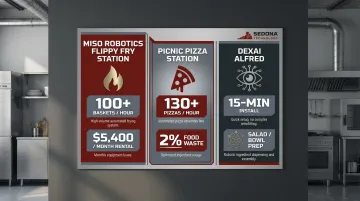
- Miso Robotics' Flippy Fry Station processes 100+ baskets per hour (nearly twice the human rate), with 99% uptime and overnight installation. Monthly rental: $5,400
- Picnic Pizza Station assembles 130+ pizzas per hour with a single operator, cutting food waste to around 2%
- Dexai Robotics' Alfred uses computer vision to prep salads and bowls, with a modular design that fits into existing kitchens in about 15 minutes
These systems use AI-driven food recognition and automated portion control to deliver consistent results across every shift. For high-volume kitchens, that consistency is the core value proposition — not just speed.
Service and Delivery Robots
Server robots navigate dining rooms using LiDAR sensors and depth cameras, carrying food to tables and bussing dirty dishes. These are the most commonly deployed restaurant robots today.
Key Server Robot Specifications:
| Model | Payload Capacity | Battery Life | Minimum Aisle Width | Monthly Rental |
|---|---|---|---|---|
| KEENON DINERBOT T8 | Compact trays | 10-12 hours | 55-60 cm | $369 |
| KEENON DINERBOT T9 Pro | 88 lbs (multi-table) | 10-12 hours | 60-65 cm | $415 |
| Bear Robotics Servi | 66 lbs (2 trays, 1 bus tub) | 10-12 hours | 55-65 cm | ~$314 |
| Richtech Matradee | 88 lbs | 10-14 hours | 60 cm | ~$750-$1,500 |
Beverage and Greeting Robots: Richtech's ADAM uses dual 6-degree-of-freedom robotic arms to prepare over 100 drink types, including coffee and cocktails. Host robots greet and seat customers in casual dining environments, though food runners remain the more widely deployed category.
Autonomous Delivery Robots
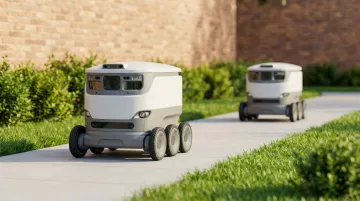
Sidewalk delivery robots have moved beyond pilot programs to commercial-scale deployment. These units use GPS and computer vision for last-mile food delivery.
Proven Delivery Systems:
- Starship Technologies has completed 9 million+ autonomous deliveries across 270+ locations in seven countries, operating a fleet of 2,700+ robots
- Serve Robotics delivers at 99.94% reliability and is rolling out up to 2,000 robots on the Uber Eats platform across U.S. markets
- Kiwibot (now Robot.com) has logged 1.7 million+ completed tasks with over 500 active robots in the field
These robots operate at Level 4 autonomy, handling short-distance deliveries on sidewalks and campuses without human intervention.
The Business Case: Why Restaurant Owners Are Turning to Automation
Restaurant operators aren't adopting robots as a novelty — they're doing it because the numbers make sense. Labor shortages, rising wage costs, and the need to stand out in a crowded market are pushing owners toward automation as a practical solution.
Solving the Labor Shortage Problem
The restaurant industry's persistent staffing crisis has made robots an operational necessity. With a 6.0% job openings rate and 6.0% quits rate in the accommodation and food services sector, operators cannot rely on traditional hiring to fill gaps.
Robots augment human staff by handling physically demanding tasks:
- Carrying heavy trays (reducing shoulder strain and slip accidents)
- Running food to tables during peak hours
- Bussing dishes continuously without fatigue
- Frying and cooking with consistent timing
At Red Ginger, manager Lilly Ni reported that their server robots (Katty and Bella) prevented accidents: "Servers used to carry huge trays, causing shoulder strain. Sometimes the trays would slip and fall. That never happens with Bella."
By offloading repetitive tasks, human staff focus on hospitality, upselling, and problem resolution—higher-value activities that drive guest satisfaction and tips.
The Cost Comparison: Robots vs. Staff
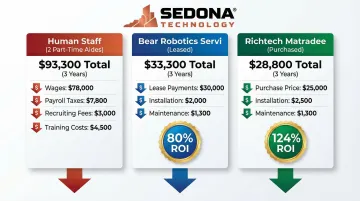
A three-year cost analysis by Culinary Services Group compared two part-time human aides against robotic alternatives:
Total 3-Year Investment:
- Human staff (2 part-time aides): $93,300 (wages, taxes, recruiting, training)
- Bear Robotics Servi (leased): $33,300 (lease, deployment, maintenance)
- Richtech Matradee (purchased): $28,800 (unit purchase, SaaS fees)
ROI: Servi delivered 80% ROI, while Matradee achieved 124% ROI over three years.
Those savings are accessible at multiple price points. Operators can choose an acquisition model based on their capital position:
| Model | Cost | Best For |
|---|---|---|
| Purchase | $10,000–$20,000 upfront | Long-term, high-volume operations |
| Rental | $369–$575/month (2-month minimum) | Testing before committing |
| Leasing | Spread over time via partner financing | Managing cash flow |
Sedona Technology offers all three options, with free installation, training, and ongoing support included regardless of which path you choose.
Consistency, Safety, and the "Novelty Effect"
Unlike human staff, robots perform the same way on a Tuesday night as they do on a packed Saturday:
- No good or bad days
- Standardized portion delivery
- Zero spills or drops
- Continuous operation without fatigue
That reliability extends beyond the kitchen. Robot-staffed restaurants generate significant organic attention on TikTok and YouTube, driving foot traffic without paid advertising. In competitive markets, that novelty translates directly into a brand differentiator — one that keeps working long after the initial launch.
Which Restaurants and Chains Are Already Using Robots?
Adoption spans global QSR chains to independent fine dining, giving operators across every category concrete examples to draw from.
Fast Food and Quick-Service Chains
Several major chains have moved beyond pilot programs into active deployments:
- Chipotle invested $25 million in Hyphen's Augmented Makeline, which builds bowls and salads (65% of digital orders) in 10-15 seconds each. The chain is also testing Autocado (avocado processing) and Chippy, Miso Robotics' tortilla chip fryer trained on Chipotle's exact recipe.
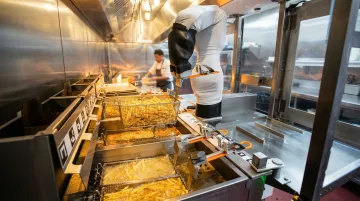
- White Castle expanded its Miso Robotics partnership to 100 standalone locations, with 14 Flippy 2 units confirmed active as of late 2025, including a location in Mokena, Illinois.
- Buffalo Wild Wings is testing Flippy Wings — a robotic fryer built specifically for high-volume wing production — to address labor shortages and poultry supply chain pressure.
- Jack in the Box is piloting both Flippy 2 and Sippy, an automated beverage dispenser, to reduce back-of-house strain.
- CaliExpress by Flippy (Pasadena, CA) was marketed as the world's first fully autonomous AI restaurant, with automated grill and fry stations. The location is currently temporarily closed, a reminder that fully human-less operations carry their own operational challenges.
Independent and Casual Dining
Independent and casual concepts are finding practical applications too:
- Red Ginger uses KEENON/BellaBot robots to carry heavy plates for large parties, freeing servers to focus on guest interaction and drink service.
- Hai Di Lao Hot Pot runs an Intelligent Kitchen Management System (IKMS) across global locations — robotic arms select dishes, automatic serving machines handle delivery, and a broth-mixing robot replaces three staff members.
- Kura Revolving Sushi Bar combines traditional conveyor belts with autonomous "Kur-B" delivery robots across 70+ U.S. locations, bringing drinks and condiments directly to tables.
Challenges and Limitations to Consider
While the business case is strong, operators must understand the constraints before deployment.
Operational and Technical Considerations
Infrastructure Requirements:
- Minimum aisle widths of 55-65 cm (Bear Robotics Servi) or 60 cm (Richtech Matradee)
- Dedicated charging or docking stations
- Reliable Wi-Fi connectivity
- Flat surfaces without steep ramps
Crowded or narrow restaurant layouts may require modification before deployment.
Downtime Costs: A MachineQ survey found that 49% of operators experience equipment downtime, costing between $1,001 and $5,000 per hour. Technical issues—software glitches, battery limitations, sensor failures—can disrupt service.
Operators should plan for maintenance protocols and choose providers that include ongoing technical support. Chili's halted a 61-store robot server pilot because the units moved too slowly and congested aisles, demonstrating that robots must fit naturally into existing workflows without disrupting service.
The Human Element
Some diners, particularly in fine dining contexts, prefer human interaction. Academic research confirms that mechanical robots in full-service restaurants decrease consumers' willingness to pay due to perceived low food quality.
Best Practice: Position robots as tools that enhance human service, not as complete substitutes. Staff still handle relationship-building, problem resolution, complex complaints, and anything requiring genuine hospitality judgment. Restrict customer-facing robots to QSR and casual dining; in fine dining, limit automation to back-of-house prep.
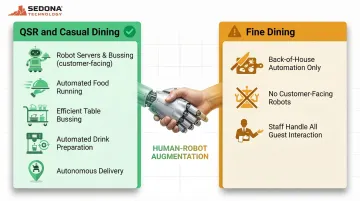
Understanding these constraints upfront helps operators deploy robots where they add real value—and avoid the costly missteps that come from forcing the technology into the wrong environment.
How to Bring Robotics Into Your Restaurant
Follow this practical framework to evaluate and deploy automation effectively.
Step 1: Identify the Right Use Case
Start by identifying your single biggest operational pain point:
- Food running during peak hours
- Table bussing capacity
- Frying consistency and speed
- Drink preparation volume
Choose a robot purpose-built for that specific task rather than attempting to automate everything at once. Starting narrow allows you to measure ROI clearly and expand based on proven results.
Step 2: Choose the Right Acquisition Model
Purchase: An upfront investment of $10,000–$20,000 provides full ownership with no ongoing fees. Best for operators with available capital and a long-term deployment plan.
Rental: Monthly costs of $369–$575 with a 2-month minimum let you test robots without a major capital commitment. Sedona Technology's rental program includes free installation, staff training, and ongoing support.
Leasing: Spread costs over time through financing partners, balancing cash flow with long-term deployment. A good fit for operators who want permanent robots without the upfront purchase.
Step 3: Plan for Integration and Training
Successful implementation requires:
- Preparing physical space (aisle clearance, charging stations, Wi-Fi)
- Training staff to work alongside robots (handoff protocols, safety zones)
- Setting customer expectations (signage, staff explanations)
Customer-facing communication turns the robot into a positive brand moment rather than a source of confusion. Getting signage right and briefing your team before launch cuts down on questions and keeps service smooth from day one.
Step 4: Measure and Optimize
Track specific KPIs post-deployment:
- Labor hours saved per shift
- Order delivery times (table to kitchen)
- Staff injury incidents (strains, slips)
- Customer satisfaction scores
Once you see consistent improvement across two or three of these metrics, you have the evidence base to scale — whether that means adding a second robot, expanding to a new station, or upgrading your acquisition model.
Frequently Asked Questions
How much does a robot waiter cost?
Robot server purchase prices typically range from $10,000 to $20,000, while monthly rental costs run $369 to $575 depending on the model and features. Leasing options are also available, making robots accessible across different budget levels.
Are there any robot restaurants?
Yes, fully and partially automated restaurants operate worldwide. CaliExpress by Flippy in Pasadena was the first fully autonomous AI restaurant in the U.S. (currently temporarily closed), and Hai Di Lao Hot Pot runs robot-assisted locations globally. Hundreds of independent and chain restaurants also deploy server robots.
What fast food restaurants are using robots?
Chipotle uses automated makeline and chip fryer systems, Buffalo Wild Wings tests robotic wing fryers, and White Castle has installed Flippy 2 in 100 locations. Jack in the Box is piloting Flippy 2 and automated beverage dispensers across select stores.
Where are robot burger machines located?
Burger-making robots operate primarily in California, including CaliExpress by Flippy in Pasadena (temporarily closed) and Creator in San Francisco (now defunct). Miso Robotics' Flippy systems are deployed in White Castle locations across the U.S., including confirmed installations in Mokena, Illinois.
Will robots replace human workers in restaurants?
No. Robots are designed to assist, not replace, human staff. They handle repetitive and physically demanding tasks (carrying trays, frying, bussing) so employees can focus on guest experience and hospitality. Most deployments use robots alongside human teams.
What types of tasks can restaurant robots perform?
Restaurant robots cover both front- and back-of-house tasks, including:
- Cooking and food prep — frying, pizza assembly, bowl building
- Food and drink delivery to tables
- Table bussing and customer greeting
- Beverage preparation (coffee, cocktails)
- Last-mile sidewalk delivery