Introduction
Picture a sleek robot gliding silently between tables, balancing plates of steaming food on its shelves, while a human server pauses to chat with regulars about their favorite dishes. This scene—once confined to science fiction—has become everyday reality in hundreds of restaurants across the United States.
The restaurant industry faces an unprecedented staffing crisis. The National Restaurant Association reported a 65.8% turnover rate in 2024, and the Bureau of Labor Statistics documented 941,000 unfilled positions in food service and accommodations. With the average cost to hire and train a single employee running $4,129 to $4,700, operators are turning to robotic solutions as practical tools for operational survival.
This article explores what restaurant robots are, how they work, why businesses are adopting them, and how you can get started with this technology in your own establishment.
Key Takeaways:
- Restaurant robots handle repetitive tasks like food delivery and bussing, not customer interaction
- Leasing costs start around $800 monthly—far below the cost of a single employee turnover
- Navigation relies on LiDAR and vision systems that map your floor layout
- Real restaurants report 1,000+ daily trips, with staff walking up to 5 fewer miles per shift
- Robots complement human servers, freeing them for high-value guest interactions
What Are Restaurant Robots and What Can They Do?
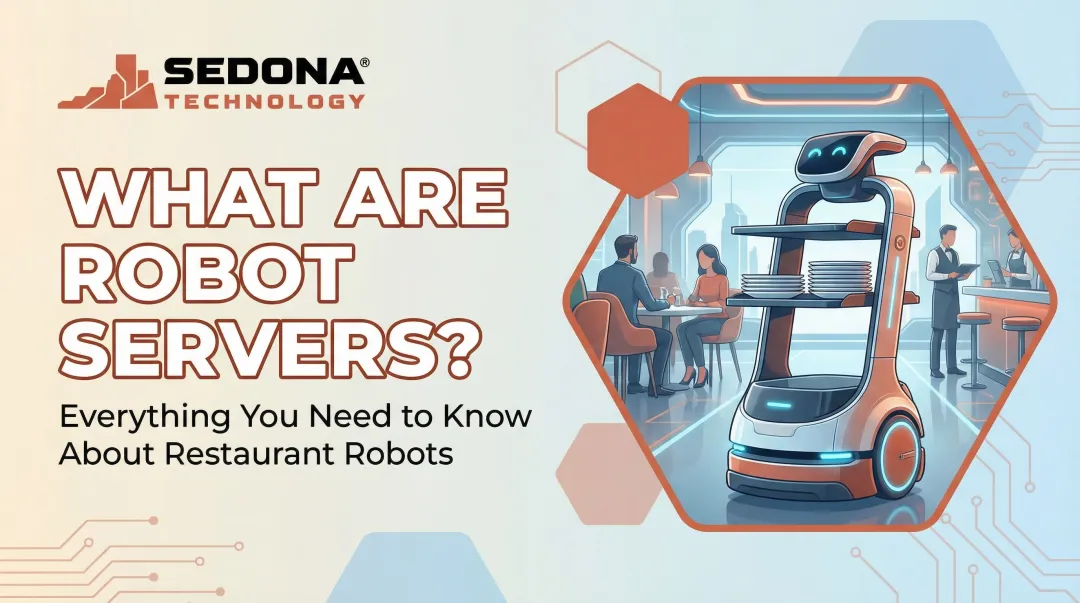
Restaurant robots are autonomous or semi-autonomous machines designed to handle repetitive, physically demanding tasks that consume staff time and energy. They're specialized tools built to carry heavy loads, freeing your human team to focus on what they do best: connecting with guests.
Primary Tasks Robots Handle Today:
- Food and beverage delivery from kitchen to table — the most common deployment
- Dirty dish collection and transport back to the kitchen
- Greeting guests and delivering menus or water during wait periods
Current robots excel at these mechanical tasks but have clear limitations. They cannot take verbal orders, grip and plate individual dishes, verify customer IDs for alcohol service, or empathize with a dissatisfied guest. By design, these machines are built as assistants — purpose-built for specific tasks rather than broad substitutes for human staff.
Beyond the Dining Room:
While serving robots dominate front-of-house deployments, the automation wave extends further. Chipotle tested "Chippy" to autonomously cook and season tortilla chips and "Autocado" to process avocados. Sweetgreen recently sold its "Infinite Kitchen" robotic salad-making division for $186 million. Serving robots, however, remain the most widely deployed category — they address the most immediate operational bottleneck: moving food from kitchen to customer quickly and reliably.
Design Philosophy:
Most restaurant robots intentionally avoid humanoid features. They use screen faces, robotic voices, and clearly mechanical designs to prevent the "uncanny valley" effect—that unsettling feeling humans experience when robots look almost, but not quite, human. This design choice keeps expectations realistic and helps both staff and customers view the robot as a tool rather than a coworker.
The Technology Behind Restaurant Robots
Restaurant robots navigate using two primary sensor systems, often working together for maximum reliability.
Navigation Systems
LiDAR (Light Detection and Ranging)
This technology uses pulsed lasers to measure distances and build detailed 3D maps of the environment. LiDAR excels in low-light conditions and creates highly accurate point cloud maps, making it ideal for dimly lit dining rooms or kitchens. The system identifies stationary objects like walls, tables, and chairs to create a virtual floor plan the robot follows with precision.
Vision-Based Navigation
Camera systems paired with AI interpret the environment in real time by identifying visual features. Visual SLAM (Simultaneous Localization and Mapping) adapts well to dynamic environments but requires adequate lighting and struggles with reflective surfaces or mirrors. Some robots, like the Richtech Matradee, use infrared cameras to read reflective ceiling markers that serve as navigation waypoints.
Many modern robots combine both technologies for redundancy. The Pudu BellaBot, for example, uses dual SLAM with laser and visual sensors, keeping navigation reliable even if one system encounters challenging conditions.
Setup and Mapping
For Bear Robotics' Servi, operators manually drive the robot through the space while its cameras and LiDAR scan the floor. From there, you annotate table locations, set boundary lines, and program destinations via a web portal. For a 1,000 sq. ft. space, minimum installation time is just 14 minutes.
Safety and Operational Features
Modern restaurant robots include multiple safety systems:
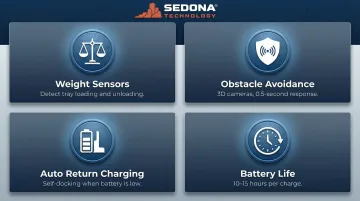
- Weight sensors detect when trays are loaded and unloaded
- Obstacle avoidance using 3D cameras with response times as short as 0.5 seconds
- Automatic return-to-base charging allows robots to dock themselves when battery runs low
- Battery life typically ranges from 10-15 hours, easily covering full service shifts
Together, these systems mean a robot can run from opening through the dinner rush without a staff member managing its movement.
Why Restaurants Are Adopting Robots
The Staffing Crisis Drives Urgency
Beyond the 65.8% annual turnover rate, the total cost of employee turnover averages 33.3% of base pay—roughly $15,000 per departed worker when you factor in recruiting, onboarding, and lost productivity. For restaurants cycling through multiple runner and busser positions annually, these costs compound quickly.
The Labor Cost Equation
Robots don't call in sick, don't require breaks, and don't need workers' compensation insurance. In California, front-end staff costs can reach $3,000 to $6,000 monthly, while a robot lease costs under $1,000. Strip out social security contributions, health benefits, and paid time off, and the gap widens further.
ROI Case Study
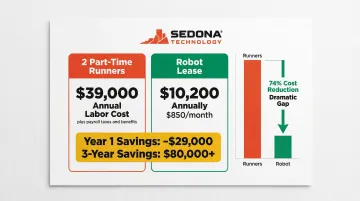
Consider a typical scenario: A restaurant employs two part-time runners at $15/hour, each working 25 hours weekly. Annual labor cost: approximately $39,000 before payroll taxes and benefits. A robot lease at $850 monthly totals $10,200 annually—a savings of nearly $29,000 in the first year alone. Over three years, the difference exceeds $80,000.
Speed and Consistency Benefits
Robots deliver at the same pace every trip, never slowing down during rushes or at the end of long shifts. They reduce the number of trips human staff must make between kitchen and floor, keeping food at proper temperature by shortening delivery time. A single robot can complete 1,000 trips during a busy service—the equivalent of roughly 12,000 server steps.
The Novelty Factor
The financial case is clear, but robots deliver a second benefit that balance sheets don't fully capture: attention. Many restaurants report that robots become conversation starters, driving social media posts and repeat visits. Guests photograph them, share to Instagram, and bring friends back to see for themselves—generating organic visibility that a staffing ad never could.
Real-World Examples: Restaurants Already Using Robots
Wing Factory (Atlanta, GA)
Owner Michael Giovine deployed a Bear Robotics Servi robot named "R2WING2" to combat severe staffing shortages at his Buckhead location. The robot runs about 90% of food during lunch shifts and completed 1,000 trips in its first few days of operation—saving servers roughly 12,000 steps.
The numbers are hard to argue with: Giovine pays approximately $800 monthly to lease the robot, which works 5-6 hours daily, 5-6 days weekly. That works out to roughly $4 per day covering the busiest shifts.
Tastee Spoon (Atlanta, GA)
Raymone Williams operates a Caribbean fusion restaurant featuring a Richtech Matradee robot named "Irie Milly" after her mother. The robot greets guests with the Jamaican Patois phrase "Wah gwaan?" and delivers menus and water while human servers focus on taking orders and building relationships.
Williams frames the robot explicitly as enhancement rather than replacement: "It was not an item to replace anyone; it was an item to enhance the worker's experience." The robot stays charged for 14 hours and carries up to 12 plates per trip.
From Local Spots to National Chains
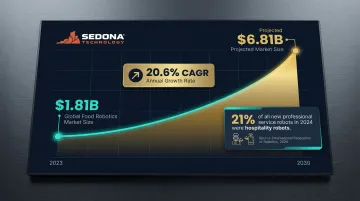
These two Atlanta restaurants aren't outliers — the same shift is happening at the national chain level. Wendy's is deploying its "FreshAI" drive-thru voice automation to over 500 locations. The global food robotics market was valued at $1.81 billion in 2023 and is projected to reach $6.81 billion by 2030, growing at 20.6% annually. In 2024, hospitality robots accounted for 21% of all new professional service robot installations globally.
Robots and Human Staff: A Team, Not a Trade-Off
Addressing the Replacement Fear
The biggest concern surrounding restaurant robots is job displacement. Most operators and manufacturers agree: robots are designed to offload repetitive, physically demanding tasks, not eliminate human positions. The goal is freeing staff to focus on high-value interactions—taking orders, reading guest needs, resolving complaints, and building the relationships that define hospitality.
The Limits of Robotic Hospitality
Current robots handle tasks well—but genuine hospitality requires capabilities they don't yet have:
- Reading body language and emotional cues
- Adapting tone and approach to each guest
- Sensing when someone needs attention versus space
- Responding to unspoken needs, like offering a complimentary dessert on an anniversary
A robot can deliver your entrée on time. It cannot notice a frustrated guest and proactively resolve their concern before they ask.
How the Division of Labor Works in Practice
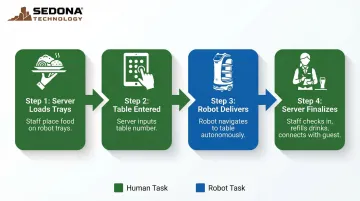
The division of labor is straightforward: servers load food onto the robot's trays, enter a table number on the touchscreen, and the robot handles the trip.
Upon arrival, the robot alerts the table and the server steps in to finalize the interaction—checking on needs, refilling drinks, and maintaining the personal connection. Removing the back-and-forth transit actually increases the time servers spend on the floor.
Legitimate Labor Concerns
Labor advocacy groups raise valid concerns about automation being used to suppress wages rather than address genuine shortages. Anthony Advincula of ROC United argues that "employers are buying expensive robots rather than increasing the $2.13 tipped minimum wage," stating, "It is less of a labor shortage and more of a wage shortage."
Responsible adoption means using robots to support staff, not as a substitute for fair compensation. The technology works best when it improves working conditions and helps servers earn higher tips through better service. Positioning it as a workaround for living wages undermines both workers and the long-term case for automation.
How to Get Started with Restaurant Robots
Key Decisions Before Adopting
Map your floor before anything else. Not every restaurant layout suits robotic navigation. Measure aisle widths (most robots require 55–70 cm clearance), check for reflective surfaces that can confuse sensors, and observe traffic patterns during peak service.
Pinpoint your highest-friction tasks. Where does staff time get eaten up most? Common targets include food running from kitchen to dining room, bussing during rushes, and water or menu delivery during wait times. Start with one use case, not three.
Build a complete budget. Factor in not just the robot cost, but also infrastructure modifications, staff training time, and workflow adjustments during initial integration.
Acquisition Options
| Option | Cost | Best For |
|---|---|---|
| Outright Purchase | $15,000–$16,500 upfront | Established restaurants confident in long-term deployment |
| Monthly Leasing | ~$750–$850/month | Operations that want predictable expenses and preserved capital |
| Short-Term Rental | Flexible; 2-month minimum | Restaurants evaluating fit before committing |
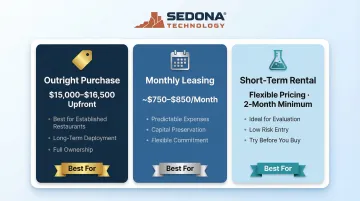
Sedona Technology's rental program includes free installation, training, and ongoing support from day one — so you're not flying blind during the trial period.
Staff Preparation and Change Management
Team buy-in determines whether the technology actually works. Introduce the robot gradually, involve staff in the setup process, and frame it clearly as a tool that reduces their physical workload — not one that threatens their jobs. Let servers name the robot, bring it into staff meetings, and make a point of celebrating the time it saves.
The restaurants that struggle with adoption usually skip this step. The ones that nail it treat the robot like a new team member from day one.
Frequently Asked Questions
What are robotic waiters?
Robotic waiters are autonomous or semi-autonomous machines used in restaurants to deliver food and beverages, collect dishes, and assist human staff with repetitive physical tasks. They work alongside people rather than replacing them, handling routine tasks while servers focus on customer interaction.
What restaurants use robots to serve?
Robot adoption spans from large chains like Chipotle, Wendy's, and Sweetgreen to independent restaurants across the US and internationally. QSR Magazine reports that 38% of adults are comfortable with robot delivery, and robots are now found in casual dining, fast casual, and specialty cuisine settings.
How much does a restaurant robot cost?
Costs vary by model and acquisition method. Leasing typically starts at $750-$850 per month, while outright purchase prices range from $15,000 to $16,500. Rental programs are also available for restaurants that want to test the technology before committing to a purchase.
Can robots fully replace human waiters?
No. Current technology cannot take verbal orders, handle complaints, grip and plate food individually, verify IDs for alcohol service, or deliver the human connection that defines hospitality. Robots handle repetitive physical tasks — the interpersonal skills servers provide remain irreplaceable.
Are customers comfortable being served by robots?
Reception is mixed and generational. While 53% of Gen Z adults are open to robot delivery, only 21% of Baby Boomers share that sentiment. Restaurants that pair robots with attentive human service tend to see the strongest guest acceptance.