This guide cuts through the noise. We tested five robot vacuums across performance, navigation, maintenance, and value to help you find the right fit for your needs.
Key Takeaways
- The Ecovacs Deebot X8 Pro Omni earns the top spot as the best all-round 2-in-1 robot vacuum and mop combo
- iRobot Roomba j9+ leads for obstacle avoidance and is the top pick for pet owners
- Roborock Qrevo Curv handles multi-level homes better than any competitor tested
- TP-Link Tapo RV30 Max Plus delivers the best budget value with self-emptying functionality under $220
- Dreame L40 Ultra is the premium choice for exceptional mopping performance
- Key buying factors: suction power, navigation type (LiDAR vs camera), hybrid mopping, self-emptying capability, and battery life
What Makes a Robot Vacuum Worth Buying in 2026
Modern robot vacuums are no longer "set and forget" toys. LiDAR navigation maps a 1,500-square-foot space in under 10 minutes, AI-powered cameras recognize and avoid pet waste, and self-washing mop systems use 167°F hot water to sanitize pads between rooms. The gap between budget and premium models has widened dramatically, but component price deflation now pushes features like LiDAR and self-emptying docks into the sub-$300 tier.
Vacuum-only vs. hybrid combo:
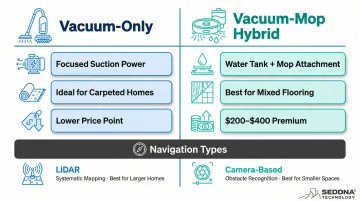
- Vacuum-only models focus entirely on suction and debris pickup, ideal for carpeted homes or pet owners prioritizing hair removal
- Vacuum-mop hybrids add a water tank and mop attachment to scrub hard floors, best for mixed flooring homes but typically cost $200-$400 more
- Navigation type also matters: LiDAR models map systematically and suit larger homes, while camera-based models excel at recognizing small obstacles
Consumer robot vacuums work well for homes, but hotels, airports, offices, and industrial facilities operate at a scale that demands something different entirely. Commercial autonomous cleaning robots are built for continuous, high-traffic use — with extended battery life, fleet management software, and navigation systems designed for 24/7 operation. Sedona Technology provides commercial-grade cleaning robots built specifically for these environments.
Best Robot Vacuums of 2026: Our Top Tested Picks
We selected these five models based on cleaning test performance, navigation accuracy, self-maintenance features, price-to-value ratio, and real-world usability across hardwood, carpet, and mixed floor types.
Ecovacs Deebot X8 Pro Omni — Best Overall
The Ecovacs Deebot X8 Pro Omni is a premium 2-in-1 hybrid vacuum and mop that uses LiDAR navigation combined with an AIVI 3D camera for obstacle detection.
Its standout feature is the OZMO Roller mop, which spins at 200 RPM and continuously washes itself during cleaning by scraping off dirty water and applying fresh solution via 16 nozzles. This prevents cross-contamination between rooms—a persistent issue with static mop pads.
Why it stands out:
The OMNI base station handles nearly everything: it empties the dustbin, washes the mop with 167°F hot water, dries it with 145°F hot air, and even dispenses detergent automatically. PCMag awarded it a 4.5/5 Editors' Choice, noting it aced the mopping stress test by removing raspberry jelly in a single pass without spreading stickiness. It mapped a 1,500-square-foot apartment in just 7 minutes and 46 seconds—the fastest in testing. Despite its premium features, it costs less than several comparable flagship models.
| Category | Details |
|---|---|
| Key Features | 2-in-1 vacuum + roller mop, self-emptying + mop-washing base station, LiDAR navigation, auto detergent dispensing, side brush and mop extend into corners, multi-map storage |
| Technical Specs | Battery: 134 minutes tested; Dimensions: 13.9 × 13.8 × 3.9 inches; Suction: 18,000Pa; Compatible with Alexa, Google Assistant, and Yiko voice assistant |
| Price Range | $729 (current promo) / $1,099 MSRP |
iRobot Roomba j9+ — Best for Pet Owners
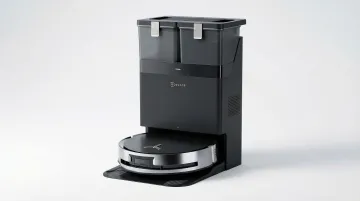
The iRobot Roomba j9+ is a vacuum-focused (non-mopping) robot with industry-leading AI obstacle avoidance using a PrecisionVision camera and machine learning. It self-empties into a base that holds 60 days of debris and uses Dirt Detective technology to learn which rooms get dirtier faster, automatically prioritizing those areas on future runs.
Why it stands out:
The j9+ comes with iRobot's Pet Owner Official Promise (P.O.O.P.)—a guarantee that it will avoid solid pet waste or iRobot will replace the vacuum for free. It photographically identifies obstacles and allows users to create Keep Out Zones via the app, excelling at navigating around cords, toys, and household clutter without user intervention. PCMag gave it a 4.0/5 Editors' Choice for best-in-class obstacle avoidance, though camera-based navigation can result in longer mapping times compared to LiDAR models.
| Category | Details |
|---|---|
| Key Features | AI obstacle avoidance with photo-based Keep Out Zones, learns home layout over time, self-emptying base (60 days), vacuum only (no mop), Dirt Detective Technology |
| Technical Specs | Battery: 113 minutes tested; Dimensions: 13.7 × 13.7 × 3.4 inches; Compatible with Alexa, Google Assistant, and Siri |
| Price Range | $589 (current promo) / $899 MSRP |
Roborock Qrevo Curv — Best for Multi-Level Homes
The Roborock Qrevo Curv is a high-end 2-in-1 robot with a self-lifting chassis featuring independently adjustable three-wheel control. Its uniquely designed AdaptiLift wheels can raise the robot over thresholds up to 1.6 inches (4cm), allowing it to handle multi-level floors and navigate over thick rugs and cords without getting stuck.
Why it stands out:
The FlexiArm extendable side brush and mop arm reach further into corners and edges than any other tested model, delivering 100% edge coverage. The base station handles self-emptying, 167°F hot water mop washing, and warm air drying. A built-in RGB camera also functions as a home security monitor with two-way video calling. PCMag verified its climbing capabilities and noted it picked up 100% of rice on carpet in testing, though its hazard avoidance system is slightly older than some competitors.
| Category | Details |
|---|---|
| Key Features | Self-lifting chassis (1.6-inch threshold clearance), extendable mop arm and side brush, self-emptying + mop wash/dry base, built-in security camera, detachable mop pads |
| Technical Specs | Battery: 120 minutes tested; Dimensions: 13.9 × 13.7 × 4.1 inches; Suction: 18,500Pa; Compatible with Alexa, Google Assistant, Siri, and "Hello Rocky" voice assistant |
| Price Range | $759 (current promo) / $1,599 MSRP |
TP-Link Tapo RV30 Max Plus — Best Budget Pick
The TP-Link Tapo RV30 Max Plus is a 2-in-1 LiDAR-navigating robot vacuum and mop with a self-emptying dustbin—one of the only models under $220 to include this feature. It's particularly strong at capturing large debris particles and pet hair, and its 3L bag capacity outpaces most budget competitors, stretching to 60 days between empties.
Why it stands out:
App control, virtual walls, scheduling, and voice control (Alexa, Google Assistant) are all supported at a price point that typically doesn't include these capabilities. PCMag awarded it a 4.0/5 Editors' Choice for budget vacuums, noting it mapped a 1,500-square-foot space in just 8 minutes and 19 seconds. Wirecutter named it a top budget pick, praising its nimble navigation and strong cleaning power, though it struggles slightly with fine sand on carpets compared to $1,000+ models.
| Category | Details |
|---|---|
| Key Features | 2-in-1 vacuum + mop, self-emptying dustbin (3L bag / 60 days), LiDAR navigation, virtual walls, scheduling, Alexa and Google Assistant support |
| Technical Specs | Battery: 98 minutes tested; Dimensions: 13.0 × 13.0 × 3.9 inches; Suction: 5,300Pa; Best suited for large particle and pet hair pickup |
| Price Range | $189 (current promo) / $299 MSRP |
Dreame L40 Ultra — Best for Mopping Performance
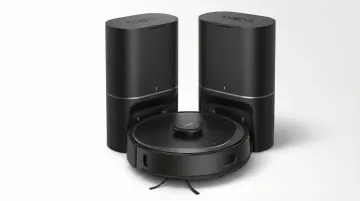
The Dreame L40 Ultra is a premium 2-in-1 recognized by Consumer Reports for outstanding mopping capability. It features an advanced roller mop system and a comprehensive self-maintenance base station with 149°F hot water washing, hot air drying, and automatic solution refilling.
Why it stands out:
The L40 Ultra outperformed competing models in mopping across all tested surfaces. Its MopExtend RoboSwing technology reaches up to 4cm under low-profile furniture—further than any other model in this roundup. The 3.2L dust bag supports 75 days of hands-free emptying, and mop pads auto-lift 10.5mm on carpet detection.
TechRadar awarded it 4.5/5, praising its pet hair handling and mopping efficacy, though noting the 24-inch tall dock requires significant floor space.
| Category | Details |
|---|---|
| Key Features | Advanced roller mop with self-washing base, self-emptying dustbin (75 days), LiDAR + 3D structured light navigation, auto mop lifting on carpet detection, MopExtend technology |
| Technical Specs | Battery: 194 minutes claimed; Dimensions: 13.8 × 13.8 × 4.1 inches; Suction: 11,000Pa; Compatible with Alexa, Google Assistant, and Siri |
| Price Range | $569 (current promo) / $649-$799 MSRP |
How We Chose the Best Robot Vacuums
Selection was based on analysis of hands-on test data from leading tech publications—PCMag, Wirecutter, Consumer Reports, and RTINGS—cross-referenced with user feedback and real-world performance scores. Common buyer mistakes include prioritizing brand name over actual cleaning test results, or overlooking battery life and floor compatibility.
Core evaluation factors:
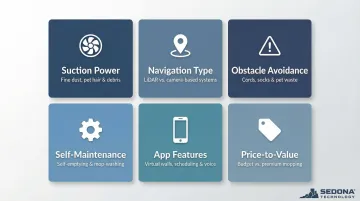
- Suction tested across fine dust, large debris, and pet hair on both hardwood and carpet
- LiDAR navigation suits larger homes; camera-based AI leads on obstacle recognition
- Self-emptying, mop washing, and auto-detergent dispensing cut hands-on upkeep time
- Obstacle avoidance rated against cords, socks, and pet waste in live tests
- App features evaluated for virtual walls, scheduling, and voice assistant compatibility
- Budget picks now include LiDAR and self-emptying — premium models earn their price through mopping performance
Floor type shapes every buying decision. Lab tests show LiDAR excels at rapid, dark-room mapping, while camera-based AI is required for recognizing and avoiding small hazards. Most models handle hardwood well, picking up 90–98% of large and fine debris. Sand on carpet is the real stress test — even $1,500 premium models typically recover only 35–45% of sand embedded in carpet fibers.
Conclusion
The best robot vacuum in 2026 depends on your specific priorities. For all-round performance, the Ecovacs Deebot X8 Pro Omni delivers the best combination of vacuuming, mopping, and self-maintenance. Pet owners benefit most from the Roomba j9+'s AI obstacle avoidance and P.O.O.P. guarantee. Budget buyers get exceptional value from the Tapo RV30 Max Plus, which brings LiDAR navigation and self-emptying to the sub-$220 tier.
Weigh ongoing maintenance costs—replacement bags, mop pads, and filters—alongside the upfront price when making your final decision. Models with self-washing bases significantly reduce hands-on upkeep, though they come with higher initial costs.
For businesses: Consumer robot vacuums aren't built for commercial environments. Hotels, restaurants, offices, airports, and industrial facilities need autonomous cleaning robots designed for large-area, high-traffic operations around the clock.
Sedona Technology offers the KLEENBOT C30, built with laser SLAM navigation, extended battery capacity, and 24/7 operational performance. Acquisition options include:
- Purchase outright for full ownership
- Rental starting at $349/month (minimum 2-month term)
- Leasing through a trusted partner
All options include free installation and training, so your team is up and running from day one.
Frequently Asked Questions
What is the best robot cleaner for home?
The Ecovacs Deebot X8 Pro Omni is the top all-around pick for most homes in 2026 — 2-in-1 vacuuming and mopping, LiDAR navigation, and self-maintenance including hot-water mop washing. Budget shoppers can look at the TP-Link Tapo RV30 Max Plus, which offers LiDAR navigation and self-emptying for under $220.
Which robot vacuum is the best for hardwood floors?
The Dreame L40 Ultra and Ecovacs Deebot X8 Pro Omni lead for hardwood. Look for mop-lifting capability — without it, the wet pad drags onto carpet and can damage both surfaces.
Are floor cleaning robots any good?
LiDAR-navigating models with strong suction do a solid job maintaining floors between deep cleans. That said, they work best alongside manual vacuuming — even premium models only retrieve 35-45% of embedded carpet debris like fine sand.
What is the best wood floor cleaner for robots?
Hybrid models with auto mop-lifting and a vibrating or roller attachment work best on wood floors. The Dreame L40 Ultra and Roborock Qrevo Curv both excel here, with hot-water mop-washing that prevents cross-contamination between rooms.
What is the difference between a robot vacuum and a robot vacuum-mop combo?
Vacuum-only models focus entirely on suction and debris pickup, ideal for carpeted homes. Hybrid combos add a water tank and mop attachment to also scrub hard floors, making them better for mixed flooring homes but typically costing $200-$400 more than vacuum-only equivalents.
How often do robot vacuums need maintenance?
Empty the dustbin every 1-2 runs, or every 30-60 days for self-emptying models. Clean brush rolls weekly (twice weekly for pet owners), replace filters every 2-3 months, and wash mop pads after each use. Premium models with self-washing bases significantly reduce hands-on upkeep by automating mop cleaning and drying.