Introduction
Robot bartenders are already working commercial shifts — in hotel lobbies, cruise ships, airports, and high-volume bars — deployed specifically for speed, consistency, and reduced labor dependency.
The market reflects that momentum: valued at $379.68 million in 2021, the commercial robotic bartender segment is projected to reach $3.88 billion by 2033, growing at a CAGR of 21.38%.
Yet most coverage focuses on the "wow factor." This guide explains how robot bartenders actually work, what types exist, where they perform best, and what they can and cannot replace. Whether you're a hospitality operator evaluating automation or simply curious about the technology changing how bars operate, you'll leave with a clear picture of what these systems actually deliver — and where their limits are.
Key Takeaways
- Robot bartenders automate drink preparation—from robotic arms to carousel dispensers—with minimal human involvement
- Operation spans digital order intake, recipe processing, precise dispensing, and automated delivery
- Commercial deployments target high-volume venues like hotels, airports, and stadiums where speed and consistency matter most
- AI integration enables preference learning, recipe suggestions, and adaptive pours beyond basic automation
- Robot bartenders handle repetitive tasks around the clock, freeing human staff to focus on guest interaction and hospitality
What Is a Robot Bartender?
A robot bartender is an electromechanical system designed to prepare and serve drinks—alcoholic and non-alcoholic—by automating the core bartender tasks: measuring, mixing, shaking, pouring, and serving. These systems respond to digital order inputs and execute drink recipes to exact specifications.
Why Robot Bartenders Exist
The operational challenges driving adoption include:
- High labor costs: The National Restaurant Association reports that labor costs now consume 36.5% of full-service restaurant sales
- Inconsistent pours: Bars lose 15-20% of profits to over-pouring, spillage, and theft
- Peak-hour bottlenecks: Human bartenders average 36-80 drinks per hour; demand spikes create long wait times
- Hygiene requirements: Contactless preparation reduces cross-contamination risk
- 24/7 availability: Venues like hotels and airports need round-the-clock service without staffing constraints
What Robot Bartenders Are Not
Most commercial systems are not humanoid robots. They're purpose-built dispensing machines or robotic arms—not AI chatbots or science-fiction androids. The distinction between a "robot bartender" and a basic drink dispenser matters: robot bartenders use programmable logic or AI to replicate bartender decision-making, not just liquid delivery.
Main Types
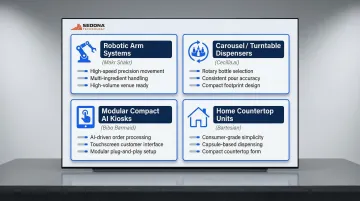
That distinction maps onto four distinct hardware categories, each suited to different venues and volumes:
- Robotic arm systems (Makr Shakr, Yanu): Articulated arms that physically shake, stir, and pour — closest to replicating human bartender motion
- Carousel/turntable dispensers (TendedBar, Backbar One): Pump-and-valve systems built for high throughput, capable of serving hundreds of drinks per hour in stadiums or hotel lobbies
- Modular compact machines (Cecilia.ai): AI kiosks with voice recognition and touchscreen ordering, designed for self-service environments
- Home-use countertop units: Consumer-grade devices for cocktail enthusiasts — though commercial-grade systems serve a different performance standard entirely
How Does a Robot Bartender Work?
Robot bartenders move through four distinct stages—order intake, recipe processing, physical dispensing, and delivery—each handled by a separate system component.
Order Intake
Orders are placed through digital interfaces: mobile apps, touchscreen kiosks, or QR code systems. Customers select ingredients, recipes, and customization options. The order data is sent to the robot's control system.
This digital-first intake eliminates human error at the point of order. However, operational independence varies—some systems require human operators to load supplies at the start of each shift, while others feature automated ingredient monitoring and low-level alerts.
Recipe Processing and AI Logic
The control system translates orders into machine instructions. The recipe database contains pre-programmed ratios, sequences, and pour volumes. AI-enabled systems go further: machine learning tracks popular combinations, personalizes suggestions, and adjusts pours based on historical data.
Why this matters for cost control: Unlike human bartenders who may free-pour, robots execute exact measurements every time. A single 1/8 oz over-pour per drink can result in thousands of dollars in lost revenue annually. Systems like Backbar One dispense ingredients accurately to 1/20th of a liquid ounce, while academic testing shows peristaltic pump-based systems achieve 98.5-99.9% precision across various liquid densities.
By locking in exact Cost of Goods Sold (COGS) for every transaction, operators can save an estimated $15,000-$25,000 annually per high-volume kiosk.
Physical Dispensing and Preparation
Those precision gains carry directly into the physical process. The robotic system activates pumps, solenoid valves, or robotic arms to measure and dispense spirits, mixers, and garnishes in the correct sequence. For arm-based systems, the arm mimics shaking, stirring, or muddling motions with pre-programmed movement paths.
Weight sensors, flow meters, or optical sensors verify ingredient volumes and flag errors before the drink is completed — keeping every pour consistent.
Delivery to the Customer
Completed drinks are delivered via conveyor rail, sliding tray, or designated pickup slot. Delivery design varies by system and venue layout — some integrate pickup windows directly into bar counters, while others use illuminated trays to signal order completion.
Speed comparison—robot vs. human:
| Bartender Type | Drinks Per Hour | Speed Per Drink |
|---|---|---|
| Human (average) | 36-80 | 45-90 seconds |
| Makr Shakr Toni | 80+ | ~45 seconds |
| Yanu | 100 | ~36 seconds |
| Cecilia.ai | 120 | ~30 seconds |
| Makr Shakr Veloce | 250 | ~15 seconds |
| Backbar One | 300 | ~10 seconds |
| TendedBar | ~365 | ~10 seconds |
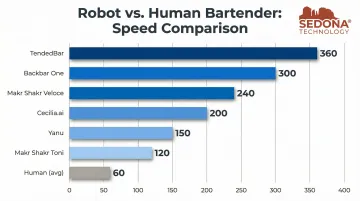
In venues like stadiums where purchasing windows are limited to short intermissions, high-throughput systems (250+ drinks/hour) prevent queue abandonment and capture otherwise lost revenue.
Where Robot Bartenders Are Used
Commercial Hospitality Settings
Robot bartenders are most commonly deployed in high-volume environments:
- Cruise ships: Royal Caribbean's Bionic Bar operates on nine vessels, serving up to 1,000 drinks per day per ship
- Airport terminals: Makr Shakr's Toni system operates at Singapore Changi Airport, while Doosan Robotics serves Gimpo International Airport in South Korea
- Sports arenas: TendedBar has deployed at VyStar Veterans Memorial Arena, AT&T Center (San Antonio Spurs), and multiple NFL and NCAA stadiums
- Hotel lobbies: MGM Springfield uses automated back-of-house systems to fulfill casino floor orders rapidly
These settings share common pressures: high foot traffic, demand for speed, persistent labor shortages, and the need for round-the-clock service. For commercial operators looking to deploy these systems, equipment suppliers like Sedona Technology offer flexible acquisition options—sales, rental (minimum two-month period), and leasing—with free installation, training, and ongoing support included.
Event and Entertainment Venues
Trade shows, concerts, and corporate events increasingly use robot bartenders as both attraction and functional service point. Cecilia.ai has been deployed for corporate events by Microsoft, Cisco, and KPMG, where the novelty drives booth engagement while delivering functional service.
Home and Personal Use
Countertop cocktail robots designed for home bars allow consumers to program custom recipes via app. This emerging segment caters to cocktail enthusiasts who want precision and novelty without commercial-scale investment.
Benefits and Real Limitations
Core Operational Benefits
Labor cost reduction: Labor costs consume roughly 36.5% of full-service restaurant sales. A single four-screen TendedBar unit can create four points of sale where only one existed before, cutting staffing needs by up to 400%.
24/7 availability: Robot bartenders operate round-the-clock without breaks, shift changes, or overtime costs.
Elimination of over-pouring losses: Bars typically lose 15-20% of inventory profits to over-pouring, spillage, and theft. Robotic precision reclaims these losses through exact measurements.
Consistent drink quality: Every drink is prepared to the same specification, eliminating variance.
Improved hygiene: Contactless preparation reduces cross-contamination risk. Commercial systems meet strict food safety standards like NSF/ANSI 18 for manual food and beverage dispensing equipment.
Genuine Limitations
Cannot replicate the human experience: Robot bartenders can't read a room, adjust to a customer's mood, or fill the social role a skilled human bartender plays. The craft side of the job — improvised cocktails, emotional attunement, genuine hospitality — remains firmly human territory.
Technical constraints:
- Struggle with muddling fresh herbs, handling delicate fruit, or executing garnishes like flaming citrus peels
- Cannot accommodate micro-customizations such as "just a splash of cranberry juice"
- Novelty can fade over time — cruise passengers report gravitating back to human bartenders for personalized service once the initial excitement wears off
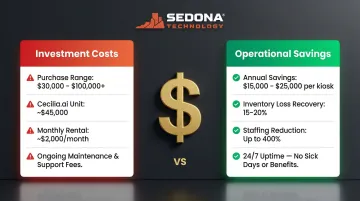
Cost and maintenance reality: Commercial robot bartender systems represent a significant upfront investment. The Cecilia.ai system carries a documented purchase price of $45,000, while robotic arm systems typically range from $30,000 to over $100,000. Rental options exist — Cecilia.ai rents for $2,000 per month — but ongoing maintenance, ingredient restocking, and technical support add to the total cost of ownership.
Harsh environments like festivals expose additional vulnerabilities: jammed syrup tubes, sensor calibration drift, and some field reports of systems failing roughly every 4.2 hours on average — making dedicated on-site technical support a practical necessity.
Conclusion
Robot bartenders are engineered systems that bring precision, speed, and operational efficiency to drink preparation. They work through digital order intake, AI-driven recipe execution, automated dispensing, and controlled delivery. Understanding how they work enables operators to match the right system type to their venue's volume, layout, and service model.
For businesses evaluating automation, robot bartenders complement human staff by handling high-volume, repetitive tasks while freeing skilled bartenders to focus on complex cocktails, personal service, and upselling. Operators interested in exploring deployment options can work with robotics suppliers like Sedona Technology to find the acquisition path (purchase, rent, or lease) that fits their operational needs.
Frequently Asked Questions
Are there robotic bartenders?
Yes, commercial robot bartenders are operating in hotels, bars, airports, and cruise ships worldwide. Several manufacturers offer purpose-built systems at various price points and formats, including robotic arm systems, carousel dispensers, and interactive AI kiosks.
How much does a robot bartender cost?
Commercial robot bartender systems typically range from $30,000 to over $100,000 depending on technology and features. The Cecilia.ai system, for example, costs $45,000 to purchase or $2,000 per month to rent.
Can robot bartenders replace human bartenders?
Robot bartenders can handle high-volume, repetitive drink preparation but cannot replicate the social, improvisational, and experiential role of a skilled human bartender. They work best as a complement, freeing human staff to focus on craft cocktails and guest interaction.
What drinks can a robot bartender make?
Depending on ingredient slots and recipe library, commercial systems can serve anywhere from dozens to hundreds of drink options—cocktails, mocktails, and mixed drinks all built from pre-programmed recipes.
How do customers order from a robot bartender?
Ordering typically happens through a mobile app, touchscreen kiosk, or QR code. Customers browse the menu, customize their drink (strength, sweetness, mixers), and submit—the robot prepares it and signals when it's ready for pickup.
Are robot bartenders safe to use around people?
Yes, commercial robot bartender systems are designed with safety enclosures, sensor-based collision detection, and physical separation from customers. Collaborative robotic systems comply with ISO 10218-1, ISO 10218-2, and ISO/TS 15066 standards, featuring motion sensors that stop movement immediately if humans are detected nearby.