Introduction
The hotel industry faces mounting pressure: 67% of properties report staffing shortages, wages have hit an all-time high of $23.91 per hour, and labor costs now consume up to 43% of operating expenses at unionized properties. These aren't temporary headaches—they're structural challenges forcing operators to rethink how hotels deliver service.
Service robots are emerging as a practical solution. From autonomous delivery bots carrying towels to guest rooms at 2 AM, to AI concierges answering questions in six languages, robots are handling the repetitive tasks that drain staff time and inflate payroll. Properties like Aloft Hotels, Hilton, and Hotel EMC2 have deployed robots for years — with robots now handling thousands of guest interactions per month across multiple locations.
TLDR:
- Hotel service robots handle delivery, check-in, cleaning, and concierge tasks autonomously
- Delivery robots replace 1.5–2 FTEs, saving $45,000–$70,000 annually per unit
- Major chains like Hilton, Aloft, and Yotel have deployed robots since 2014
- Rental models starting at $575/month lower the barrier to entry for smaller properties
- Robots work best for repetitive tasks — complex interactions requiring empathy still need staff
What Are Hotel Service Robots?
Hotel service robots are automated machines or AI-driven systems designed to perform specific operational tasks—from delivering amenities to greeting guests, all with minimal human supervision. They don't replace hospitality professionals; they handle the repetitive work that keeps staff from focusing on genuine guest connections.
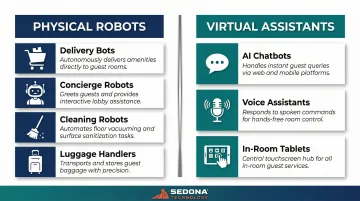
The industry distinguishes between two main categories:
Physical Robots
These are tangible machines guests can see and interact with. Delivery bots transport items to rooms, concierge robots handle lobbies, cleaning robots vacuum hallways, and robotic arms manage luggage — all navigating hotel spaces autonomously using sensors, cameras, and floor mapping.
Virtual Assistants
These are software-based systems — AI chatbots and voice-controlled devices — that handle requests and bookings digitally. Running on hotel apps, in-room tablets, or voice speakers, they manage routine inquiries and information requests 24/7 without a physical presence.
These robots aren't a single product — they're a spectrum of technologies, each built for a specific function. A delivery robot optimized for navigating elevators won't handle front-desk check-in, and that distinction matters when choosing what to deploy.
Types of Service Robots Transforming Hotel Operations
Front Desk and Concierge Robots
Front desk robots cut lobby wait times by handling check-in, fielding common questions, and offering local recommendations—freeing staff for the interactions that actually require a human touch. Hilton's "Connie," launched in 2016, was the industry's first Watson-enabled robot concierge. Built on IBM's AI platform, Connie greeted guests at the Hilton McLean and used natural language processing to answer questions about dining, attractions, and hotel amenities.
These robots don't replace front desk agents. They handle the repetitive questions—"What time is breakfast?" "Where's the gym?"—that consume hours of staff time, allowing human employees to focus on resolving complaints, managing group bookings, and delivering personalized service moments that build loyalty.
Delivery and Butler Robots
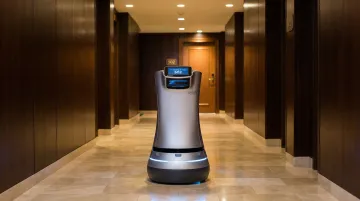
Room-service delivery robots transport amenities directly to guest rooms, operating autonomously via Wi-Fi navigation and elevator integration. Aloft Hotels pioneered this category in 2014 with "A.L.O." (also called Botlr), a Savioke Relay robot at the Aloft Cupertino that navigated hallways, called elevators, and even accepted tweets as tips.
The format spread quickly. Crowne Plaza San Jose deployed "Dash" in 2015, and Hotel EMC2 in Chicago launched "Cleo" and "Leo" in 2017 — those two robots now complete approximately 400 deliveries per week across 195 guest rooms.
Operationally, delivery robots move at human walking pace and use secure compartments to protect items. When they arrive at the door, guests receive an automatic phone notification.
Housekeeping and Cleaning Robots
Cleaning robots take on the sanitation work that doesn't require judgment — vacuuming, mopping, and surface disinfection in public spaces like lobbies, hallways, and conference rooms. Unlike delivery robots, they rarely interact with guests directly.
Commercial-grade housekeeping robots use SLAM (Simultaneous Localization and Mapping) technology to navigate spaces without pre-mapping, avoiding obstacles and adapting to changing environments. These robots don't replace human housekeepers; they vacuum and mop common areas, freeing staff to focus entirely on detailed in-room cleaning. This division of labor can improve room turnover speed by 20%, putting rooms back on the market faster and improving revenue per available room.
Luggage-Handling Robots
For high-turnover properties, front-of-house congestion is a real bottleneck — and robotic luggage systems address it directly by automating collection and storage. YOTEL New York introduced "YOBOT" in 2011, an ABB industrial robotic arm originally designed for auto manufacturing. Housed behind a glass enclosure, YOBOT stores guest luggage in one of 117 secure lockers, completing storage or retrieval in 30 seconds or less.
Unlike mobile robots, luggage-handling systems are stationary installations that require significant upfront infrastructure investment. They work best in properties with compact footprints and high guest turnover, where speed and automation create competitive advantage.
AI-Powered Virtual Concierge and Chatbots
Not every service robot has wheels. Voice-activated devices and chatbots handle guest requests, manage bookings, and deliver personalized recommendations 24/7 — extending service coverage well beyond what overnight staff can manage alone. These virtual assistants run on hotel apps, in-room tablets, or voice speakers, and can process requests instantly without queuing.
Virtual assistants collect guest preference data across interactions, enabling hotels to offer more personalized service on return visits. Unlike physical robots, these systems scale effortlessly—one AI platform can serve thousands of rooms simultaneously without additional hardware costs per room.
Key Operational Benefits of Hotel Robots
Labor Cost Reduction and Staff Reallocation
Robots handle repetitive, routine tasks—deliveries, cleaning, check-in support—reducing the hours human staff spend on low-value work. A single delivery robot operating 24/7 typically replaces 1.5 to 2 full-time equivalent positions, generating $45,000 to $70,000 in annual savings on wages and benefits.
The goal is reallocation, not replacement. With robots handling towel deliveries and hallway vacuuming, human employees can focus on complex guest interactions—resolving complaints, coordinating special requests, and creating the high-touch service moments that drive loyalty and positive reviews.
Given that labor costs consume up to 43% of operating expenses at unionized properties and wages have reached record highs, this cost relief is critical for protecting shrinking margins.
24/7 Availability Without Fatigue
Robots operate around the clock without breaks, shift changes, or performance variability. A delivery robot provides the same service quality at 2 AM as it does during peak check-in hours. This consistency eliminates the operational gaps that occur during overnight shifts when staffing is minimal.
Hotels can fulfill guest requests instantly at any hour without waking staff, calling in backup, or making guests wait until morning. This continuous availability directly improves guest satisfaction by reducing friction in service delivery.
Improved Guest Satisfaction and Novelty Factor
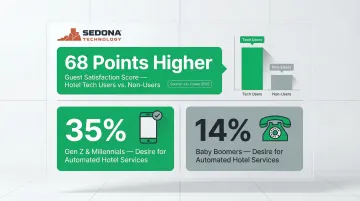
Robots create memorable guest experiences, generate social media buzz, and can improve satisfaction scores by reducing wait times for common requests. According to J.D. Power's 2025 study, guests who utilize a hotel's technology report overall satisfaction scores 68 points higher than non-users.
The novelty factor matters, especially for younger travelers. Nearly 35% of Gen Z and Millennials highly desire automated services, compared to just 14% of Baby Boomers. Properties that deploy robots often see 15% to 30% increases in social media mentions, driving organic marketing value and improved review scores related to innovation and service speed.
Operational Efficiency and Error Reduction
Automated systems reduce human error in deliveries, check-in workflows, and inventory tracking—leading to more predictable operations and fewer guest complaints. Unlike human staff under pressure, robots follow programmed routes precisely, confirm deliveries digitally, and log every handoff automatically. The downstream effect is measurable:
- Fewer service recovery costs and comped stays
- Less time resolving delivery mistakes or missed requests
- More predictable labor scheduling for operations managers
- Automatic audit trails that simplify dispute resolution
Data Collection and Personalization
AI-enabled robots and virtual assistants collect guest preference data across interactions, enabling hotels to offer more personalized service, increase upsell opportunities, and improve return guest rates. Every interaction—room temperature preferences, dining choices, service timing—feeds into a guest profile that informs future stays.
That turns robots from cost-saving tools into revenue-generating assets. Hotels can use preference data to recommend upgrades, suggest dining options, and trigger promotional offers during check-in, after breakfast service, or at checkout—when guests are most likely to act.
Real-World Hotels Already Using Service Robots
Established Hotel Brands
Major international chains have deployed robots for nearly a decade, proving the technology works beyond experimental pilots:
- Hilton's Connie (2016): IBM Watson-enabled concierge robot at Hilton McLean, providing local recommendations and answering guest questions using natural language processing
- Aloft's A.L.O./Botlr (2014): Savioke Relay delivery robot at Aloft Cupertino, autonomously delivering amenities to guest rooms
- Hotel EMC2's Cleo and Leo (2017): Two Savioke robots completing 400 weekly deliveries of in-room dining and amenities across 195 rooms
- YOTEL New York's YOBOT (2011): ABB industrial robotic arm providing automated luggage storage and retrieval in 30 seconds
These deployments span multiple brands and property types, demonstrating that robot adoption isn't limited to tech-forward boutique hotels or luxury flagships.
The Henn na Hotel (Japan) as an Extreme Example
Japan's Henn na ("Strange") Hotel opened in 2015 as the world's first robot-staffed property, deploying 243 robots to handle check-in, luggage, and in-room concierge services. Velociraptor robots greeted guests at the front desk, robotic arms handled luggage, and in-room voice assistants managed environment controls.
The experiment didn't hold up. By 2019, the hotel had fired more than half its robotic workforce — the machines created more work for human staff than they saved. The specific failures tell the real story:
- In-room assistants repeatedly woke guests by mistaking snoring for voice commands
- Luggage robots failed in rain, couldn't navigate slopes, and frequently got stuck
- Front desk robots couldn't photocopy passports, triggering constant human intervention
This case illustrates what full-scale automation looks like, and why matching the right robot to the right task matters more than chasing headcount reductions.
Emerging Adoption Beyond Luxury Brands
Robot adoption is expanding beyond flagship properties and large chains. As prices decline and Robot-as-a-Service (RaaS) models become more accessible, mid-scale and boutique hotels are exploring delivery robots and AI concierge tools. The hospitality robotics market is surging at ~24% annual growth toward $2.2 billion by 2030, driven by persistent labor shortages and declining hardware costs.
For independent and midscale operators, the RaaS model removes the six-figure hardware barrier entirely — a hotel can now pilot a delivery robot for two months before committing to ownership. That's a different conversation than it was five years ago.
Challenges and Considerations Before Adopting Hotel Robots
Upfront Investment and Total Cost of Ownership
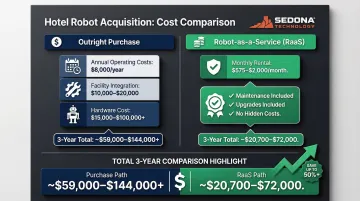
Hardware, integration, and maintenance costs vary significantly by robot type and vendor. Delivery robots typically cost $15,000 to $40,000 for outright purchase, while humanoid concierge robots range from $25,000 to $100,000+. Commercial cleaning robots run $20,000 to $50,000.
Purchase price is only part of the equation. Total Cost of Ownership (TCO) adds up across several categories:
- Facility integration: Elevator systems and Wi-Fi infrastructure upgrades, typically $10,000–$20,000 for legacy properties
- PMS connectivity: Linking robots to your Property Management System for seamless task dispatching
- Annual operating costs: Software subscriptions, maintenance, and energy average roughly $8,000 per year
Robot-as-a-Service models ($1,000–$2,000 monthly for delivery robots) eliminate high upfront costs and shift maintenance responsibilities to the vendor — making it easier for properties to trial robotics without a major capital commitment.
Technical Reliability and Guest Experience Risks
Robots can experience technical glitches, navigation errors, or software failures. For robots to deliver positive ROI, they must maintain success rates above 95% and system uptime above 98%. When reliability falls below these thresholds, maintenance burdens and workflow disruptions quickly erode projected savings.
Hotels should plan for human backup systems and clear escalation protocols to avoid guest-facing service failures. If a delivery robot gets stuck in an elevator at midnight, staff need immediate notification and procedures to complete the delivery manually.
Guest Acceptance and Brand Fit
Reliability planning is closely tied to another question: whether your guests actually want robot service. Business travelers and tech-forward guests tend to respond well, but luxury or boutique properties need to consider whether robotics fits their service promise.
Studies indicate that robotic service influences higher ratings for budget and midscale hotels, but not for luxury hotels. Luxury guests expect emotional attentiveness and highly personalized service — areas where robots still fall short.
Properties must align robotics strategy with their primary guest demographic. A budget hotel catering to Millennials will see higher acceptance rates than a luxury resort serving Baby Boomers.
How Hotels Can Get Started with Service Robots
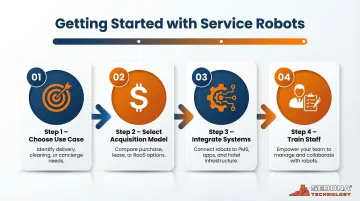
Start with a High-Impact, Low-Complexity Use Case
Identify one operational bottleneck—such as room delivery, cleaning, or check-in queues—and pilot a single robot type there before scaling. Don't attempt a full-scale rollout across multiple functions simultaneously.
Room delivery is often the ideal starting point. It's high-frequency, repetitive, and doesn't require complex decision-making. A delivery robot handles towels, toiletries, and snacks autonomously, freeing staff for higher-value interactions without requiring guests to interact with the robot directly.
Evaluate Acquisition Models — Buy, Rent, or Lease
Hotels don't need to purchase robots outright. Rental and leasing options allow properties to test robots with lower upfront commitment. Providers like Sedona Technology offer flexible acquisition options — sales, rental (minimum 2-month period), and leasing — with free installation, training, and ongoing support included.
For example, the KEENON BUTLERBOT W3, designed specifically for hotel room service delivery, rents for $575 per month. This entry point makes automation financially viable even for smaller properties with limited budgets, allowing them to evaluate impact on guest satisfaction and labor costs before committing to purchase.
Rental models also shift maintenance risk to the vendor, ensuring that technical issues don't become costly operational disruptions.
Plan for Integration and Staff Training
Successful robot deployment requires integrating the robot with existing hotel systems—Property Management Systems, Wi-Fi infrastructure, elevator controls—and training staff to work alongside robots. Deployment without preparation leads to navigation failures, staff confusion, and frustrated guests.
Staff need clear protocols for:
- When to dispatch the robot vs. handle requests manually
- How to troubleshoot common issues
- How to explain robot capabilities to guests
- How to intervene when technical failures occur
Properties should audit their physical and digital infrastructure before procurement. Flat flooring, elevator integration, and PMS connectivity all affect total cost of ownership directly. Retrofitting legacy elevators or resolving navigation gaps post-deployment can quickly erode the ROI you projected at purchase.
Frequently Asked Questions
What are the service robots in hotels?
Hotel service robots are automated machines or AI-powered systems used to perform tasks like room deliveries, check-in assistance, cleaning, and concierge services. They're available as physical robots (delivery bots, cleaning machines, luggage handlers) or virtual assistants (chatbots, voice AI).
How much do robot maids typically cost?
Commercial-grade cleaning robots cost $20,000 to $50,000 for outright purchase. However, subscription models make adoption more affordable—for example, some vendors offer month-to-month leases starting around $479, including maintenance, warranty, and support, eliminating large upfront costs.
Which hotels use robots?
Notable examples include Hilton (Connie the AI concierge), Aloft Hotels (A.L.O. delivery robot), YOTEL New York (YOBOT luggage system), Hotel EMC2 (Cleo and Leo delivery robots), and Henn na Hotel in Japan (full robotic operations). Adoption is growing across hotel tiers worldwide, from luxury flagships to midscale properties.
Are hotel robots replacing human staff?
No. Robots handle routine, repetitive tasks like deliveries, vacuuming, and answering basic questions. This frees human staff for the work that actually requires people: resolving complaints, coordinating special requests, and building real guest connections.
Can small or mid-sized hotels afford to use service robots?
Yes. Rental and leasing options make it practical for smaller properties to start with a single robot, like a delivery bot at $575 per month, without a large upfront purchase or long-term contract.