Introduction
Robot baristas are already serving thousands of customers daily in airports, malls, corporate offices, and cafes across the US. What started as novelty installations has become a legitimate operational strategy for food service businesses facing real staffing pressure. As of January 2026, full-service restaurant employment remains 204,000 jobs below pre-pandemic levels, forcing hospitality operators to rethink staffing strategies.
Robot coffee baristas address critical operational pain points: chronic labor shortages, inconsistent drink quality, long customer wait times, and rising staffing costs. For food service operators and hospitality businesses, these systems represent a dependable response to labor uncertainty. This guide profiles the top robot coffee barista systems and the suppliers behind them, along with the criteria businesses should use when evaluating options.
Key Takeaways
- Robot baristas produce espresso-based drinks, lattes, and cold brew with little to no staff involvement
- Leading systems deliver 100–200+ cups per hour, matching the output of multiple human baristas
- Top suppliers include Cafe X Technologies, Crown Digital, Rozum Café, Briggo/Costa BaristaBot, and Know Intelligent Technology
- Key selection factors: throughput, menu flexibility, ordering interface, maintenance needs, acquisition model
- Strongest fit for airports, hotels, corporate offices, malls, and high-volume cafes
Overview of Robot Coffee Baristas in the Food Service Industry
Robot coffee baristas are fully automated kiosk or arm-based systems that grind, brew, and serve coffee beverages using pre-programmed recipes, AI, and precision robotics. Customers order via touchscreen, mobile app, or QR code—no human barista required for drink preparation.
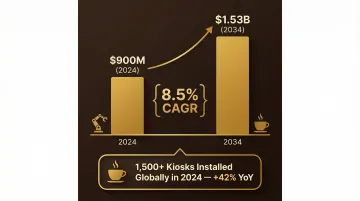
The global robotic coffee kiosk market reached $900 million in 2024 and is projected to hit $1.53 billion by 2034, growing at 8.5% annually. In 2024 alone, over 1,500 robot coffee kiosks were installed globally—a 42% year-over-year increase. Deployments concentrate in high-traffic environments: airports, corporate campuses, hospitals, and transit hubs.
What follows profiles five commercially deployed robot coffee barista systems, selected based on market presence, deployment scale, technological capability, and supplier credibility.
Top Robot Coffee Baristas & Best Suppliers
The suppliers below represent the most commercially proven robot barista systems available — each evaluated on deployment track record, throughput, distinguishing technology, and fit for commercial food service environments.
Cafe X Technologies
Founded in 2015 and headquartered in California, Cafe X pioneered commercial robot baristas with its kiosk-style system featuring a six-axis Mitsubishi robotic arm enclosed in a transparent "aquarium" unit. The system serves hot and cold coffee, tea, and specialty drinks ordered via tablet or mobile app.
Its signature "ta-da" cup presentation gesture, 100+ drinks per hour throughput, and deployments at San Francisco International Airport, Dubai's Museum of the Future, and Tesla's Berlin Gigafactory set a high bar for customer-facing polish.
Key Features:
- Six-axis robotic arm, touchscreen/app ordering
- Enclosed transparent kiosk
- Wide specialty menu
- Premium aesthetic with theatrical presentation
Throughput: 100+ cups per hour
Best Suited For: Airports, corporate offices, high-traffic hospitality venues
Pricing Note: A 2023 disclosure listed units at $285,000 plus $15,000 annual software/service costs.
Briggo / Costa Coffee BaristaBot
Briggo, founded in 2011 in Austin, Texas and later acquired by Costa Coffee, pioneered the "coffee haus" format—a fully enclosed, appliance-style automated café resembling a log cabin. Unlike arm-based systems, it uses an internal automated brewing system.
The focus on gourmet, fully customizable coffee — temperature, milk type, flavor, and strength — ordered via mobile app with pickup notifications makes it a strong fit for self-service locations. It operates as a standalone unit requiring minimal floor staff.
Key Features:
- Enclosed appliance format (no visible robotic arm)
- Mobile app ordering with text notifications
- Full customization (temperature/flavors/creamers)
- Gourmet ingredient focus
Throughput: Up to 100 cups per hour
Footprint: Approximately 40 square feet
Best Suited For: Airports, university campuses, corporate headquarters, transit hubs
Deployments: Austin-Bergstrom International Airport, SFO, Whole Foods Market locations, corporate campuses
Crown Digital (ELLA)
Singapore-based Crown Digital produces ELLA, a robotic coffee kiosk combining a six-axis articulating arm with a distinctive transparent OLED screen. This dual-purpose unit handles both drink preparation and digital advertising or promotions within the same footprint—making it an additional revenue stream for operators.
Smart display integration generates customer engagement and advertising income alongside beverage sales. With 300+ coffee combinations and a strong footprint across Southeast Asia and the Middle East, ELLA suits operators in high-footfall Asian-Pacific and Gulf locations.
Key Features:
- Six-axis articulating arm
- Transparent interactive OLED ordering screen
- Dual-function (beverage + digital advertising)
- Compact kiosk form
Throughput: Up to 200 cups per hour
Footprint: Less than 5 square meters (2.881m L x 1.428m W x 1.998m H)
Best Suited For: Shopping malls, hotel lobbies, retail spaces, transit locations in Asia-Pacific and Middle East
Deployments: 30 SMRT stations in Singapore, JR East train stations in Tokyo and Yokohama, Changi Airport
Rozum Café
Rozum Café is a commercially available robot barista system built around a countertop PULSE articulating arm paired with a professional Nuova Simonelli coffee machine, enclosed in transparent panels so customers watch their coffee being made. Multi-language touchscreen ordering supports card, phone, and cash payments.
One of the few systems available for outright purchase, Rozum includes a one-year warranty (extendable for 10% of the purchase price) — a straightforward option for operators who prefer ownership over a subscription or service model.
Key Features:
- Transparent enclosure with visible brewing process
- Multi-language touchscreen
- Card/phone/cash payment options
- Nuova Simonelli espresso machine
- Servo-motor articulating arm
Throughput: 450+ cups per day (approximately 90 seconds per espresso, up to 2.5 minutes for iced cappuccino)
Menu: Espresso, Americano, cappuccino, latte, flat white
Cup Sizes: 175ml, 250ml, 350ml
Footprint: 5 square meters
Best Suited For: Cafes, office lobbies, co-working spaces, small-to-mid retail locations
Pricing: Turnkey packages range from $75,000 to $100,000
Deployments: King Abdullah Center for Oncology (Saudi Arabia), malls in Ukraine, Belarus, and Dubai
Know Intelligent Technology (InBot)
Know Intelligent Technology, based in China with deployments across Hong Kong and Dubai, offers the InBot robotic coffee system in two configurations: P Series (rectangular kiosk) and T Series (compact, round with video screen). Both feature dual robotic arms, Eversys commercial coffee machines, and Know's proprietary inBot OS for smart order management.
The dual-arm design enables faster parallel operations, while enterprise-grade Eversys machine integration ensures consistent quality across locations. The system replicates human barista hand movements for latte art — a differentiator for operators where presentation matters.
Key Features:
- Dual robotic arms for parallel operations
- Eversys commercial coffee machine
- inBot OS with motion control algorithms
- Two kiosk configurations (P Series & T Series)
- Video screen on T Series
Throughput: T Series rated at ≥30 cups/hour (note: internal Eversys machine capable of 140-175 cups/hour)
Footprint (T Series): 1500mm diameter x 1730mm height
Best Suited For: High-volume cafes, hotel F&B outlets, airports, multi-location operators in Asia and Middle East
Deployments: FishEye Café and Know Coffee in Beijing, locations in Hong Kong and Dubai
Supplier Comparison Summary
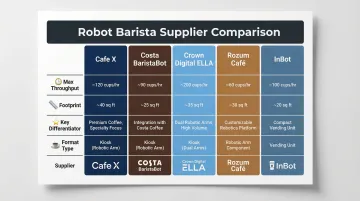
| Supplier | Format | Max Throughput | Footprint | Key Differentiator |
|---|---|---|---|---|
| Cafe X | Transparent Kiosk / 6-Axis Arm | 100+ cups/hr | Not publicly specified | "Ta-da" gesture, premium aesthetic |
| Costa BaristaBot | Enclosed Appliance | ~100 cups/hr | ~40 sq ft | App ordering with pickup alerts |
| Crown Digital (ELLA) | Transparent Kiosk / 6-Axis Arm | Up to 200 cups/hr | <5 sq meters | OLED advertising screen |
| Rozum Café | Countertop / Articulating Arm | ~25 cups/hr (450+/day) | 5 sq meters | Outright purchase, Nuova Simonelli |
| InBot (T Series) | Round Kiosk / Dual Arms | ≥30 cups/hr | 1.5m diameter | inBot OS latte art replication |
How We Chose the Best Robot Coffee Barista Suppliers
Our evaluation framework prioritized commercially deployed systems—not prototypes—with proven throughput data, defined ordering interfaces, and track records in real-world high-traffic environments. The common mistake buyers make? Selecting based on aesthetics or novelty alone rather than operational reliability and after-sales support.
Key evaluation criteria:
Throughput Capacity
Advertised throughput often conflates internal machine capacity with robotic arm speed—scrutinize the numbers. Most commercial systems produce 80–200+ cups per hour, equivalent to two to four human baristas working simultaneously. This directly impacts ROI and customer wait times.
Menu Flexibility & Ordering Integration
Verify the system can handle your full drink menu before committing. Key questions to ask:
- Customization depth: temperature control, milk alternatives, flavor shots
- Ability to add seasonal or specialty drinks post-deployment
- Ordering interface options: touchscreen, mobile app, or QR code
- Payment processing: card, phone, and cash support
- Compatibility with your existing POS system
Footprint, Installation & Maintenance
Physical constraints vary significantly by location. Account for plumbing, electrical, and structural load requirements early—some units need professional installation while others are closer to plug-and-play. On the maintenance side, daily upkeep typically runs 30–60 minutes; look for systems with remote telemetry and predictive maintenance to avoid unplanned downtime. Check maintenance SLAs and coverage areas before signing.
Acquisition Model
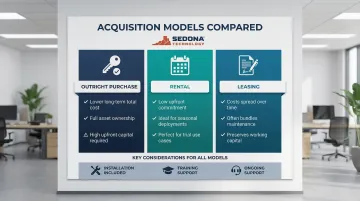
Three models are common in the market:
- Outright purchase — lower total cost of ownership for long-term, high-volume deployments
- Rental — reduces upfront capital expenditure; suitable for testing the concept or seasonal locations (minimum 2 months is typical)
- Leasing — spreads costs over time, often bundling maintenance and support
One factor buyers consistently overlook: whether installation, training, and ongoing support are included in the price. Sedona Technology, for example, offers all three acquisition models with free installation and training included—worth comparing against suppliers who charge these separately.
Conclusion
Robot coffee baristas have moved well beyond novelty status. They represent a practical, scalable solution for food service operators looking to reduce labor dependency, improve consistency, and serve high volumes without sacrificing quality. With the market growing at 8.5% annually and over 1,500 units deployed globally in 2024 alone, adoption is accelerating across airports, corporate campuses, hotels, and retail locations.
When evaluating suppliers, look beyond the machine itself. The full support ecosystem matters just as much as the hardware. Key factors to weigh:
- Installation assistance and training quality
- Maintenance SLAs and response time commitments
- Whether the acquisition model fits your cash flow and risk tolerance
- Hidden costs: annual software fees ($15,000+ in some cases) and daily restocking labor (30-60 minutes)
All of these feed into a realistic total cost of ownership — and that number often looks quite different from the sticker price.
Once you've mapped out those costs, choosing the right supplier becomes straightforward. Whether you're planning a single café deployment, an airport kiosk, or a multi-location rollout, Sedona Technology offers sales, rental, and leasing options (leasing available through a trusted partner) — with free installation and ongoing support included with every solution. Contact their team to discuss which system and acquisition model best fits your operational needs.
Frequently Asked Questions
How much does a robot coffee barista cost?
Prices vary widely by system complexity and supplier, from $75,000-$100,000 for countertop units like Rozum Café to $200,000-$285,000 for full enclosed kiosks like Cafe X. Rental and leasing options exist as alternatives to outright purchase, lowering the barrier for smaller operators or trial deployments.
How many cups per hour can a robot barista make?
Most commercial systems produce between 80 and 200+ cups per hour depending on drink complexity and system design. This is roughly equivalent to the output of two to four human baristas . Crown Digital's ELLA leads at 200 cups/hour, while systems prioritizing latte art (like InBot) sacrifice speed for visual quality.
Can a robot barista fully replace a human barista?
Robot baristas handle high-volume standardized drink production autonomously, but human staff are still needed for maintenance, restocking (30-60 minutes daily), and edge-case customer interactions. They work best as a complement to human staff, not a full replacement.
What maintenance does a robot coffee barista require?
Routine maintenance includes daily cleaning cycles, emptying wastewater and coffee grounds, refilling beans/milk/cups/syrups, and periodic software updates. Most systems require 30-60 minutes of daily labor, with automated cleaning handling espresso machine components.
Is it better to buy or rent a robot coffee barista?
Renting or leasing reduces upfront capital risk and suits operators testing the concept or running seasonal locations (typical minimum: 2 months). Purchasing makes more sense for long-term, high-volume deployments where total cost of ownership is lower.
Which locations are best suited for robot coffee baristas?
Airports, corporate offices, shopping malls, hotel lobbies, hospitals, and university campuses are ideal — all share consistent foot traffic, fast-service demand, and the ability to operate with minimal on-site staffing during peak or off-hours.