Introduction
Picture this: you're rushing through an airport terminal with 10 minutes before boarding. You tap a screen, select your latte with oat milk, and in under 60 seconds, a robotic arm hands you your drink—no line, no wait, no quality variation. Robotic baristas are operating right now in airports, hotels, corporate offices, and shopping malls across the country.
With labor costs running 31.7% to 36.5% of sales in food service, businesses are turning to automation as an operational necessity. Cafe robots deliver consistent quality, 24/7 availability, and throughput exceeding 100 cups per hour—all with minimal human supervision.
This article covers what cafe robots are, how they work, the benefits and trade-offs, where they're being deployed, and what you need to know before adding one to your business.
Key Takeaways
- Cafe robots automate the full coffee-making process—grinding, brewing, and milk frothing—with programmed precision
- High-performance systems produce 100–120+ drinks per hour with consistent quality every time
- Labor costs drop significantly; robots operate 24/7 without supervision or shift changes
- Faster peak-hour service means shorter lines and higher throughput in high-traffic venues
- Available to acquire via purchase, rental, or leasing—all with installation and support included
How Robotic Baristas Work
A robotic barista is an automated system — typically a multi-axis robotic arm or integrated kiosk — that handles the complete coffee-making process. These systems grind beans, tamp espresso, pull shots, froth milk, and dispense drinks with pre-programmed precision, eliminating the inconsistency of manual preparation.
Ordering and Pickup Process
Customers place orders through a touchscreen kiosk or mobile app. Once the order is submitted, the robot executes it autonomously. Some systems send a text notification when the drink is ready and use a PIN code or QR code for secure pickup. Cafe X uses a custom iPad-based POS integrated with Square for on-site orders, while their mobile app allows users to scan a QR code to order in seconds. Briggo's Costa BaristaBot holds finished drinks in a locked carousel and texts customers a code to unlock their beverage.
Hardware Components
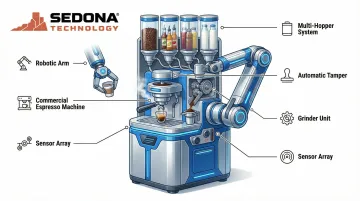
Commercial cafe robots integrate multiple systems:
- Professional espresso machines from manufacturers like WMF and Nuova Simonelli handle brewing
- Industrial-grade robotic arms manipulate portafilters, cups, and dispensers with repeatable accuracy
- Multiple hoppers manage beans, milk alternatives, and syrups for ingredient variety
- Weight sensors, cameras, and temperature monitors verify every parameter meets spec
Cafe X integrates two WMF 5000S+ commercial machines, a dynamic milk system, multiple hoppers, a nitrogen generator, and peristaltic syrup pumps. Rozum Cafe pairs a proprietary PULSE robotic arm with a Nuova Simonelli MDXS grinder, Puqpress 2 automatic tamper, and Nuova Simonelli Aurellia II espresso machine.
Achieving Consistency
Because every parameter — grind size, water temperature, extraction time, milk froth duration — is programmed and repeatable, robotic baristas eliminate human variability. This is especially valuable in high-volume environments where barista fatigue or rushed service during peak hours can compromise quality. Premium coffee roasters are more willing to partner with robotic systems precisely because of this quality guarantee.
The Human Role
That consistency doesn't run itself entirely. Most cafe robot setups still require one person on-site to restock ingredients, perform light cleaning, and handle customer service questions. The robot handles the repetitive brewing tasks, while the human focuses on higher-value interactions and operational oversight. Cafe X states that daily cleaning and restocking takes under 30 minutes, while Rozum Cafe requires about 60 minutes per shift for cleaning programs and workspace maintenance.
Types of Cafe Robots
Commercial robotic baristas fall into two main form factors, each suited to different venue types and operational goals.
Robotic Arm Systems
These feature a visible multi-axis industrial arm operating within a transparent kiosk. The arm manipulates portafilters, cups, and dispensers in full view of customers, creating a "theater" experience. Leading examples include Cafe X, Rozum Cafe, and Artly.
Best for: Hotel lobbies, shopping malls, and premium airport terminals where visual appeal and brand perception matter.
Fully Automated Kiosks
These are compact, self-contained units with no exposed arm—designed like high-end vending machines with hidden mechanisms. Examples include Briggo/Costa BaristaBot and Crown Coffee's Ella.
Ideal venues: Transit corridors, hospitals, corporate break rooms, and gate hold-rooms where throughput per square foot matters most.
Beverage Range and Customization
Most commercial cafe robots produce:
- Espresso-based drinks (lattes, cappuccinos, flat whites, cortados, Americanos)
- Matcha lattes
- Cold brew and nitro cold brew
- Hot chocolate and tea
Newer systems accommodate milk alternatives (oat, almond, soy) and allow customization of syrup levels and shot strength. Cafe X offers multiple bean types, syrups, and oat milk options, while Briggo systems allow customization of strength, temperature, and flavorings.
One quick distinction worth making: don't confuse these commercial systems with consumer-grade tools like the Cafelat Robot, a non-electric manual lever device designed for home enthusiasts — an entirely different category.
Key Benefits of Cafe Robots for Business Owners
Key Benefits of Cafe Robots for Business Owners
Speed and Throughput
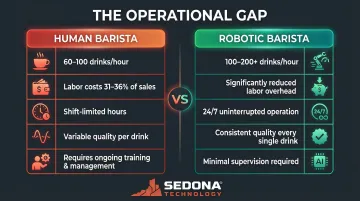
High-performance robotic baristas can easily outpace human baristas during peak hours. Cafe X claims its system can produce 100+ drinks per hour and up to 600 drinks per day, preparing up to seven drinks simultaneously. Crown Digital's Ella kiosk claims 200 cups per hour, while Rozum Cafe claims 400 cups per 24-hour shift.
For comparison, a highly skilled human barista typically produces 60 to 100 coffees per hour, depending on equipment and drink complexity. That gap matters most in high-traffic settings — airport terminals, corporate lobbies during morning rush, and event venues where demand spikes unpredictably.
Labor Cost Reduction
Labor costs consume 31.7% to 36.5% of sales in the food service industry, making labor one of the biggest targets for cost reduction. Robotic baristas reduce headcount requirements during peak hours and eliminate overnight shift premiums entirely.
While independent financial audits are limited, industry analysts note that automation can significantly alter unit economics. Automated drive-thru concepts like Octane Coffee report labor costs at half the rate of traditional models, and RobotLAB models suggest a 40% improvement in net income for casual dining chains that reallocate repetitive tasks to robots.
Consistency and Quality Control
Every drink is made to the exact same specification every time, eliminating variability from staff turnover, training gaps, or high-pressure rush periods. Premium coffee roasters and specialty brands are more willing to partner with robotic setups for exactly this reason — the quality guarantee is engineered in, not trained in.
24/7 Operation with Minimal Supervision
Unlike human staff, cafe robots can operate overnight or during off-peak hours without additional labor cost. This is especially valuable for hotels, airports, and office buildings that need round-the-clock coffee availability.
Briggo launched a 24/7 "Connected Coffee" experience at Austin-Bergstrom International Airport, and Cafe X operates unattended kiosks at San Francisco International Airport. Crown Digital's Ella operates at Singapore hospitals, providing round-the-clock service to healthcare workers and visitors.
Hygiene and Food Safety
Robotic systems follow consistent cleaning and preparation routines, reducing contamination risk. Customers can observe the process directly, which builds confidence in food handling standards.
Commercial systems must comply with FDA Food Code requirements and meet NSF/ANSI standards. Key certifications include:
- NSF 18 — Manual Food and Beverage Dispensing Equipment
- NSF 25 — Vending Machines
Both standards verify that equipment meets sanitation and public health requirements for foodservice use.
Challenges and Limitations to Consider
High Upfront Costs and ROI Timeline
Commercial robotic barista systems represent a significant capital investment. Businesses must weigh this against projected labor savings and daily volume. While some vendors market payback periods as short as 11 months, these are best-case scenarios that assume optimal placement and consistently high order counts.
Limited Customization and Experiential Factors
Cost is only part of the equation. Robotic baristas deliver speed and consistency, but they fall short on high-craft elements. Free-pour latte art, spontaneous upselling, and the conversational warmth of a skilled human barista are still beyond their capabilities. In third-wave coffee environments where the barista relationship is core to the brand, this gap matters.
Maintenance, Downtime, and Technical Complexity
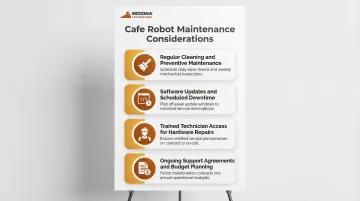
Beyond the customer experience, operational reliability is another consideration. Robotic systems come with ongoing maintenance demands that owners need to plan for:
- Regular cleaning and scheduled preventive maintenance
- Software updates that may require temporary downtime
- Access to trained technicians for hardware repairs
- Support agreements that add to your overall budget
Warranty coverage varies by vendor. Rozum, for example, includes a 1-year warranty with fault diagnosis and spare parts delivery within two weeks, with extended coverage available for an additional 10% of the product cost. Reviewing these terms before purchase helps avoid surprises.
Where Cafe Robots Are Being Used Right Now
Commercial deployments are concentrated in high-traffic, time-sensitive environments where speed and convenience outweigh the desire for a traditional cafe experience.
Airports and Transit Hubs
Airports are among the most natural deployment environments: high foot traffic, time-sensitive customers, long operating hours, and consistent demand throughout the day and night. A robotic kiosk can serve dozens of passengers per hour without the staffing challenges of 24/7 shift coverage.
Cafe X operates at San Francisco International Airport (Terminals 1 and 3), and Briggo has operated at SFO and Austin-Bergstrom.
Hotels and Hospitality
Hotels are integrating robotic baristas in lobbies, breakfast areas, and co-working lounges to offer premium coffee experiences without dedicated barista staff. The appeal is practical: overnight and early morning coverage is expensive to staff, and a robot doesn't call in sick.
Corporate Offices and Campuses
Companies are installing robotic coffee stations in break rooms and common areas as an employee perk. The National Coffee Association reports that 66% of American adults drink coffee daily, and 13% of past-day coffee drinkers consume their coffee at the workplace. That daily habit makes an on-site robotic barista a concrete, visible perk — not just a novelty.
Cafe X is deployed at JPMorgan Chase's headquarters in Ohio and the Tesla Gigafactory in Berlin.
Malls, Retail Spaces, and Stand-Alone Kiosks
Robotic baristas can operate as fully standalone units in shopping malls, retail corridors, or event venues, opening up locations where a traditional café build-out would be cost-prohibitive. Key examples include:
- Cafe X at the Glendale Galleria in California and the Museum of the Future in Dubai
- Crown Digital's Ella in Singapore MRT train stations, with rollout across 30 stations
How to Add a Robotic Barista to Your Business
Key Evaluation Factors
Before acquiring a cafe robot, assess:
- Expected daily order volume – Systems are optimized for high throughput; low-volume locations may not justify the investment
- Available floor space – Robotic arm kiosks require more footprint than enclosed units
- Power and water supply – Verify electrical capacity and water line access
- POS/app integration – Determine if the system needs to integrate with existing point-of-sale or mobile ordering platforms
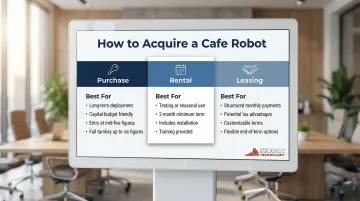
Acquisition Paths
| Path | Best For | Key Details |
|---|---|---|
| Purchase | Long-term deployment with capital budget | Entry-level units start in the mid-five figures; full turnkey installations with multiple machines and custom branding run six figures or more |
| Rental | Testing the technology or seasonal operations | Sedona Technology offers rentals with a minimum 2-month period, including free installation, training, and ongoing support |
| Leasing | Structured monthly payments with potential tax advantages | Available through partner leasing companies and customizable to your business requirements |
Post-Installation Support
Ensure your supplier provides:
- Staff training – Comprehensive instruction on operation, restocking, and basic troubleshooting
- Regular maintenance coverage – Scheduled service visits and preventive maintenance
- Responsive technical support – Fast response times to minimize downtime and lost revenue
Frequently Asked Questions
How much does a robotic barista cost?
Commercial robotic barista systems range from mid-five figures for entry-level units to $100,000+ for full turnkey installations. Rental options start around $369 per month, and leasing arrangements offer structured monthly payments for businesses that prefer to avoid a large upfront purchase.
Can a robotic barista make specialty drinks like lattes and cappuccinos?
Yes. Modern cafe robots produce a full espresso menu including lattes, cappuccinos, flat whites, cortados, Americanos, and matcha drinks. Most systems accommodate milk alternatives (oat, almond, soy) and allow customization of syrup levels and shot strength.
Do cafe robots replace human baristas entirely?
No. Most deployments retain one human staff member for restocking ingredients, performing cleaning routines, and handling customer service interactions. The robot handles the repetitive brewing tasks, not the full human role.
How fast can a robotic barista make coffee?
High-performance systems can produce 100–120+ drinks per hour, with individual drink preparation often taking under 60 seconds from order to cup. A typical human barista manages 2–3 drinks per minute at peak capacity — these systems sustain that pace without slowdown.
Where are robotic baristas currently being used?
The most common deployment environments are airports, hotels, corporate offices, shopping malls, university campuses, and hospital facilities—locations with high foot traffic, extended operating hours, and consistent demand.
Are cafe robots worth the investment for a small business?
Viability depends on daily order volume and local labor costs — businesses with high peak-hour demand see the fastest returns. Rental and leasing models let operators test performance before committing to a full purchase.