Introduction
Businesses across restaurants, hotels, airports, and warehouses face mounting pressure from labor shortages, rising wages, and customer expectations for faster service. Service robots address all three directly—reducing wait times, cutting overtime costs, and keeping operations running consistently around the clock. Yet for first-time buyers, the landscape is overwhelming: dozens of manufacturers, varying capabilities, and an unclear mix of suppliers and distributors.
This guide gives you a clear path forward. You'll learn the core categories of service robots, which manufacturers lead each segment, how suppliers differ from manufacturers, and what to evaluate when sourcing a solution for your business. Whether you're exploring your first robot or scaling a multi-location deployment, this roadmap will help you make an informed decision.
Key Takeaways
- The global service robotics market is projected to reach $107.75 billion by 2030, growing at 12.4% annually, driven by labor costs, e-commerce demand, and AI advancements
- Service robots span distinct categories—food delivery, cleaning, logistics, and hospitality—with different manufacturers dominating each
- Manufacturers build the robots; suppliers handle sourcing, installation, training, and ongoing support for businesses
- Choosing the right solution depends on your industry, use case, budget, and whether you prefer to buy, rent, or lease
- The shift to Robotics-as-a-Service (RaaS) and flexible rental models makes autonomous robots accessible to mid-size businesses without large upfront capital
What Are Service Robots? Types and Categories
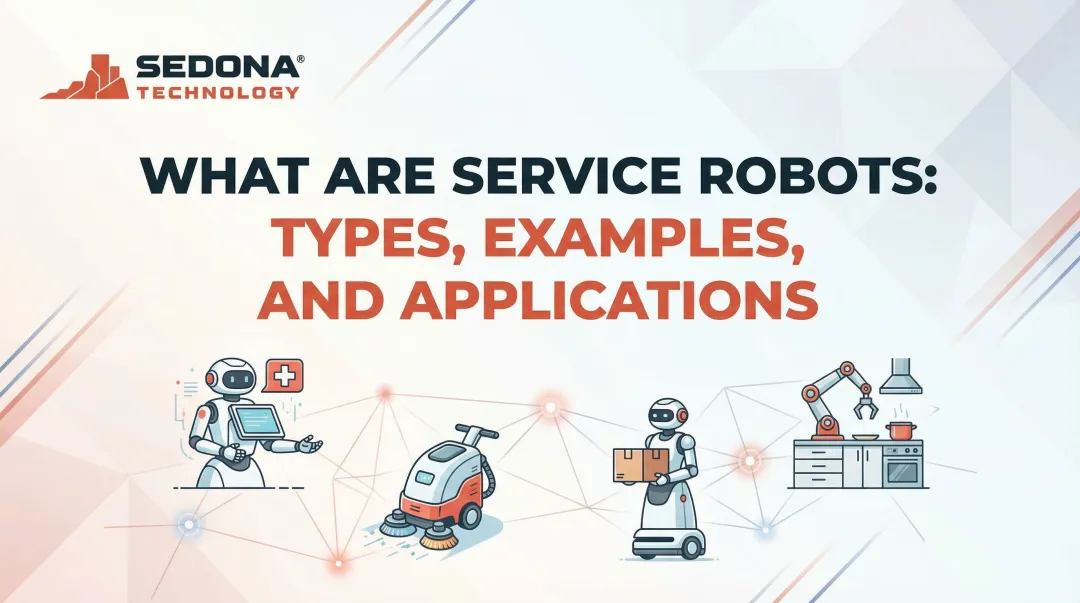
Service robots are autonomous or semi-autonomous machines that assist humans in professional or consumer environments. Unlike industrial robots confined to fixed production lines, they operate in dynamic, human-occupied spaces—restaurants, lobbies, airports, and warehouse floors.
They navigate around people, adapt to changing layouts, and handle repetitive tasks without constant oversight.
The ISO 8373:2021 standard defines a service robot as a machine "that performs useful tasks for humans or equipment." The International Federation of Robotics (IFR) draws a clear line between the two categories: industrial robots are fixed manipulators operating inside safety fencing, while service robots—including Autonomous Mobile Robots (AMRs)—work safely alongside people without those barriers.
That distinction is showing up in the numbers. In 2024, almost 200,000 professional service robots were sold globally—a 9% increase from the prior year. The IFR Service Robot Database currently tracks 921 service robot producers worldwide.
Key Types of Service Robots for Businesses
- Food Delivery & Serving Robots — transport dishes from kitchen to table, freeing servers to focus on guest interaction during peak hours
- Hospitality & Concierge Robots — greet guests, deliver room amenities, and handle automated in-room service requests
- Autonomous Cleaning Robots — scrub floors and vacuum carpets in retail spaces, airports, and commercial buildings on consistent schedules
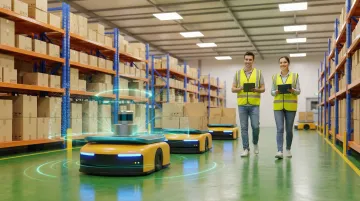
- Logistics & Material-Handling Robots — move inventory across warehouse floors and factory lines, working alongside humans without safety fencing
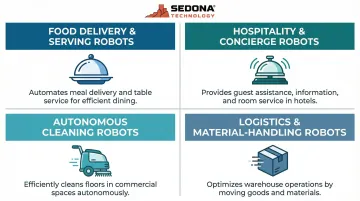
Many of today's service robots are designed for 24/7 operation, making them a practical fit for businesses managing shift labor and overtime costs.
Top Service Robot Manufacturers: Who Makes What?
No single manufacturer dominates all categories. Instead, different companies specialize in specific use cases and deployment environments. The global service robotics market includes both legacy industrial brands expanding into service applications and newer robotics-first companies built specifically for hospitality, food service, and logistics. Here's how the leading manufacturers break down by category.
Food Service and Restaurant Robots
Bear Robotics offers the Servi and Servi Plus models, designed for heavy-duty bussing and delivery. The Servi carries 66 lbs (30 kg) across two trays and one bus tub, while the Servi Plus handles 88 lbs (40 kg) across 2-4 customizable trays. Both feature 100% self-driving navigation, near-zero blind spot detection, and 10-12 hour battery life.
Pudu Robotics provides the BellaBot and PuduBot2, both using Dual SLAM (Laser + Visual) navigation. The PuduBot2 carries 88 lbs across up to seven trays, features marker-less deployment, and offers 12-15 hour battery life. Its dual LiDAR system enables navigation in tight spaces as narrow as 80 cm.
Keenon Robotics manufactures the DINERBOT series, including the T8 model optimized for ultra-narrow 55 cm passages. It carries 44 lbs (20 kg) and features three stereo vision sensors capable of detecting obstacles under 5 cm. Battery life extends up to 15 hours, making it ideal for all-day restaurant operations.
Hospitality and Hotel Service Robots
SoftBank Robotics discontinued its humanoid Pepper robot in 2020 after limited real-world adoption. The company refocused on the Whiz commercial cleaning robot — a move that mirrors a broader industry shift away from novelty interactions toward practical, repeatable tasks.
Savioke (Relay Robotics) offers the Relay2 robot with a 10-gallon (41-liter) cargo bay capable of carrying pizza boxes and delivery bags. Relay robots feature proprietary elevator integration supporting Otis, Schindler, TK, and Mitsubishi systems, allowing 24/7 autonomous multi-floor navigation. The company has completed over 1.5 million deliveries across hundreds of hotels.
LG Electronics produces the CLOi ServeBot (model LDLIM31), a door-type service robot featuring four internal compartments, each holding up to 30 kg. It includes independent suspension for spill-free beverage transport, automatic doors, and elevator utilization capabilities.
Autonomous Cleaning Robots
Avidbots manufactures the Neo 2W, an industrial-grade floor scrubber covering up to 42,000 sq ft/hr (3,900 sq m/hr). It features a 6-hour runtime, swappable batteries, and 109L clean / 135L dirty tanks. The Avidbots Autonomy platform and Command Center provide real-time remote monitoring and performance analytics.
Brain Corp powers autonomous floor care robots deployed in retail and airports through its BrainOS platform. The Tennant T380AMR, powered by BrainOS, covers up to 33,440 sq ft per charge and features teach-and-repeat routing with obstacle and people avoidance.
SoftBank Robotics' Whiz vacuum covers 5,000-6,000 sq ft/hr (465-557 sq m/hr) with a 3-hour runtime and 4.0L dust bag capacity. The Whiz Connect SaaS platform provides data-driven analytics and SMS alerts. In a 2025 ISSA benchmarking survey, 43% of facility management respondents reported plans to purchase autonomous cleaning equipment within the next 12 months.
Warehouse and Logistics Service Robots
Locus Robotics operates the LocusONE platform, orchestrating fleets of Origin (80 lb payload) and Vector (600 lb payload) AMRs. Using a "Robots-to-Goods" model, Locus has surpassed 1 billion picks at DHL facilities, driving 30-180% increases in units picked per hour (UPH). Deployments typically go live in 4-6 weeks.
Mobile Industrial Robots (MiR) produces heavy-duty collaborative AMRs, including the MiR600 (1,322 lbs payload) and MiR1000 (2,200 lbs payload). These robots navigate highly dynamic environments without exterior safety measures, making them ideal for shared factory and warehouse spaces.
Aethon TUG (acquired by ST Engineering in 2017) automates internal material transport in hospitals and manufacturing. The T3 model carries 750 lbs, while the T3XL carries 1,000 lbs. Both feature omni-directional drive and native elevator integration for multi-floor operations.
Understanding the Role of Service Robot Suppliers
Manufacturers design and build robot hardware and software. Suppliers source robots from one or more manufacturers and handle delivery, installation, training, and ongoing support for the end customer. Most businesses don't buy direct from manufacturers—they work through suppliers who tailor the solution to their environment.
What a Good Supplier Relationship Looks Like
A quality supplier does more than drop off a robot. Look for these four services before signing:
- Pre-sale consultation — assesses your environment and recommends the right robot for your use case, not just what's in stock
- Professional installation — includes site mapping, environment testing, and system integration before handover
- Staff training — covers operating procedures, error handling, task scheduling, and basic maintenance
- Ongoing technical support — phone, email, or on-site help with clear response times and availability hours
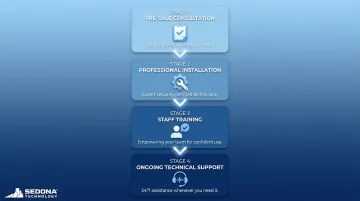
Sedona Technology includes all four of these services at no extra cost. That support structure pairs with flexible acquisition options—so the right model depends on your timeline and budget.
Why Acquisition Model Matters
Buying suits long-term deployments where the use case is proven. If you're planning multi-year operation, purchasing minimizes total cost of ownership over time.
Renting works well for first-time pilots, seasonal operations, or event-based deployments—flexibility without the full upfront commitment. Sedona Technology's rental model starts at $349/month (minimum 2-month term) and includes all support services.
Leasing keeps your fleet upgradeable as the technology improves, spreading cost without large capital expenditures. Sedona Technology offers leasing through a trusted partner for businesses that want predictable monthly costs.
Evaluate which model fits your cash flow and operational timeline before committing.
How to Choose the Right Service Robot for Your Business
Start with Use Case Clarity
Before evaluating any manufacturer or supplier, define the specific problem being solved. Are you reducing wait staff hours, improving guest delivery speed, automating floor cleaning, or moving inventory across a warehouse? The answer determines which robot category is relevant and which manufacturers to consider.
Assess Operational Environment Fit
Indoor vs. outdoor: Most service robots are designed for indoor use only.
Floor surface types: Carpeted vs. hard floors impact cleaning robot selection; uneven surfaces may limit delivery robot navigation.
Space layout: Tight corridors (under 60 cm) require compact models like the Keenon T8, while open floor plans accommodate larger payload robots.
Foot traffic: High-traffic environments require advanced obstacle avoidance and 3D omnidirectional sensors.
Some robots use LiDAR-based SLAM for dynamic navigation, while others require mapped routes. Modern AMRs use Dual SLAM (Visual + Laser) powered by LiDAR and 3D vision. The cost of LiDAR sensors has fallen by 99% over the past decade to roughly $500, making it the standard for commercial robots. Dual SLAM allows robots to navigate dynamic, unstructured environments without requiring physical infrastructure like magnetic tape or reflectors.
Evaluate Payload and Task Capacity
For delivery robots: Typical tray payloads range from 20 kg (44 lbs) on compact models up to 40 kg (88 lbs) on heavy-duty models. Consider how much weight must be carried per trip and how many trips are required during peak hours.
For cleaning robots: Commercial vacuums cover 5,000-6,000 sq ft per hour, while industrial scrubbers can cover up to 42,000 sq ft per hour. Match coverage capacity to your facility size and cleaning frequency requirements.
For logistics robots: Capacities range from 36 kg (80 lbs) for collaborative piece-picking up to 1,000 kg (2,200 lbs) for pallet-moving AMRs. Assess typical load weight and transport distance to determine the right model.
Address Integration and Support Requirements
A robot that can't connect to your existing systems caps its own value. Before committing to a supplier, confirm which integrations are supported:
- POS systems — essential for food service robots managing order-triggered deliveries
- Hotel PMS platforms — Savioke Relay integrates directly with Newmarket HotSOS to auto-dispatch robots when guests request amenities
- Warehouse management systems — required for logistics robots coordinating with inventory software
- Oracle Hospitality's Integration Platform — connects property management systems directly to robots, powering 40% of smart hotel automations
Also confirm whether the supplier provides integration support and ongoing software updates. Strong fleet management software lets businesses monitor performance, schedule tasks, and scale deployments over time.
Consider Total Cost of Ownership vs. Sticker Price
Acquisition cost is only part of the equation. Factor in installation, training, maintenance, connectivity, and potential downtime costs. Businesses that work with suppliers offering bundled support (as opposed to buying direct from overseas manufacturers) often see lower total cost and get up and running faster.
For hotel delivery robots, benchmarks for success include a >95% delivery success rate, a 20-50% reduction in time-to-serve, and keeping maintenance incidents below 5%.
Service Robotics Market Trends Shaping Business Adoption
The global service robotics market was valued at $46.99 billion in 2023 and is projected to reach $107.75 billion by 2030 (CAGR: 12.4%). Key growth signals from 2024:
| Segment | Units Sold | Year-over-Year Change |
|---|---|---|
| Transportation & Logistics | 102,900 | +14% |
| Professional Cleaning | 25,000+ | +34% |
| Hospitality | 42,000 | -11% |
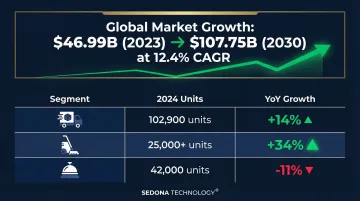
Hospitality's dip reflects a shift in buyer expectations — operators are moving away from novelty interactions toward robots that handle practical delivery tasks reliably.
Labor Cost Pressures Drive Adoption
Between 2020 and early 2025, average U.S. hospitality wages rose nearly 35%, from $16.84 to $22.70 per hour. Combined with annual turnover rates of 70-80%, operators are forced to adopt automation to protect profit margins and maintain service levels. At those labor economics, the ROI calculation for automation becomes hard to ignore.
AI and Sensor Technology Enable Broader Deployment
Improved obstacle avoidance, natural language interaction (for hospitality robots), multi-robot fleet coordination, and cloud-based remote monitoring are all enabling broader adoption across mid-size businesses that previously couldn't justify the investment. Modern robots feature 3D omnidirectional obstacle avoidance with response times as fast as 0.5 seconds — fast enough to operate safely in busy restaurant floors, hotel corridors, and warehouse aisles without constant supervision.
Flexible Acquisition Models Lower Barriers to Entry
The Robot-as-a-Service (RaaS) market is projected to grow from $2.4 billion in 2025 to $12.4 billion by 2035 (18.0% CAGR). The IFR notes that the global RaaS fleet grew by 31% in 2024. RaaS shifts robotics from a CapEx investment to an OpEx subscription, reducing upfront costs by 50-60% and putting robotics within reach of smaller operators. Restaurants, hotels, and retailers can now pilot automation through rental or subscription arrangements — testing real-world performance before any long-term commitment.
Frequently Asked Questions
What companies make service robots?
Leading service robot manufacturers vary by category. Bear Robotics and Pudu Robotics dominate food service with heavy-duty delivery robots. SoftBank Robotics and LG Electronics serve hospitality with concierge and delivery solutions. Avidbots and Brain Corp lead commercial cleaning with autonomous scrubbers and vacuums. Aethon and Locus Robotics specialize in logistics and warehouse service.
Who are the big 4 robot manufacturers?
The "Big 4" in industrial robotics are FANUC (11% market share), ABB (13%), KUKA (6%), and Yaskawa (8%). In service robotics, the leading names differ by segment — SoftBank Robotics, iRobot, and Boston Dynamics are more prominent in non-industrial applications.
What is the difference between a service robot and an industrial robot?
Industrial robots operate in controlled, fenced environments performing repetitive manufacturing tasks like welding or assembly. Service robots are designed to work in dynamic, human-occupied spaces like restaurants, hotels, and warehouses—assisting with delivery, cleaning, guiding, or logistics rather than assembly or welding. Service robots navigate safely alongside humans without requiring safety caging or barriers.
How much does a service robot cost to acquire?
Costs vary widely by type and acquisition model. Food delivery robots typically range from a few thousand to tens of thousands of dollars to purchase. Rental and leasing options make entry more affordable: food service robots rent for $300–$500 per month, commercial cleaning robots start at $349 per month, and logistics AMRs lease for approximately $711 per month. Providers like Sedona Technology offer all three models — purchase, rental, and leasing — with free installation and training included.
Is it better to buy or rent a service robot?
Buying offers lower long-term cost for stable deployments where you're confident in the ROI. Renting provides flexibility for seasonal businesses, short-term needs, or pilot testing before committing. Leasing balances cost spread with the ability to upgrade as technology evolves.
What types of service robots are used in restaurants and hotels?
Common types include:
- Food delivery robots — transport dishes from kitchen to table, reducing server workload during peak hours
- Concierge robots — greet and guide guests in hotel lobbies
- In-room delivery robots — bring amenities to rooms with elevator integration and contactless delivery
- Autonomous cleaning robots — maintain floors in lobbies and common areas
All operate with minimal human supervision, enabling 24/7 service.