Introduction
Floor cleaning eats up a surprising chunk of the week—time most people would rather spend on work, family, or anything else. Robot vacuums have turned that manual grind into a background task, and you no longer need to spend $1,000+ to get capable, reliable performance.
Today's sub-$300 robot vacuums now include capabilities that cost four times as much just a few years ago. LiDAR navigation, self-emptying docks, and mop-vacuum hybrids have all migrated from premium to budget territory. This guide reviews the top budget robot vacuums available in 2026, breaks down the key features that actually matter, and helps you match the right model to your home's floor type, layout, and cleaning needs.
Key Takeaways
- Budget models under $300 now offer LiDAR navigation, auto-empty docks, and hybrid mopping
- The TP-Link Tapo RV30 Max Plus offers the best value: self-emptying dock and systematic LiDAR mapping
- Prioritize suction power (2,500 Pa minimum), navigation type, and battery life (120+ minutes)
- Skip no-name brands under $150—discounted models from Roborock, Shark, eufy, or Tapo offer better longevity
- Match your pick to your space—small apartments and large pet-friendly homes have very different feature needs
Overview of Budget Robot Vacuums
For this guide, "budget" means robot vacuums regularly priced at $300 or less. This price range has expanded significantly in capability over the past three years, driven by hardware cost deflation and fierce competition among manufacturers. Features once reserved for $800+ models — systematic room mapping, voice assistant integration, and scheduled cleaning — are now standard on entry-level bots.
What budget bots can do:
- Navigate systematically using gyroscope or LiDAR sensors
- Schedule cleaning sessions via smartphone app
- Integrate with Alexa and Google Assistant voice commands
- Run for 90-150 minutes on a single charge
- Handle mixed floor types (hard floors and low-pile carpet)
What they cannot do (compared to premium models):
- Identify and avoid specific objects like pet waste, socks, or cables
- Offer AI-powered obstacle recognition
- Provide multi-level mapping for homes with stairs
- Deliver the same deep-cleaning power as full-size upright vacuums
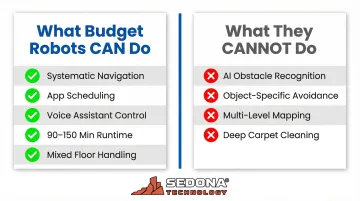
Budget robots work best as maintenance tools — keeping floors consistently tidy between manual deep cleans.
Top 5 Best Budget Robot Vacuums
The following models were selected based on real-world cleaning performance, navigation reliability, battery life, app usability, and overall value. Each was tested across hard floors, carpet, and mixed-surface environments.
TP-Link Tapo RV30 Max Plus — Best Overall
The Tapo RV30 Max Plus is the first sub-$300 robot vacuum to combine LiDAR navigation with a self-emptying dock — a combination previously found only in mid-range models costing $500 or more. Developed by TP-Link under its Tapo smart home line, this model vacuums and mops effectively while navigating systematically and emptying its own dustbin into a 3-liter bag.
LiDAR mapping enables the RV30 Max Plus to create accurate floor plans, set virtual walls, and schedule room-specific cleanings. Independent testing shows it completes whole-home cleans in 68–69 minutes with minimal intervention. The self-emptying dock holds up to 60 days of debris, making it the most low-maintenance pick in this price range.
| Attribute | Details |
|---|---|
| Price Range | $229.99 (Amazon, verified March 2026) |
| Key Specs | 5,300 Pa suction, LiDAR navigation, self-emptying dock (3L bag), mop-vacuum hybrid, 98-minute battery, 13" × 3.9" dimensions |
| Best For | Buyers seeking maximum features at budget price; homes with mixed carpet and hard floors |
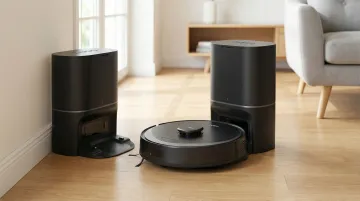
Tapo RV20 Max — Most Affordable Mop + Vacuum Combo
The Tapo RV20 Max offers **embedded LiDAR navigation** in an ultra-slim 3.27" profile, making it one of the thinnest LiDAR-equipped robots available. This lower-cost sibling to the RV30 sacrifices the self-emptying dock but retains systematic mapping, virtual walls, and voice control compatibility.
Its low profile allows it to clean under furniture that blocks taller models. At $119.99, it's the most affordable way to get LiDAR navigation and hybrid mopping in a single device — ideal for first-time buyers who want smart features without the premium price tag.
| Attribute | Details |
|---|---|
| Price Range | $119.99 (Amazon, verified March 2026) |
| Key Specs | 5,300 Pa suction, embedded LiDAR, mop-vacuum hybrid, 90-minute battery, 13" × 3.27" dimensions, no self-emptying |
| Best For | First-time buyers; homes with low-clearance furniture; shoppers who don't need auto-empty |
iRobot Roomba Combo Essential — Best Affordable Roomba
The Roomba Combo Essential is the most affordable model in iRobot's lineup, offering vacuum and mop capability with the reliability of the well-established Roomba ecosystem. While it lacks advanced mapping features like Smart Maps or Keep-Out Zones, it navigates thoroughly using infrared and gyroscope sensors.
With 127 minutes of tested battery life, it excels on hard floors and handles low-pile carpet effectively. It's the natural choice for apartment dwellers or existing iRobot users who want a budget-friendly entry point into the ecosystem.
| Attribute | Details |
|---|---|
| Price Range | $274.99 (iRobot MSRP, verified March 2026) |
| Key Specs | Gyro + infrared navigation, mop-vacuum hybrid, 127-minute battery, 12.99" × 3.15" dimensions |
| Best For | Apartment dwellers; Roomba ecosystem users; homes with mixed carpet and hard flooring |
Eufy RoboVac 11S — Best for Quiet, Compact Cleaning
Made by Eufy (an Anker brand), the RoboVac 11S is one of the quietest and most compact budget robots available. At just 2.8" tall, it slips under furniture that blocks nearly every other model on this list.
The 11S uses BoostIQ technology to automatically increase suction when it detects carpet. It lacks app or voice control (using a physical remote instead), but delivers strong cleaning performance at an entry-level price. A solid pick for noise-sensitive households or anyone who doesn't need smart home integration.
| Attribute | Details |
|---|---|
| Price Range | $149.99 (Amazon, verified March 2026) |
| Key Specs | 2,000 Pa suction, bump-and-roll navigation with BoostIQ, vacuum only, 100-minute battery, 12.8" × 2.8" dimensions |
| Best For | Noise-sensitive users; homes with very low-profile furniture; minimalists who don't need app control |
Shark Ion Robot Vacuum — Best for Pet Hair
Manufactured by SharkNinja, the Shark Ion is a no-frills vacuum-only bot with standout pickup results for pet hair on both hard floors and carpet. It excels in particle pickup tests with minimal brush tangles and offers basic app and Alexa/Google Assistant voice control.
Independent testing shows it picks up pet hair more effectively than competitors in this price range. Navigation is slow (bump-and-roll), but the tested battery life of 144 minutes is the longest runtime on this list. SharkNinja's repairability support and widely available replacement parts add practical long-term value.
| Attribute | Details |
|---|---|
| Price Range | $149.99 (Amazon, verified March 2026) |
| Key Specs | Bump-and-roll navigation, vacuum only, 144-minute battery, 12.4" × 3.54" dimensions, widely available replacement parts |
| Best For | Pet owners dealing with fur and dander; small homes where slow navigation isn't a concern; buyers prioritizing repairability |
How We Chose the Best Budget Robot Vacuums
Our evaluation framework prioritizes real-world performance over manufacturer marketing claims. Each robot was assessed on these criteria:
Key Evaluation Factors:
- Suction power at or above 2,500 Pa (though Pa ratings correlate poorly with actual debris pickup — more on this below)
- Navigation type: LiDAR outperforms gyroscope, which beats bump-and-roll for coverage efficiency
- Bin capacity of 450 ml or more to reduce manual empties
- Battery runtime of at least 120 minutes for whole-home coverage
- Mopping capability where applicable for hybrid models
- App usability: scheduling, virtual walls, and room-specific cleaning
- Parts availability from established brands with accessible replacements
These criteria also informed three buying mistakes worth avoiding before you spend a dollar.
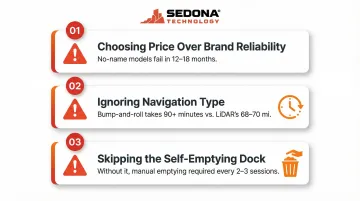
Common Buyer Mistakes to Avoid:
Choosing the lowest price over brand reliability — No-name models under $150 often lack replacement parts and fail within 12-18 months. A discounted older model from Roborock, eufy, or Tapo delivers better longevity at the same price point.
Ignoring navigation type in multi-room homes — Bump-and-roll models take significantly longer to clean and frequently get stuck. Independent testing shows LiDAR models finish whole-home cleans in 68-70 minutes, while bump-and-roll models need 90+ minutes and occasional human rescue.
Skipping the self-emptying dock — Without auto-empty, you'll manually empty the bin every 2-3 sessions. Self-emptying docks keep suction consistent for 60+ days between interventions.
Why Sales on Older Models Offer Better Value
Manufacturers release new models annually, often with minimal real improvements. A discounted 2024 Roborock or eufy model regularly outperforms a brand-new no-name bot at the same price. Watch deal pages during Black Friday, Prime Day, and seasonal sales — that's where the best per-dollar performance hides.
Navigation Type Matters More Than Suction Power
Pa ratings get heavy marketing, but independent testing tells a different story: an 18,000 Pa model picked up only 37.7% of sand on carpet, while an older 8,000 Pa model picked up 45.6%. Brush roll design, airflow path, and navigation efficiency drive real-world cleaning performance far more than raw suction numbers.
Frequently Asked Questions
What is the best budget robot cleaner?
The TP-Link Tapo RV30 Max Plus is the top pick for under $300, combining LiDAR navigation, a self-emptying dock, and mop-vacuum hybrid capability. It offers features previously found only in mid-range models, making it the best all-around value for most households.
Do floor cleaning robots actually work?
Yes, robot vacuums reliably maintain floor cleanliness between deep cleans. Consumer Reports confirms that while robots cannot match the deep-cleaning power of upright vacuums for embedded carpet dirt, they excel as hassle-free daily maintenance tools that remove surface debris effectively.
Which robot floor cleaner is the best?
For most households, the Tapo RV30 Max Plus leads at $229.99. If budget isn't a constraint, the Roborock Saros series adds advanced obstacle recognition and multi-level mapping for $1,000+. Match your choice to floor type, home size, and must-have features.
What is the name of the robot that cleans floors?
Robot vacuums (also called robovacs or robot floor cleaners) are the general product category. Popular brand names include Roomba (by iRobot), Roborock, eufy, Shark, and Tapo. Each brand offers multiple models with varying features and price points.
What features should I look for in a budget robot vacuum?
Focus on these five specs:
- Suction power — 2,500 Pa minimum
- Navigation — LiDAR preferred for multi-room homes
- Bin size — 450 ml+ to reduce emptying frequency
- Battery life — 120+ minutes for whole-home coverage
- App/voice control — for scheduling and virtual boundaries
Is a robot vacuum worth it for a small apartment?
Yes—small apartments are ideal for budget robots. Navigation limitations matter less in compact spaces, and even basic bump-and-roll models can thoroughly cover 500–800 square feet on a single charge. Models like the Tapo RV20 Max or Eufy 11S offer excellent value for apartment dwellers.
Conclusion
The best budget robot vacuum depends on your home size, floor type, and lifestyle. The Tapo RV30 Max Plus leads for all-around capability with its self-emptying dock and LiDAR navigation, while the Shark Ion excels for pet hair pickup, the Eufy 11S wins for ultra-compact cleaning, and the Roomba Combo Essential serves existing iRobot ecosystem users.
Consumer robot vacuums are just one end of the automation spectrum. Hotels, restaurants, warehouses, and airports are increasingly deploying purpose-built cleaning robots to maintain facilities around the clock with minimal staff involvement.
Sedona Technology provides commercial-grade robotic cleaning solutions — with laser SLAM navigation and real-time performance reporting — available through sales, rental (starting at $349/month), or leasing. Free installation, training, and ongoing support are included.
Ready to automate your floor cleaning? Use the buying criteria to match your top pick to your specific needs, and watch for seasonal sales on older models from established brands to maximize value. The right budget robot vacuum can reclaim hours of your week — the picks above give you a clear starting point at every price level.