Introduction
Autonomous robots—whether delivering meals across a restaurant floor, ferrying linens through a hotel, or moving materials through a warehouse—are only as reliable as the maintenance behind them. When they fail, the consequences are immediate: frustrated diners, safety hazards in high-traffic spaces, halted production lines.
Those failures rarely come without warning—they come from skipped maintenance. Reactive upkeep leads to unplanned downtime, costly emergency repairs, and shortened equipment lifespan. According to Siemens' 2024 downtime study, unplanned robot downtime costs automated facilities between $1,000 and $10,000 per minute, with reactive repairs running 3 to 5 times more expensive than planned interventions.
This guide breaks down the four types of robot maintenance, the warning signs to watch for, and a complete inspection schedule and checklist you can put to use immediately.
Key Takeaways
- Regular robot maintenance prevents costly breakdowns and extends equipment lifespan — in some cases by up to 80%
- Know which maintenance type to use: preventive, corrective, predictive, and overhaul each serve a distinct purpose
- Warning signs include performance drops, unusual noises, recurring error codes, and increased power consumption
- Maintenance frequency depends on usage intensity: daily checks for 24/7 operations, with deeper inspections monthly and full servicing annually
- Following a structured inspection checklist is the most reliable way to catch problems before they cause unplanned downtime
Why Robot Maintenance Matters
Robots degrade without consistent care, just like any precision equipment. Reactive maintenance costs 3 to 5 times more than preventive maintenance when you factor in downtime, cascading damage, and emergency service fees. Poor maintenance strategies can reduce an asset's productive capacity by 5% to 20%.
Efficiency Losses Add Up Fast
A poorly maintained robot slows throughput, produces inconsistent results, and disrupts surrounding workflows. The downstream effects vary by setting:
- In restaurants, a stalled delivery robot blocks service flow and creates bottlenecks during peak hours
- In warehouses, a malfunctioning transport robot halts material movement and delays production schedules
- In hotels, a broken service robot pushes tasks back onto staff — undoing the efficiency gains the robot was purchased to deliver
Safety and Liability Are on the Line
Malfunctioning robots in shared spaces — hotels, airports, factories — pose real risks to people and property. A Coco delivery robot caused property damage in Los Angeles in February 2026, and a cyclist sued an autonomous delivery robot company after a collision in Austin. These incidents show that maintenance is a compliance and liability issue, not just an operational one.
That's why having structured support matters from day one. Sedona Technology includes free installation, training, and ongoing support with all robot solutions — giving businesses a knowledgeable resource for building a defensible maintenance plan rather than figuring it out under pressure.
Types of Robot Maintenance
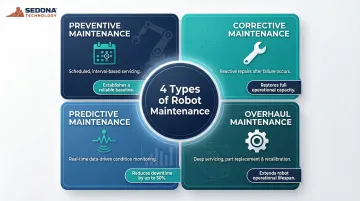
Maintenance is not one-size-fits-all. The right approach depends on the robot type, usage intensity, operating environment, and budget. Understanding the four core maintenance types helps you build a plan that balances cost, risk, and uptime.
Preventive Maintenance
Preventive maintenance is scheduled upkeep performed at regular intervals regardless of robot condition. Common tasks include:
- Visual inspections for physical damage
- Cleaning sensors, cameras, and exterior surfaces
- Lubricating joints and moving parts
- Updating software and firmware
This approach works best for predictable usage patterns, moderate workloads, and operations where downtime windows can be planned in advance — it's the baseline most operators should follow. For every dollar spent on preventive maintenance, companies can expect a more than 545% return.
Corrective Maintenance
Corrective maintenance is reactive — repairs performed after a failure or malfunction has already occurred. It's triggered by error alerts, unexpected shutdowns, or operator-reported issues.
Over-relying on it leads to unplanned downtime, higher repair costs, and cascading damage to other components. A failed drive motor can damage the gearbox; a worn bearing can destroy the actuator. Treat corrective maintenance as a fallback, not a strategy.
Predictive Maintenance
Predictive maintenance uses real-time data — sensor readings, performance metrics, error logs — to anticipate when service is needed, not just when the calendar says it is.
Most modern robots with onboard diagnostics support this approach. Predictive maintenance reduces unplanned downtime by up to 50% and cuts overall maintenance costs by 10% to 40%. It catches issues earlier than scheduled checks alone, reducing unnecessary maintenance while preventing catastrophic failures.
Overhaul Maintenance
Overhaul maintenance is deep, comprehensive servicing that includes:
- Replace worn or end-of-life parts
- Recalibrate the full system
- Inspect joints and replace seals
- Check wiring harnesses for wear or damage
Schedule an overhaul after a set number of operating hours (per manufacturer guidelines), following a major collision or error event, or when the robot consistently underperforms despite routine upkeep. Combining predictive and preventive maintenance can extend fixed asset lifespan by 35% to 80%.
Signs Your Robot Needs Maintenance
Catching maintenance needs early prevents minor issues from becoming expensive repairs. These practical indicators signal that maintenance may be overdue—especially useful for operators without formal monitoring systems.
Performance and Output Degradation
Watch for these early warning signs:
- Reduced speed or longer cycle times
- Inconsistent task completion
- Measurable drop in output quality
- Increased power consumption for the same workload
A motor with a misalignment or bearing defect can draw 5% to 10% more amperage than a healthy motor to perform the same work. This increased energy consumption often points to friction in joints, worn actuators, or software inefficiency.
Unusual Behavior and Error Indicators
Watch for both physical and digital red flags:
- Abnormal sounds (grinding, clicking, humming)
- Vibrations outside normal range
- Unexpected pauses or erratic movements
- Failure to complete programmed tasks
- Recurring error codes
- System alerts or warning messages on the control panel
- Safety shutdowns
Never dismiss or repeatedly override these warnings. Each one is the robot telling you something is wrong before it becomes a failure.
Recurring Downtime and Temporary Fixes
When the same issue keeps reappearing—or when a "quick fix" (restart, manual reset) becomes routine—something deeper is wrong. Frequent manual interventions and escalating support calls are reliable signs that a scheduled maintenance check or full overhaul is overdue.
Robot Maintenance Schedule and Inspection Checklist
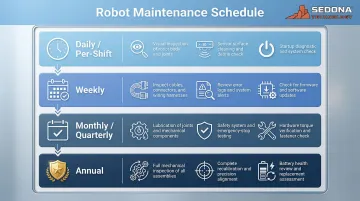
Maintenance frequency is not universal. It depends on daily operating hours, the environment (dusty, humid, high-traffic), and the manufacturer's specifications. Businesses running robots 24/7 need more aggressive schedules than low-usage deployments.
Maintenance Frequency Table
| Frequency | Tasks |
|---|---|
| Daily / Per-Shift | • Visual inspection for physical damage or debris • Check that all safety sensors and emergency stops are functional • Verify the robot completes its startup routine without errors • Wipe down exterior surfaces if operating in food service or dusty environments • Clean LiDAR sensors, RGB-D cameras, and image modules with a microfiber cloth |
| Weekly | • Inspect cables and connectors for wear or loose fittings • Check joint movement for unusual resistance or noise • Review onboard error logs and clear resolved alerts • Confirm software/firmware is up to date if auto-updates are not enabled • Clean tangled hair and debris from driving wheels and auxiliary wheels |
| Monthly / Quarterly | • Lubricate joints and moving parts per manufacturer specs • Inspect mounting bolts and tool flange hardware for proper torque • Clean or replace air filters in control boxes (where applicable) • Test all safety functions including emergency stops and collision detection • Measure charging contact height and replace if below 7.0 mm |
| Annual / Long-Term | • Full mechanical inspection including actuators, wiring harnesses, seals, and bearings • Recalibration of sensors and end-effectors • Review of battery health and backup power systems • Consider a professional service check through your supplier or manufacturer • Check mechanical brakes for proper operation |
Environmental adjustments: Cleaning intervals may need to be shortened for dusty, humid, or high-traffic environments. Operating robots in environments with heavy dust, grease, or floor vibrations rapidly accelerates bearing wear and drive wheel degradation.
Cybersecurity hygiene: Incorporate mandatory firmware patching, network security audits, and password rotations into quarterly maintenance checklists. Zero-day vulnerabilities in hospital robots and API hijacking flaws in service robots prove that software decay is as dangerous as hardware wear.
Conclusion
Robot maintenance is the operational foundation that protects uptime, performance, and the long-term value of your investment. Reactive repairs cost more than prevention — in downtime, parts, and lost productivity. A structured plan, calibrated to your robot's workload and environment, keeps those costs predictable.
Businesses that pair a solid maintenance schedule with reliable supplier support tend to see fewer unplanned outages. Sedona Technology includes ongoing support with all sales, rental, and leasing options — so whether you're running a hotel service robot or a warehouse transport unit, expert help is available when you need it. Use the checklist in this guide as your starting point, then build a cadence that fits your specific operation.
Frequently Asked Questions
What is robotic maintenance?
Robotic maintenance is the systematic process of inspecting, cleaning, servicing, and repairing robotic systems to ensure they operate reliably. It covers mechanical components (joints, motors, wheels), electrical systems (wiring, sensors, batteries), and software (firmware updates, error log reviews).
What are the 4 types of maintenance?
The four types are:
- Preventive — scheduled inspections and routine servicing
- Corrective — reactive repairs after a failure occurs
- Predictive — condition-based maintenance using real-time data
- Overhaul — deep servicing with part replacements and recalibration
Most robots benefit from a combination of all four.
How often do robots need maintenance?
It depends on usage and environment. High-use robots running 24/7 need daily checks, monthly inspections, and annual servicing. Low-use robots typically require weekly checks and semi-annual servicing.
Can skipping maintenance damage a robot permanently?
Yes. Neglected maintenance causes accelerated wear on joints and actuators, electrical failures, and software faults that can lead to full system replacement before the end of the robot's expected lifespan. Reactive repairs typically cost 3 to 5 times more than preventive servicing.
Who should perform robot maintenance?
Basic daily and weekly checks can be performed by trained on-site staff. Monthly inspections and annual overhauls are best handled by qualified technicians or the robot supplier's support team. Sedona Technology includes free installation, training, and ongoing support with all robot solutions.
What are the warning signs that a robot needs immediate maintenance?
Watch for unusual noises (grinding, clicking), erratic movement, unexpected error codes, slower-than-normal operation, or visible wear on joints and cables. Any of these signals warrants inspection before the next scheduled service window.