Introduction
Businesses investing in autonomous service robots often focus on the purchase price—$30,000 for a delivery robot or $80,000 for an industrial cleaning system—only to be blindsided by ongoing maintenance costs that erode profitability. Annual upkeep typically runs 10–20% of the robot's purchase price, meaning a $50,000 robot costs $5,000–$10,000 per year to maintain.
Failing to account for these recurring expenses distorts ROI projections and can turn a promising automation project into a financial disappointment.
This article covers:
- What robot maintenance actually costs in real dollar terms
- What's included in routine servicing versus emergency repairs
- How to calculate true ROI when upkeep is factored in
- Practical strategies to keep operating costs lean without cutting corners on uptime
Key Takeaways
- Annual robot maintenance typically costs 10–20% of purchase price, meaning a $30,000 service robot requires $3,000–$6,000 yearly
- Preventive maintenance cuts costs 25–30% compared to reactive repairs and prevents downtime costing up to $25,000 per hour
- Maintenance schedules run quarterly for most service robots, with annual overhauls standard and monthly inspections required for 24/7 operations
- Robots-as-a-Service (RaaS) models bundle maintenance into predictable monthly fees ($450–$1,200), removing unplanned repair costs
What Does Robot Maintenance Actually Cost?
The 10–20% Annual Benchmark in Real Dollars
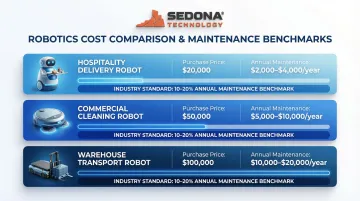
Industry research consistently shows that annual robot maintenance costs run between 10% and 20% of the robot's purchase price. For the $20,000–$100,000 price range common in service industries, this translates to:
- $20,000 hospitality delivery robot: $2,000–$4,000 annually
- $50,000 commercial cleaning robot: $5,000–$10,000 annually
- $100,000 warehouse transport robot: $10,000–$20,000 annually
These figures cover scheduled labor, replacement parts, diagnostics, and software updates for robots purchased outright.
Fixed vs. Variable Maintenance Costs
Maintenance expenses fall into two categories with distinct behavior patterns:
Fixed Costs:
- Annual service contract fees
- Scheduled preventive inspection visits
- Software licensing renewals
- Fleet management platform subscriptions
Variable Costs:
- Emergency repairs after collisions or mechanical failures
- Expedited parts replacement
- After-hours technician callouts (often $120+ per hour plus travel)
- Unplanned downtime recovery
Fixed costs remain stable regardless of usage intensity, while variable costs spike sharply in high-stress environments or when preventive care is neglected.
Where a robot operates, though, can shift these numbers significantly.
How Operating Environment Multiplies Baseline Costs
A restaurant robot navigating a busy kitchen accumulates wear far faster than a hotel delivery robot cruising carpeted hallways. Robots operating in harsh environments or running 24/7 require maintenance interventions 50% more frequently than those in clean, single-shift settings.
Environmental multipliers include:
- High-frequency contact zones: Restaurant kitchens, warehouse loading docks
- Dust and debris exposure: Factory floors, construction sites
- Moisture and chemical exposure: Commercial kitchens, cleaning applications
- Multi-shift operations: 24/7 warehouses vs. single-shift retail
The Hidden Cost of Software Maintenance
Many businesses overlook software as a recurring maintenance category. Beyond physical repairs, robots require:
- Fleet management software subscriptions
- Navigation map updates and recalibration
- AI model retraining for improved performance
- Cybersecurity patches and firmware updates
Software licensing and fleet management typically add $5,000–$15,000 per robot to total system costs, though RaaS models bundle these fees into monthly subscriptions.
The Reactive Maintenance Penalty
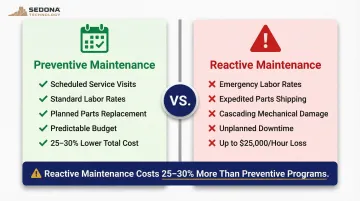
Waiting for equipment to fail costs 25–30% more than scheduled preventive maintenance, driven by emergency labor rates, expedited parts shipping, and cascading mechanical damage. Unplanned downtime can cost facilities up to $25,000 per hour in lost productivity—a figure that dwarfs the cost of scheduled servicing.
What's Included in Robot Maintenance
Preventive Maintenance Tasks
Routine preventive maintenance follows manufacturer-specified schedules to catch problems before they cause failures:
Mechanical Inspections:
- Joint and actuator integrity checks
- Lubrication of steering chains and u-joints (every 200 operating hours)
- Drive wheel debris removal (daily in high-traffic environments)
- Mechanical connection tightening
Sensor and Navigation Care:
- Weekly cleaning of LiDAR sensors, depth cameras, and vision systems using microfiber cloths
- Calibration verification to prevent navigation drift
- Obstacle detection system testing
Battery and Power Systems:
- Battery health diagnostics and capacity testing
- Charging cycle monitoring
- Battery replacement when capacity drops below 80% (typically after 2–3 years)
Software Updates:
- Firmware pushed over-the-air to fix bugs and improve performance
- Navigation maps updated after any facility layout changes
- AI models recalibrated periodically to maintain accuracy
Manufacturers typically specify who handles each task. Vendor technicians cover more complex work, while in-house staff handle daily checks after basic training. When preventive care isn't enough, that's where reactive maintenance comes in.
Reactive Maintenance and Repairs
Even well-maintained robots experience component failures and damage from operational incidents:
Common Repair Scenarios and Costs:
- LiDAR sensor replacement: $450–$4,375 depending on resolution and model
- Battery pack replacement: ~$2,299 for commercial-grade 36V 90Ah lithium bundles
- Motor and actuator repairs: carbon brush replacement every 500–1,250 hours to prevent motor failure
- Structural damage: collision repairs ranging from minor body panel replacement to frame realignment
End-of-Life Component Replacement:
Moving parts wear predictably and require scheduled replacement:
- Wheels and casters: 12–18 months in high-use environments
- Squeegee blades (cleaning robots): Daily inspection, monthly rotation, quarterly replacement
- Scrub brushes and pads: Daily inspection, replacement when worn
- Drive belts and cables: Annual inspection, replacement every 2–3 years
How Often Do Robots Need Maintenance?
Maintenance Frequency by Usage Level
Service intervals scale with operational intensity:
Single-Shift Operations (8 hours/day):
- Daily: Sensor cleaning, visual inspection, debris removal
- Monthly: Mechanical system checks, battery diagnostics
- Quarterly: Comprehensive preventive maintenance visit
- Annually: Full system overhaul and component replacement
24/7 Multi-Shift Operations:
- Daily: All single-shift tasks plus extended wear monitoring
- Bi-monthly: Comprehensive inspections (50% more frequent than single-shift)
- Quarterly: Major component replacement and calibration
- Annually: Full system rebuild with all consumables replaced
Robot Type Affects Service Cadence
Different robot categories accumulate wear at different rates:
- Hospitality delivery robots: Focus on sanitation and sensor clarity; weekly tray and wheel cleaning, monthly comprehensive service
- Autonomous cleaning robots: Intensive daily fluid management (tank draining, filter cleaning, squeegee inspection) plus quarterly mechanical overhauls
- Warehouse AMRs: Emphasis on drive systems and battery health; strict adherence to 500-hour motor brush checks and 200-hour steering lubrication
Knowing your robot type's baseline cadence is only half the picture. The other half is catching problems between scheduled visits — before they escalate.
Early Warning Signs Maintenance Is Overdue
Most fleet management platforms surface real-time performance data that points to issues days before a breakdown. Watch for:
- "Off-path" or "route lost" navigation alerts — usually dirty sensors or an environment that needs re-mapping
- Frequent "path blocked" warnings, which often signal sensor degradation rather than actual obstructions
- Slower cycle times or reduced throughput compared to baseline
- Unusual sounds, vibration, or grinding from drive systems
- Reduced battery runtime, longer charge cycles, or capacity warnings
When staff know what these signals mean, most issues can be caught early enough to resolve during a scheduled visit rather than an emergency call — keeping maintenance costs predictable.
Robot Maintenance ROI: Running the Numbers
The ROI Framework
Accurate ROI calculations require accounting for total ownership costs against total operational benefits:
Benefits Side:
- Labor cost savings (wages + benefits + overtime + turnover)
- Throughput and productivity gains
- Quality improvements and error reduction
- Staff reallocation to higher-value tasks
Cost Side:
- Purchase price or lease payments
- Installation and integration
- Staff training
- Annual maintenance (10–20% of purchase price)
- Software licensing and subscriptions
- Consumables and spare parts inventory
Quantifying Labor Savings
Labor replacement drives ROI for most service robot deployments. That said, businesses must calculate fully loaded labor costs, not just base wages. Benefits add 29.7% to base wages in private industry, meaning the true employer cost is base wage divided by 0.703.
Fully Loaded Annual Labor Costs:
- Warehouse worker (mean wage $41,420): ~$58,918 total employer cost
- Food service worker (mean wage $31,350): ~$44,594 total employer cost
A $50,000 robot replacing one full-time worker saves $40,000–$60,000 annually in fully loaded labor costs, which accelerates payback.
How Maintenance Affects Payback Period
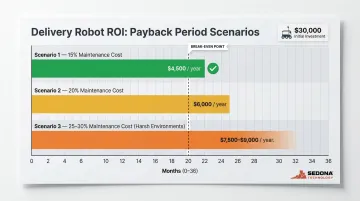
Consider a $30,000 restaurant delivery robot with 15% annual maintenance costs:
- Annual maintenance: $4,500
- Total first-year cost: $34,500 (purchase + maintenance)
- Annual labor savings: $44,594 (one food service worker)
- Net first-year benefit: $10,094
- Payback period: ~20 months
If maintenance costs rise to 20% ($6,000 annually), payback extends to 22 months. High-utilization environments requiring 50% more frequent service can push maintenance to 25–30% of purchase price, extending payback to 26–30 months.
The Rental and Leasing Advantage
Robots-as-a-Service (RaaS) models transform ROI calculations by bundling hardware, software, and maintenance into predictable monthly fees:
- Cleaning robots: $450–$1,200/month
- Warehouse AMRs: $1,500–$8,000/month
RaaS subscriptions include hardware, software updates, 24/7 support, and maintenance, eliminating surprise repair bills and simplifying financial planning. Sedona Technology's rental and leasing model follows this structure — hardware, training, installation, and ongoing support are bundled, so ROI projections don't require a separate line item for service contracts or emergency repairs.
ROI Timelines by Industry
Payback timelines are consistent across deployment types, based on published operator data:
- Warehouse/logistics: 12–24 months typical ROI, driven by doubled or tripled picking productivity
- Hospitality/hotels: 18–24 months average payback, accelerated by labor reallocation and improved guest experience
- Restaurant/food service: 18–24 months for delivery robots, with some kitchen automation achieving 4–8 month payback through waste reduction and injury prevention
How to Reduce Robot Maintenance Costs
Prioritize Preventive Over Reactive Maintenance
Following the manufacturer's recommended maintenance schedule is the single most effective cost control strategy. Proactive servicing reduces component replacement costs by 25% by catching worn parts before they fail and damage adjacent systems.
A $300 scheduled quarterly inspection prevents a $2,000 emergency motor replacement plus $5,000 in lost productivity from unplanned downtime.
Train Staff on Basic Maintenance Tasks
Vendor technician callouts typically cost $120+ per hour plus travel and per diem expenses. Training frontline employees to handle daily preventive tasks eliminates expensive service calls for routine issues:
In-House Basic Maintenance:
- Cleaning sensors and cameras (daily, 5 minutes)
- Clearing debris from wheels and drive systems (daily, 5 minutes)
- Checking battery levels and charging status (daily, 2 minutes)
- Resetting emergency stops and error codes (as needed)
Cost Comparison:
- In-house daily care: $15–20 labor cost (15 minutes at $60–80/hour fully loaded)
- Vendor technician callout: $300–500 minimum (travel + 2-hour minimum service)
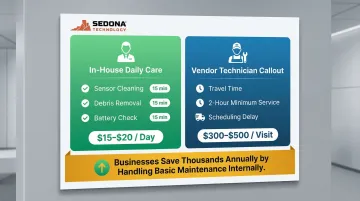
Businesses save thousands annually by handling basic maintenance internally and reserving vendor visits for complex repairs and scheduled overhauls.
Choose Vendors Who Bundle Support
Hidden service contract fees are a common post-deployment surprise — and they add up fast. Once in-house staff handles daily tasks, the next lever is ensuring vendor-provided support doesn't arrive with unexpected invoices attached.
Sedona Technology bundles free installation, training, and ongoing support with all robotic solutions. For restaurants, hotels, and warehouses, this structure means maintenance costs are predictable from day one, with no separate service contracts eating into ROI.
Frequently Asked Questions
How much does it cost to maintain a robot?
Annual maintenance typically costs 10–20% of the robot's purchase price. A $30,000 service robot requires roughly $3,000–$6,000 per year for scheduled servicing, software updates, and minor repairs, though high-utilization environments can increase costs by 50%.
How often do robots need maintenance?
Most service robots require quarterly preventive checks and annual comprehensive overhauls. Robots operating 24/7 in high-throughput environments need monthly inspections to maintain performance and prevent costly breakdowns.
Are robots cost effective?
Robots are cost effective when total ownership costs—including maintenance—are weighed against fully loaded labor savings and productivity gains. Typical payback periods range from 18 months to 3 years depending on deployment type, with warehouse applications often achieving ROI in 12–24 months.
What is included in a robot maintenance contract?
Most service contracts cover scheduled preventive maintenance visits, software updates, priority technical support, and parts coverage. Premium tiers add next-day onsite response and emergency breakdown repair. Review contract terms carefully, as coverage scope varies significantly between providers.
How does preventive maintenance affect robot ROI?
Proactive maintenance reduces unplanned downtime by 25–30% and catches component wear before it becomes a breakdown. The result is consistent performance and higher productive uptime — both of which translate directly into stronger ROI.
What are the biggest hidden costs of operating a robot?
Software licensing renewals, staff retraining when workflows change, integration updates, and cybersecurity patching are the most commonly overlooked recurring expenses beyond stated maintenance fees. Left unbudgeted, these can add 15–25% to baseline maintenance costs.