Introduction
Modern warehouses are absorbing pressure from every direction at once. The numbers tell the story:
- U.S. e-commerce sales hit $1.2 trillion in 2025—a 5.4% year-over-year increase
- 80% of consumers now expect same-day delivery
- Warehouse turnover sits at 36%, and replacing one worker costs up to 150% of that role's annual salary
- Average delivery speed has dropped from 6.6 days to 4.2 days since 2020—a 40% acceleration
Warehouse automation robots are no longer experimental—they're how operations actually keep pace with these demands without burning through budgets or burning out workers. Businesses that understand and deploy the latest robotics innovations cut costs, reduce errors, and fulfill orders faster than those still relying on manual processes.
Key Takeaways
- AMRs navigate dynamically without fixed paths — delivering up to 3x productivity gains over traditional rigid-track AGVs
- Goods-to-Person systems cut miles of daily worker travel, pushing picking rates from 50–100 to 400–1,000 lines per hour
- Picking accuracy hits 99.9% with AI-guided arms that process up to 1,200 irregular items per hour
- Collaborative robots cut workplace injuries by 50–73% while actively augmenting worker output
- RaaS models replace $100,000+ capital purchases with monthly subscriptions starting around $750–$2,000
Top Innovations in Warehouse Automation Robots
Warehouse robotics has evolved far beyond conveyor belts and fixed-path vehicles. The latest innovations represent a convergence of AI, advanced sensing, and flexible deployment models that are redefining what automation can accomplish in modern fulfillment operations.
Autonomous Mobile Robots (AMRs): From Fixed Paths to Dynamic Intelligence
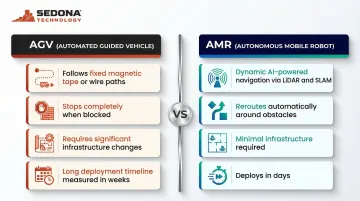
AMRs differ fundamentally from traditional Automated Guided Vehicles (AGVs). While AGVs follow magnetic tape, wires, or QR codes and stop when blocked, AMRs use onboard LiDAR, 3D cameras, and Simultaneous Localization and Mapping (SLAM) to build real-time digital maps. They dynamically reroute around obstacles and adapt to changing warehouse layouts without infrastructure modifications.
This dynamic navigation unlocks major efficiency gains. DHL Supply Chain doubled productivity in case picking after deploying Locus Robotics AMRs. Denso executed over 500,000 missions with MiR AMRs, achieving ROI in under a year. The scale is massive: Locus Robotics surpassed 4 billion picks across global customer sites in 2024.
Key AMR advantages over AGVs:
- Deploy in days vs. weeks—no facility downtime required
- Calculate shortest alternative routes automatically when paths are blocked
- Require minimal infrastructure investment compared to fixed-path systems
- Adapt instantly to layout changes, seasonal zones, and workflow shifts
Goods-to-Person (G2P) Systems and Micro-Fulfillment Centers
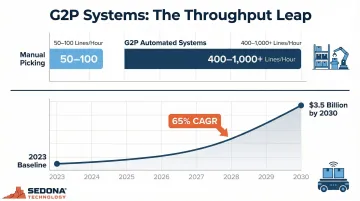
Building on the mobility gains AMRs provide, G2P automation attacks a different bottleneck: the 8-12 miles workers walk per shift. By bringing inventory directly to stationary pickers, vertical lift modules, shuttle systems, and mobile shelf-bots deliver totes to ergonomic workstations, boosting throughput from 50-100 lines per hour to 400-1,000+ lines per hour.
Exotec's Skypod system exemplifies this innovation. Robots travel at 4 m/s on the ground and climb racks up to 40 feet high, accessing any tote in under two minutes. Customer results validate the technology: Cdiscount achieved 5x storage density and 1,000 bins per hour throughput, while Carrefour quadrupled fulfillment capacity to enable 2-hour grocery delivery.
AutoStore's RelayPort workstations handle up to 650 bins per hour, and their Router software doubled overall system performance. At a UK ASDA facility, AutoStore deployment doubled picking rates while achieving 99.8% accuracy.
These high-density systems are driving the micro-fulfillment center (MFC) trend—compact, automated warehouses embedded in urban locations. The automated MFC market is projected to grow at 65% CAGR from 2023 to 2030, reaching $3.5 billion annually, driven heavily by grocery and rapid delivery demands.
AI-Powered Robotic Picking and Sorting Arms
Where G2P systems move inventory efficiently, AI-powered arms handle what's inside those totes. Modern picking robots use deep learning and computer vision to identify, grasp, and sort items of varying shapes, sizes, and packaging—overcoming the long-standing limitation of robots only handling uniform items. Systems from Covariant and RightHand Robotics use 3D point clouds and model-free grasp synthesis, allowing the AI to calculate optimal pick angles for items it has never encountered before.
The performance numbers back it up. RightHand Robotics' RightPick system sustained 900 picks per hour with 99.9% accuracy at PALTAC Corp, doubling manual picking rates. Covariant's Robotic Putwalls at Radial facilities process 425 puts per hour, handling 1.2 million units monthly. Berkshire Grey's sortation systems at FedEx handle 1,000-1,100 packages per hour.
Why this matters for warehouse operations:
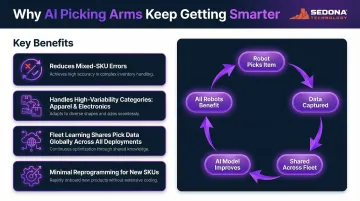
- Reduces manual re-sorting and error rates on mixed-SKU orders
- Handles categories with high item variability (apparel, electronics, pharmaceuticals)
- Continuously improves through "fleet learning" where pick data is shared globally across all deployments
- Requires minimal reprogramming when introducing new SKUs
Despite advances, certain product categories remain challenging. Highly variable items—apparel, soft goods, transparent polybags, and fragile items—require adaptive speed and specialized grasp planning to minimize human intervention.
Collaborative Robots (Cobots) and Human-Robot Teaming
Unlike fully autonomous picking arms, cobots are designed to work directly alongside human workers—not replacing them, but augmenting their productivity. They use advanced proximity sensors and force-limiting mechanisms governed by the updated ISO 10218:2025 standard, which absorbed ISO/TS 15066 and strictly defines Speed and Separation Monitoring (SSM) for human-robot collaboration.
Cobots take on physically demanding or repetitive elements of tasks—carrying, lifting, transporting—while humans handle judgment-intensive steps like verifying, packing irregulars, and exception handling. Research indicates automated material handling systems reduce workplace injuries by 50-73%, specifically lowering manual lifting and repetitive motion incidents.
Why cobots are gaining traction in warehouses:
- Redeploy quickly without extensive facility overhauls
- Require minimal programming, often using no-code interfaces
- Integrate into existing workflows without full automation commitments
- Enable phased automation that preserves workforce while improving safety
At Etalex, Universal Robots deployment for press brake tending eliminated safety guarding needs and made the workplace "100% safer" by removing human hands from hazardous zones.
Robotics-as-a-Service (RaaS): Making Automation Accessible
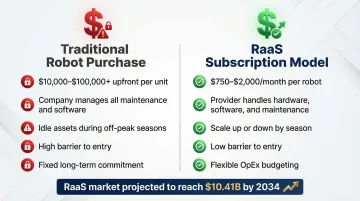
The final barrier to adoption isn't capability—it's cost. RaaS shifts automation from capital expenditure to operating expenditure. Instead of purchasing robots outright—which can run $10,000 to $100,000+ per unit—businesses subscribe to robotic capabilities for a recurring fee, with the provider handling hardware, software updates, and maintenance.
The global RaaS market is projected to grow from $1.96 billion in 2024 to $10.41 billion by 2034 at an 18.2% CAGR. Pricing structures vary: Brightpick offers RaaS starting at $1,990 per robot per month, while pay-per-pick models typically range from $0.06 to $0.10 per pick.
Why RaaS is transforming industry adoption:
- Removes the single largest barrier: upfront capital cost
- Enables faster scaling during peak seasons without carrying idle assets year-round
- Allows warehouses to test automation before committing to purchase
- Shifts costs to operational budgets where they're easier to manage
Providers like Sedona Technology extend this flexibility further with sales, rental, and leasing options—including free installation and training—so warehouses and production facilities can start deploying robots without the financial risk of full ownership. Rental options for industrial transport robots like the KEENON S100 start at $575 per month.
What's Driving the Warehouse Automation Revolution
The warehouse automation market is projected to grow from $19.23 billion in 2023 to $59.52 billion by 2030 at an 18.7% CAGR. Several converging forces are pushing adoption well beyond simple cost reduction.
Technology Getting Cheaper and Smarter
AI, machine learning, computer vision, and sensor hardware — LiDAR, 3D cameras — have made robots cheaper and more reliable than ever. Systems that required multi-million dollar investments five years ago are now commercially accessible at a fraction of the cost. Amazon's "DeepFleet" AI foundation model improved robot travel time by 10%, showing how software gains are compounding hardware efficiency.
A Labor Shortage That Isn't Going Away
The BLS reported 6.54 million job openings across the total nonfarm sector in December 2025, and warehousing feels it acutely — 38% of supply chain respondents describe hiring and retaining talent as extremely or somewhat challenging. Online retail's demand for 24/7 fulfillment and same-day delivery only sharpens that pressure. Automation doesn't just help — for many operations, it's become the only viable path to meeting volume.
Competitive Pressure From the Top Down
Amazon has deployed over 1 million robots since 2012. Walmart acquired Symbotic's Advanced Systems for $200 million and committed an additional $520 million to roll out 400 store-level automation systems. As the largest retailers push delivery speed and order accuracy higher, mid-market and smaller operators face a clear choice: automate, or fall further behind on fulfillment expectations.
How These Innovations Are Reshaping Warehouse Operations
The impact of warehouse automation innovations is measurable across three distinct dimensions: operational performance, business strategy, and workforce dynamics.
Operational Impact
Manual picking environments typically achieve 80-150 lines per hour; automated G2P systems support 300-1,000+ lines per hour per operator. Human-driven processes average error rates up to 4%, whereas automated systems operate with accuracy rates of 99.96% to 99.99%. Exotec contractually guarantees flow performance and maintains 99% uptime globally while completing over one million container presentations daily.
Automation shifts warehouses from worker-driven flow to system-coordinated flow where robots, WMS software, and human workers operate as a unit. This enables facilities to:
- Dynamically re-slot inventory based on velocity patterns
- Prioritize high-velocity SKUs automatically
- Run operations continuously (24/7 without fatigue)
- Reduce idle time through predictive task assignment
Business Impact
Businesses are moving from viewing robotics as a capital expense to treating automation as core infrastructure. The ROI case rests on three drivers:
- Labor cost reduction — fewer workers needed for repetitive pick-and-place tasks
- Space optimization — AS/RS and vertical storage systems increase density per square foot
- Peak scalability — capacity expands during high-volume periods without equivalent cost increases
Flexible acquisition options and the RaaS model have changed how companies budget for automation. Over 50% of supply chain executives report their legacy automation is too rigid to handle unplanned disruptions. RaaS enables phased deployments with lower initial commitment—Locus Robotics' PeakFLEX program deployed nearly 2,000 additional bots during peak season to help warehouses meet SLAs.
Suppliers offering bundled installation, training, and ongoing support reduce the hidden costs of adoption. Sedona Technology includes free installation and training with all rentals and sales, so teams are operational from day one.
Workforce Impact
Automation is reshaping warehouse roles rather than eliminating them. Physically demanding and repetitive tasks shift to robots, while workers move into robot supervision, exception handling, maintenance oversight, and system management — all higher-skill positions.
The data backs this up. The 2025 MHI Annual Industry Report indicates 63% of respondents are upskilling current employees to meet new technology demands. The World Economic Forum's 2025 Future of Jobs Report finds 96% of firms in consumer goods production plan to invest in workforce development, with analytical thinking and AI/big data literacy ranking as the fastest-growing skill priorities.
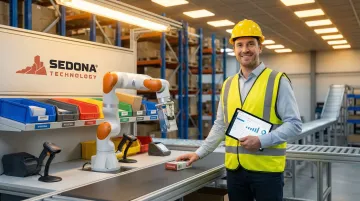
For operations making this shift, the practical implication is straightforward: automation investments and workforce training need to move in parallel. Facilities that deploy robots without a parallel upskilling plan tend to underutilize the systems they've invested in.
Future Signals: What's Next for Warehouse Robots
The pace of innovation in warehouse robotics is accelerating. Technologies emerging now will define standard practice within the next 1-3 years.
Foundation AI Models for Robotics
Just as large language models transformed software, AI foundation models trained across diverse robot fleets let warehouse robots generalize to new tasks with minimal retraining. Amazon's DeepFleet and Google DeepMind's Gemini Robotics (a Vision-Language-Action model that helps robots recover from dropped items and adapt to new instructions on the fly) demonstrate this shift. NVIDIA's GR00T is an open VLA model built specifically for humanoid robots.
Humanoid and Multi-Purpose Robots
Amazon is testing Agility Robotics' Digit for repetitive tote recycling. BMW recently completed an 11-month pilot with Figure AI's humanoid robots for intrafactory logistics. These bipedal robots are designed to operate in warehouses built for human movement, handling multiple task types rather than a single specialized function. That said, widespread commercial deployment remains in the pilot phase.
Deeper Integration Between Robots and Warehouse Software
The next frontier is real-time AI orchestration, where WMS, ERP, and robotic fleets communicate continuously to optimize inventory positioning, predict demand spikes, and pre-stage goods before orders are placed.
Platforms like inVia Logic WES and Blue Yonder's AI Orchestrator continuously evaluate facility states, dynamically assigning tasks and routing AMRs to prevent gridlock. The result: a warehouse that anticipates and adjusts in real time rather than reacting after the fact.
Conclusion
Warehouse automation robots are no longer a future-state aspiration. The technologies covered here — AI-powered AMRs, goods-to-person systems, collaborative robots, intelligent picking arms, and RaaS models — are operating in warehouses today, delivering measurable gains in throughput, order accuracy, safety, and cost per pick.
Businesses that move early will compress costs and scale throughput before competitors catch up — advantages that compound over time. With lower barriers to entry through RaaS, leasing, and flexible deployment models, the upfront commitment is smaller than most expect. Sedona Technology's rental programs, which include free installation, training, and ongoing support, are one example of how accessible that entry point has become.
Frequently Asked Questions
What robots are used in warehouses?
Modern warehouses typically deploy a mix of robot types based on workflow needs:
- AMRs — dynamic transport and navigation
- AGVs — fixed-path movement along set routes
- Robotic arms — picking, packing, and palletizing
- AS/RS systems — high-density automated storage and retrieval
- Cobots — human-robot collaborative tasks
- Sorting robots — package distribution and routing
- Goods-to-Person vehicles — bringing inventory directly to workers
What's the difference between AGV and AMR?
AGVs follow fixed, pre-set paths via magnetic tape, rails, or wires and stop when blocked, requiring manual intervention. AMRs use onboard sensors (LiDAR, cameras) and AI to navigate dynamically, reroute around obstacles in real time, and adapt to changing environments without infrastructure changes or operational downtime.
What are the main benefits of warehouse automation robots?
Warehouse robots deliver measurable gains across operations:
- Throughput: 300-1,000+ lines/hour vs. 80-150 manually
- Accuracy: 99.96-99.99% order accuracy vs. ~96% manually
- Safety: 50-73% reduction in workplace injuries
- Uptime: 24/7 operation without fatigue or shift constraints
- Space: Higher density storage through vertical AS/RS systems
How much does a warehouse robot cost?
Individual AMRs range from $50,000 to $150,000+, while full AS/RS or automated DC systems can run into the millions. RaaS and leasing options reduce upfront barriers — subscription models start at $750-$2,000 per robot per month, with pay-per-pick options at $0.06-$0.10 per pick.
What is Robotics-as-a-Service (RaaS) in warehousing?
RaaS is a subscription-based model where businesses access robotic systems for a recurring fee rather than purchasing outright, shifting costs from CapEx to OpEx. The provider manages hardware, software updates, and maintenance, making automation accessible to businesses without large capital budgets and enabling flexible scaling during peak seasons.
Are warehouse robots replacing human workers?
Robots primarily take over repetitive, physically demanding, and dangerous tasks, while human workers shift into supervisory, maintenance, exception-handling, and system management roles. Research shows 63% of companies are upskilling current employees to adapt to automation. Most operations deploy a human-robot collaboration model rather than full replacement, with workers transitioning to higher-value functions.