Introduction
Warehouse operations face mounting pressure from rising labor costs, growing order volumes, and tighter delivery windows. According to a 2021 report by the Association for Advancing Automation (A3), robot adoption has accelerated across facilities of all sizes as these pressures intensify.
Warehouse robots span several distinct categories, each built for different tasks: transport, storage, picking, and human collaboration.
This guide breaks down the most widely used types of warehouse robots, how each one works, and what to consider before choosing one. Understanding these differences helps businesses invest in the right system for their specific workflow — not just the one with the most buzz.
Key Takeaways
- Warehouse robots handle moving, storing, retrieving, and picking goods — reducing reliance on manual labor
- Main types include AGVs, AMRs, AS/RS systems, robotic arms, and cobots
- Choosing the right type comes down to your layout, task complexity, throughput volume, and budget
- Rental and leasing options make adoption feasible without heavy upfront capital
What Are Warehouse Robots and Why Do They Matter?
Warehouse robots are automated systems ranging from mobile vehicles to stationary robotic arms, designed to take over repetitive, physically demanding, or time-sensitive tasks in warehouses and distribution centers.
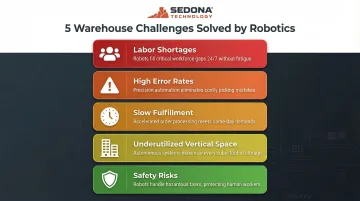
Key Problems Robots Address:
- Labor shortages and high turnover rates
- High error rates in picking and sorting
- Slow order fulfillment cycles
- Underutilized vertical storage space
- Safety risks from heavy lifting and repetitive motion
Adoption is accelerating across the industry, driven by e-commerce growth, advances in automation technology, and ongoing supply chain pressure. According to the Material Handling Industry's ASRS industry overview, demand for automated storage and retrieval continues to climb. Robots don't replace all human roles. They free workers from low-value tasks so teams can focus on work that requires human judgment — improving output without proportionally increasing headcount.
Types of Warehouse Robots
Warehouse robots aren't one-size-fits-all. Different robot types are designed for distinct functions, environments, and throughput requirements. Understanding the differences helps businesses invest in the right solution.
Automated Guided Vehicles (AGVs)
AGVs are mobile robots that transport materials — pallets, carts, trolleys — along fixed, pre-programmed routes within a warehouse. According to the Association for Advancing Automation, AGVs follow predefined guidepaths using navigation aids like magnetic tape, floor wires, reflectors, or barcodes.
Fixed paths make AGVs predictable and reliable in stable, structured environments — but that same infrastructure dependency limits flexibility. When an AGV encounters an obstacle, it stops and waits for manual clearance rather than navigating around it.
Best use cases:
- High-volume manufacturing or distribution facilities
- Consistent, repetitive material flows
- Moving pallets from receiving docks to storage
Limitations:
- Require facility modifications for path setup
- Scaling or rerouting involves significant reconfiguration
- Cannot adapt to dynamic environments
Autonomous Mobile Robots (AMRs)
AMRs are self-navigating robots that use onboard sensors, cameras, and AI-powered software to map their environment and move autonomously — without relying on fixed tracks or floor markers.
Unlike AGVs, AMRs can dynamically reroute around obstacles or people in real time, making them faster to deploy in changing environments. They use LiDAR, 3D vision, and SLAM (Simultaneous Localization and Mapping) to navigate without floor infrastructure. That sophistication comes at a higher unit cost than traditional AGVs.
Best use cases:
- E-commerce fulfillment centers
- Facilities with variable layouts
- Order-picking assistance where workers travel long distances
Limitations:
- Performance can degrade in highly cluttered or poorly lit environments
- Integration with existing WMS requires technical setup
- Higher upfront cost than AGVs
Automated Storage and Retrieval Systems (AS/RS)
AS/RS are computer-controlled systems that automatically store and retrieve inventory from high-density storage structures. The category includes vertical lift modules (VLMs), mini-load shuttles, and cube storage robots. The Material Handling Industry defines AS/RS as systems that handle, store, and retrieve materials with precision and speed under a defined degree of automation.
Goods come to workers — not the other way around. AS/RS systems dramatically increase vertical space utilization and remove travel time from the picking process, making them fundamentally different from transport-focused robots.
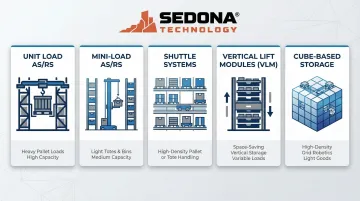
AS/RS Sub-types:
- Unit Load AS/RS: Crane-based machines for heavy loads (1,000+ lbs), typically full pallets
- Mini-Load AS/RS: Scaled-down cranes for lighter loads under 1,000 lbs
- Shuttle Systems: Autonomous shuttles traveling horizontally along rack levels
- Vertical Lift Modules (VLMs): Enclosed systems delivering trays to ergonomic picking windows
- Cube-Based Storage: Ultra-high-density systems like AutoStore using robots on cubical grids
Best use cases:
- High-SKU environments
- Pharmaceutical or electronics warehouses needing precise inventory control
- Facilities with limited floor space
Limitations:
- High upfront capital cost
- Long installation timelines
- Less suited to operations with highly irregular item sizes
Robotic Arms and Picking Robots
Robotic arms — also called robotic manipulators or piece-picking robots — are stationary or semi-mobile robots equipped with multi-jointed arms and specialized end-effectors (grippers, suction cups). They can pick, sort, pack, palletize, or depalletize items with high repeatability.
Their value is precision at fixed workstations, not mobility. Robotic arms are often paired with computer vision and machine learning to handle a wide variety of object shapes and sizes — something that would overwhelm a purely rules-based system.
Best use cases:
- Order fulfillment pick-and-pack stations
- Palletizing at shipping docks
- Goods-to-person workstations
Limitations:
- Performance depends heavily on item variability
- Highly irregular or fragile items remain challenging
- Requires significant programming and integration effort for complex SKU ranges
Collaborative Robots (Cobots)
Cobots are robots specifically designed to work safely alongside human workers in shared spaces. According to ISO/TS 15066, cobots use force-limiting sensors and rounded designs to reduce injury risk, as opposed to traditional industrial robots that require physical barriers.
Cobots trade speed for safety and flexibility. They're designed for tasks that are too variable or delicate to fully automate, but too ergonomically demanding for workers to sustain at scale.
Collaborative Operation Methods:
- Safety-rated monitored stop
- Hand guiding
- Speed and separation monitoring
- Power and force limiting
Best use cases:
- Assembly support and inspection
- Light picking tasks in mixed human-robot environments
- Businesses trialing automation without full infrastructure overhaul
Limitations:
- Slower cycle times than traditional industrial robots
- Not suited for high-speed, high-volume applications where throughput is the priority
How to Choose the Right Warehouse Robot for Your Business
The "right" robot type depends on operational fit — not which technology is newest or most widely discussed. Start by mapping your warehouse's highest-pain processes first.
Task and Workflow Fit
Identify the primary function needed — transport, storage, picking, or human assistance. Each robot category is optimized for a different task. Trying to force one type to do another's job results in underperformance.
Scale and Throughput Requirements
Some robots (AS/RS, conveyor-integrated systems) are best justified at high volumes, while AMRs and cobots can deliver value at smaller scales. Matching capacity to actual throughput needs prevents both over-investment and underinvestment.
Facility Layout and Flexibility Needs
Assess whether your warehouse layout is stable or frequently changing — stable environments favor AGVs or AS/RS, while dynamic layouts suit AMRs or cobots. Also factor in:
- Ceiling height constraints for vertical storage systems
- Aisle widths that may restrict certain robot footprints
- Floor conditions (uneven surfaces, ramps) that limit navigation options
Total Cost of Ownership vs. Upfront Budget
Purchase price is only part of the equation. Factor in installation, software licensing, maintenance, training, and integration costs before committing. Rental and leasing options lower the entry point considerably — Sedona Technology, for instance, includes free installation, training, and ongoing support in rental agreements starting at $575/month (minimum 2-month term).
Long-Term Scalability
Consider whether the chosen robot type can grow with your business. Modular systems like AMRs or AS/RS with expandable grids are easier to scale incrementally than fixed-infrastructure solutions.
Mistakes to Avoid When Selecting a Warehouse Robot
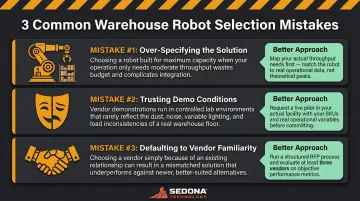
Even well-researched purchases go sideways when buyers fall into these common traps:
- Over-specifying the solution: Deploying a full AS/RS system for a warehouse that only needs basic pallet transport is a costly mismatch — an AGV could handle the same task at a fraction of the price. Match the robot type to the actual task, not the most impressive option on the market.
- Trusting demo conditions over live ones: Controlled vendor demos rarely capture the variability of real operations — shift changes, irregular loads, floor congestion. Pilot any robot in your actual warehouse before committing. A short-term rental lets you stress-test performance before signing a long-term contract.
- Defaulting to vendor familiarity: Choosing whatever a preferred supplier offers — rather than evaluating which robot type fits the specific task — often produces a system that technically functions but falls short of expected ROI. Let operational requirements drive the decision, not existing relationships.
Conclusion
Warehouse robots span several distinct categories — from AGVs and AMRs to AS/RS systems, robotic arms, and cobots — each designed to solve different operational problems and suited to different warehouse environments. The best choice isn't the most advanced option, but the one that fits the specific workflow, scale, facility, and budget.
Whether you're addressing labor shortages, improving picking accuracy, or squeezing more throughput from existing floor space, the robot type has to match the bottleneck — not just the budget. Get that pairing right, and the returns follow.
Frequently Asked Questions
What robots are used in warehouses?
Warehouses commonly use AGVs and AMRs for transport, AS/RS systems for storage and retrieval, robotic arms for picking and palletizing, and cobots for human-assisted tasks. Many facilities deploy multiple robot types in combination depending on their specific operational needs.
What are the 5 types of industrial robots?
The five commonly cited types are articulated robots (robotic arms), SCARA robots, delta robots, Cartesian/gantry robots, and cobots. In warehouse settings, mobile robots like AGVs and AMRs tend to be more operationally relevant than this traditional industrial classification.
What are logistics robots?
Logistics robots are automated machines deployed across warehouses, distribution centers, and fulfillment facilities to handle tasks like moving, sorting, storing, and packing goods. They reduce manual labor and speed up order fulfillment.
What is the difference between an AGV and an AMR?
AGVs follow fixed, pre-programmed paths using physical markers, making them predictable but inflexible. AMRs navigate autonomously using sensors and AI, allowing them to reroute in real time and adapt to dynamic warehouse environments without requiring floor modifications.
How much do warehouse robots cost?
Robot costs vary significantly by type — rental options start around $575/month for some providers, while larger AS/RS or articulated arm systems can run into the hundreds of thousands. Total cost of ownership includes software, maintenance, and training, making rental and leasing worth considering for businesses managing cash flow.
Can small warehouses benefit from warehouse robots?
Yes, smaller facilities can benefit — particularly from AMRs and cobots, which require less infrastructure investment and can be deployed incrementally. The key is matching the robot type to the specific bottleneck rather than attempting to automate everything at once.