Introduction
Humanoid home robots have officially crossed from science fiction into commercial reality. Models like 1X's NEO are now available for preorder at approximately $20,000, a milestone that signals just how quickly this technology is maturing. According to ABI Research, the humanoid robot market is projected to reach $6.5 billion by 2030, growing at a 138% compound annual growth rate between 2024 and 2030.
Many consumers struggle with understanding what these robots can actually do today versus what marketing materials promise. This guide covers what humanoid home robot assistants are, the AI technologies that power them, their key features and capabilities, realistic cost expectations, and critical limitations you should understand before buying.
TLDR:
- Humanoid home robots like 1X NEO are now available for preorder at around $20,000, designed for household tasks like tidying and carrying items
- These robots use world models, large language models, and computer vision to navigate homes and interpret natural language commands
- Early models blend autonomous AI with remote human operators (teleoperation) to handle complex tasks
- Always-on cameras, microphones, and remote operator access raise real privacy concerns
- Businesses deploying service robots commercially can access flexible rental and leasing options to reduce upfront costs
What Is a Humanoid Home Robot Assistant?
A humanoid home robot assistant is a bipedal, AI-powered machine designed to move through home environments and assist with physical and conversational tasks. According to the International Organization for Standardization (ISO 8373:2021), a humanoid robot features a body, head, and limbs that look and move like a human, distinguishing it from single-function devices like robot vacuums or stationary smart speakers.
Why the Human Form Factor Matters
The primary advantage of humanoid design is environmental compatibility. Our homes are built exclusively for human bodies — stairs, countertops, door handles, light switches, and furniture all assume human proportions and capabilities. A humanoid robot can navigate these spaces without requiring any home modifications.
1X Technologies points to a key AI training advantage: internet video implicitly encodes how humans move and interact with the world. By matching human kinematics, robots can translate web-scale video data showing human actions directly into physical behaviors.
This cuts the need for expensive, custom robot training data — one reason humanoid form is favored over purpose-built alternatives.
Current Market Reality
That technical progress hasn't yet translated into shelf-ready products. Most humanoid home robots remain in early commercial or late prototype stages as of 2026, with consumer options just beginning to emerge:
- 1X NEO opened for preorder in October 2025, targeting initial U.S. home deliveries in 2026
- Current products ship with "foundational autonomy" — capable but limited, with improvements delivered over time via software updates
- No humanoid home robot today matches the reliability of a dishwasher or washing machine
Buyers should treat these as first-generation platforms, not finished appliances.
Key Features of Humanoid Home Robots
Physical Mobility and Dexterity
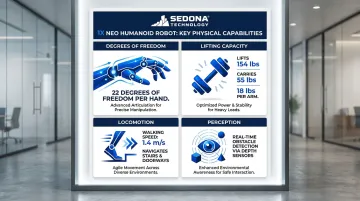
Advanced humanoid robots replicate natural human movement patterns to navigate standard home layouts. The 1X NEO, for example, walks at 1.4 meters per second using a natural gait with arm swing, stands 5'6" tall, and weighs just 66 pounds—making it lightweight enough to minimize collision risks while maintaining stability.
Key mobility capabilities include:
- 22 degrees of freedom per hand across multi-jointed hands, enabling human-equivalent tool use and grasping
- Lifts up to 154 pounds, carries 55 pounds, and handles 18 pounds per arm—sufficient for grocery bags, laundry baskets, and household items
- Navigates stairs and passes through doorways without home modifications
- Detects and avoids obstacles in real-time using depth perception sensors
Task Execution and Scheduling
Users can assign household chores through natural language voice commands or scheduled task lists. Current capabilities focus on physical manipulation tasks rather than complex decision-making:
- Tidies rooms by picking up and organizing items
- Carries objects between rooms on request
- Retrieves specific items by name
- Runs recurring chores automatically on a programmed schedule
You speak to the robot naturally—no command syntax or programming required.
Environmental Awareness and Safety
Safety is built into the hardware, not just the software. 1X NEO achieves a Head Injury Criterion (HIC) of less than 250 through its patented Tendon Drive system, which produces gentle, low-energy movements. The frame is wrapped in a custom 3D lattice polymer that cushions impact during any accidental contact.
Safety features include:
- Dual 8.85MP 90Hz stereo fisheye cameras for spatial awareness
- Tactile feedback sensors that detect contact with objects and people
- Real-time person and pet detection to avoid collisions
- "No-go" zone programming to keep the robot out of restricted areas
Conversational Interaction
Humanoid home robots embed large language models (LLMs) directly onboard, so conversation happens without internet latency. 1X's Redwood model runs a 160-million parameter vision-language transformer entirely on the robot's GPU at approximately 5Hz. This makes several things possible:
- Understands natural speech — no fixed commands or keyword phrases needed
- Recalls past interactions to maintain continuity across conversations
- Adapts responses based on household routines and context
- Four beamforming microphones identify when the robot is being directly addressed, filtering out background noise
Design Considerations for Home Comfort
Manufacturers address the "uncanny valley" concern—the discomfort people feel around humanoid robots that look almost, but not quite, human—through intentional design choices. 1X NEO Gamma wears a soft knit suit made using a Japanese Shimaseki machine with whole-garment seamless knitting technology. This machine-washable nylon covering hides the metallic frame and makes the robot feel less industrial and more domestic.
The robot also features "Emotive Ear Rings"—visual indicators that change colors or patterns to convey the robot's state, battery level, and attention, providing non-verbal communication that helps household members understand what the robot is doing.
AI Capabilities That Power Humanoid Home Robots
On-Device and Cloud AI Processing
Modern humanoid robots use a hybrid approach combining onboard AI processing with occasional cloud connectivity. 1X NEO runs on NVIDIA Jetson Thor, delivering up to 2,070 FP4 TFLOPS of compute power—enough to process computer vision, language models, and motion planning locally without constant internet dependency.
Critical transparency issue: CNET and The Wall Street Journal reported that early NEO demonstrations relied heavily on remote human operators using VR headsets and controllers. 1X acknowledges this through its "Expert Mode," where owners can schedule a 1X Expert to remotely supervise and guide the robot for complex chores the AI doesn't yet know. This teleoperation serves dual purposes: completing the immediate task and collecting training data to improve future autonomy.
World Modeling and Generalization
On January 12, 2026, 1X disclosed its "1X World Model" (1XWM), a video-pretrained, text-conditioned diffusion model that represents a new training approach that removes reliance on large robot-specific datasets.
The training process involves three stages:
- Web-scale pretraining on internet video to learn structural priors of reality (physics, object permanence)
- Egocentric mid-training on 900 hours of first-person human video to align with manipulation tasks
- Embodiment fine-tuning on just 70 hours of robot-specific data to adapt to NEO's kinematics
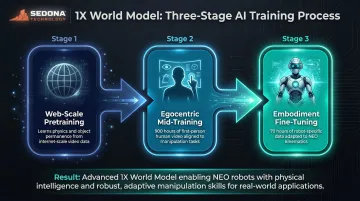
During operation, when a user gives a command, the World Model visualizes the intended future scene. An integrated Inverse Dynamics Model then extracts the exact action trajectory required and executes it on the robot. The result: robots can handle unfamiliar tasks without needing dedicated training data for each one.
Routine Learning and Personalization
That same capacity to generalize feeds into longer-term adaptation. Humanoid robots observe household patterns over time—sleep schedules, preferred task times, frequently moved objects—and adjust their behavior accordingly. The conversational memory system recalls previous interactions and preferences, personalizing responses to fit the owner's routine over weeks of use.
Emotion and Social Awareness
Some models use facial recognition and tone analysis to detect emotional cues like stress or fatigue, adjusting interaction style accordingly. The practical effect is a more responsive interaction style—though independent testing has yet to verify how reliably these features work in real households.
Natural Language Command Processing
1X developed an in-house language model specifically for NEO, allowing owners to speak naturally without learning command syntax. The four beamforming microphones enable the robot to determine when it's being addressed versus when people are having conversations nearby, reducing false activations and unnecessary interruptions.
How Much Does a Humanoid Home Robot Cost?
Consumer Humanoid Price Range
Humanoid robot pricing reflects immense R&D investment, high-performance actuators, dense battery requirements, and currently low manufacturing volumes. One accessible entry point: 1X NEO is available for preorder at $20,000 with a $200 refundable deposit, or $499 per month on subscription.
The broader humanoid market currently averages over $100,000 per unit, though ABI Research projects prices will drop sharply as production scales toward the 2030 market inflection point.
Current pricing examples:
- 1X NEO: $20,000 purchase or $499/month subscription
- Miko 3 (children's companion): $199 one-time purchase
- Pepper (SoftBank hospitality robot): Approximately $440/month enterprise leasing
- temi (enterprise telepresence): $4,500–$19,000 hardware plus $99/month software subscription
What Drives the Cost
Several factors contribute to the high price of humanoid robots:
- Require advanced actuators enabling human-like movement across 20+ degrees of freedom
- Incorporate multi-sensor perception arrays — including cameras, LiDAR, and depth sensors — for real-time environmental awareness