Introduction
Factory floors are undergoing a real transformation in 2025: humanoid robots—once confined to research labs and viral demo videos—are now taking on real production tasks at major manufacturers. Goldman Sachs projects the humanoid robot market to reach $38 billion by 2035, with an estimated 1.4 million unit shipments, driven by a 40% reduction in manufacturing costs.
For facility managers weighing adoption, the key questions are practical: what these robots can actually do today, where they fall short, and whether the timing is right for your operation. Here's what the current deployments show.
TLDR:
- Humanoid robots offer multi-task flexibility in existing factory infrastructure without costly retrofits
- Early deployments focus on heavy lifting, material handling, and 24/7 operational continuity
- Vision-Language-Action AI models enable robots to learn new tasks through natural language instruction
- Reliability, safety standards, and supply chain constraints remain significant deployment barriers
- Factory operators should start with structured pilots targeting variable, multi-step workflows
Humanoid Robots vs. Traditional Industrial Robots: What's the Difference?
Traditional industrial robots—articulated arms, SCARA robots, delta robots, Cartesian gantry systems—are engineered for one specific, repeatable task and require the surrounding environment to be redesigned around them. The International Federation of Robotics reports that 4.6 million industrial robots are currently in operation worldwide, with 542,000 new units installed in 2024 alone. This massive installed base demonstrates how deeply embedded traditional automation already is.
The Core Difference: Form Factor and Flexibility
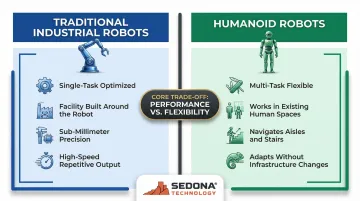
That entrenched base is also its limitation. Traditional robots require facilities built around them — humanoid robots work within facilities built for people.
What sets humanoid robots apart is their bipedal form factor, two-armed manipulation, and ability to navigate spaces already designed for humans. They can walk aisles, climb stairs, open doors, and use existing tools without the facility modifications fixed automation demands.
The core trade-off comes down to performance versus flexibility: purpose-built automation excels at a single task done repeatedly at high speed, while humanoids adapt across many tasks in changing environments — often without any infrastructure changes at all.
When Each Approach Makes Sense
Choose traditional fixed automation for:
- High-volume, 24/7 single-task production lines
- Precision welding, assembly, or CNC operations
- Environments already designed around robotic cells
- Tasks requiring sub-millimeter accuracy
Choose humanoid robots for:
- Variable, multi-step workflows that change frequently
- Physically demanding or ergonomically complex tasks beyond the reach of fixed arms
- Facilities where the cost of retrofitting for traditional automation is prohibitive
Key Ways Humanoid Robots Are Transforming Factory Operations
Heavy Lifting and Ergonomically Hazardous Material Handling
One of the first documented industrial use cases focuses on picking up heavy, awkward objects that strain human workers—tasks that are simultaneously dangerous and difficult to automate with fixed equipment. Boston Dynamics' Atlas deployment at Hyundai specifically targets handling tasks that are difficult or hazardous for human workers, addressing the intersection of safety and automation complexity.
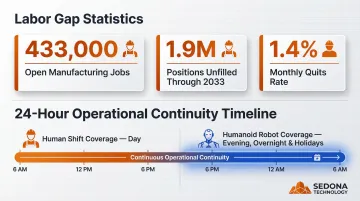
The US Bureau of Labor Statistics reports 433,000 open manufacturing jobs as of December 2025, with a Deloitte study projecting that 1.9 million manufacturing positions could remain unfilled through 2033. Humanoid robots directly address this gap by taking on the physically demanding roles that are hardest to staff.
Multi-Task Flexibility on the Production Floor
A single humanoid unit can move between depalletizing, assembly assistance, quality inspection staging, and restocking—all within the same shift. Agility Robotics' Digit robot exemplifies this flexibility, moving totes from autonomous mobile robots to conveyors in warehouse settings, demonstrating how one platform can handle multiple logistics tasks without reprogramming.
Operating in Existing Human-Designed Infrastructure
Because factories were designed around human workers, humanoid robots can navigate existing infrastructure without modification. They walk aisles, climb stairs, open doors, and use existing tools and equipment—eliminating the costly facility modifications that fixed automation demands.
This is particularly valuable for facilities with legacy layouts or multi-building campuses where traditional automation would require extensive retrofitting.
24/7 Operational Continuity
Humanoid robots can run during off-shifts, holidays, and overnight windows—covering the productivity gaps that labor shortages create—while requiring minimal human supervision during those periods. The manufacturing sector's 1.4% monthly quits rate (184,000 workers in December 2025) means production gaps are a persistent problem. Continuous robot operation helps maintain output despite ongoing workforce turnover.
Collaborative Human-Robot Workflows
Humanoid robots aren't replacing workers in the near term—they're handling the physically demanding or repetitive segments so human workers can focus on quality control, problem-solving, and oversight.
Updated safety standards governing this co-working environment:
- ISO 10218-1:2025 & ISO 10218-2:2025 expand functional safety requirements and incorporate cybersecurity mandates
- ANSI/A3 R15.06-2025 includes a new Part 3 outlining safety requirements and risk assessment responsibilities for industrial robot cell users
- OSHA/NIOSH/A3 Alliance continues developing risk profiles and compliance assistance tools for human-robot collaboration
Real-World Examples: Who Is Deploying Humanoid Robots Right Now?
Boston Dynamics Atlas at Hyundai
Boston Dynamics' all-electric Atlas model is scheduled for commercial deployment in 2026 at Hyundai's RMAC facility, marking the first time Atlas moves from demo to paid production use. The roadmap targets parts sequencing by 2028 and component assembly by 2030.
Agility Robotics Digit in Warehouse Operations
Digit became one of the first humanoid robots to take on a paying warehouse job when GXO Logistics deployed it at a Spanx facility in Georgia in June 2024. The robot moves totes from autonomous mobile robots to conveyors, establishing a proof-of-concept that has since attracted broad commercial interest. Amazon began testing Digit in October 2023 for tote recycling at an R&D facility south of Seattle.
Figure AI's Commercial Robot Shipments
Figure's biped became the second humanoid robot to secure paying commercial customers, signaling that the transition from prototype to product is underway. BMW Manufacturing completed a weeks-long trial in Spartanburg where Figure robots inserted sheet metal parts for 30,000 cars. However, BMW confirmed no Figure robots are currently at the plant and there is no definite timetable for return, showing how much distance remains between a successful pilot and a permanent production role.
Tesla Optimus Production Ambitions
Tesla CEO Elon Musk stated expectations to have thousands of Optimus units working in Tesla factories by the end of 2025. However, challenges around autonomous function and supply chain constraints—particularly China's export restrictions on rare earth magnets required for compact actuators—have tempered timelines. Musk confirmed in April 2025 that Optimus production was disrupted by these export restrictions.
China's Humanoid Robot Output: Volume, Speed, and Cost Pressure
China accounted for 54% of global industrial robot deployments in 2024 (295,000 units), with an operational stock exceeding 2 million units. Unitree Robotics reported shipping over 5,500 humanoid robots in 2025. UBTECH secured 800 million yuan (~$110 million USD) in orders and shipped hundreds of Walker S2 units to automotive and logistics partners.
That production volume has real implications: Chinese manufacturing capacity could drive down unit costs faster than Western forecasts currently account for.
The AI Engine Powering Humanoid Factory Robots
The Historical Bottleneck
Teaching a robot a new task traditionally required extensive manual programming, making multi-task humanoids impractical. Every new object, environment variation, or workflow change demanded hours of engineering time to code new behaviors and test edge cases.
Large language models are changing this by giving robots a form of "common sense"—the ability to adapt to new situations using learned context rather than hard-coded instructions.
Google DeepMind's Gemini Robotics
Announced in March 2025, DeepMind's Gemini Robotics is a Vision-Language-Action (VLA) model built on Gemini 2.0 that adds physical actions as a new output modality for directly controlling robots. It enables robots to understand conversational instructions and adapt to environmental changes on the fly — including complex, multi-step dexterous manipulation tasks.
Industrial application: DeepMind introduced Gemini Robotics-ER (Embodied Reasoning) for roboticists to connect to low-level controllers. DeepMind is partnering with Apptronik to build next-generation humanoids and providing the model to trusted testers including Agility Robotics and Boston Dynamics.
Natural Language Programming: The Near-Future Capability
Gemini Robotics points toward a near-term shift in how factories deploy robots: verbal instruction rather than code. A supervisor could tell a robot "move this pallet to Bay 4," and the robot acts — no specialized programming knowledge required. Floor supervisors can redirect robots as production needs shift throughout the day.
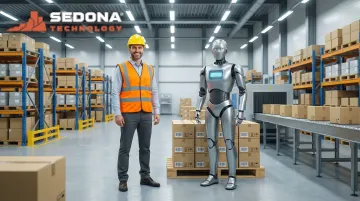
Covariant's RFM-1 Robotics Foundation Model already demonstrates this in warehouse operations. It uses video generation to predict how objects will react to robotic actions, enabling language-guided programming for pick-and-place tasks.
Challenges and Limitations Still on the Factory Floor
Reliability and Edge-Case Failure
In a May 2025 WIRED article, Chris Atkeson, a professor at Carnegie Mellon University's Robotics Institute, highlighted reliability as the central challenge. Atkeson noted that a robot restocking shelves might work perfectly for months until an edge case causes a failure: "Suppose the owner comes in one day and nothing's on the shelves, everything's on the floor. Suppose the place burns down... Those are very expensive failures."
Reliability engineering — not raw capability — is what blocks scaled deployment right now. Robots can perform well in controlled demos, but production environments demand consistent performance across thousands of operating hours and unpredictable real-world conditions.
Safety Protocols for Human-Robot Co-Existence
Heavy metallic robots operating near human workers create injury risks that require robust safety standards, sensor systems, and carefully designed workflows. The updated 2025 ISO and ANSI standards now require:
- Comprehensive risk assessments for collaborative applications (not just individual robots)
- Cybersecurity protections to prevent unauthorized robot control
- User responsibility frameworks for maintaining safe operating conditions
OSHA, NIOSH, and the Robotic Industries Association are actively developing updated standards, but gaps remain, particularly around real-world enforcement and best practices for mixed human-robot workflows.
Cost, Supply Chain, and Market Maturity Constraints
Production costs remain high despite recent reductions. Goldman Sachs estimates manufacturing costs have dropped to $30,000–$150,000 per unit, but most commercial deployments operate under undisclosed Robots-as-a-Service (RaaS) contracts rather than outright purchases.
Two additional constraints slow broader adoption:
- Rare earth supply risk: China's export restrictions on rare earth magnets directly impact humanoid production, since compact actuators require permanent magnets — and those restrictions can push back deployment schedules.
- Limited market maturity: Most deployments remain in pilot or early commercial phases. Even successful trials like Figure at BMW have not yet transitioned to permanent, scaled production.
What Factory Operators Should Consider Before Adopting Humanoid Robots
Start by Auditing Workflows for Humanoid-Fit Tasks
Identify processes that are variable, multi-step, physically demanding, or currently understaffed—these are the highest-value targets for humanoid robot deployment. Don't try to replace fixed automation that already runs efficiently.
Ideal humanoid use cases:
- End-of-line material handling with variable pallet configurations
- Multi-step kitting operations that change by product line
- Overnight restocking or inventory staging
- Tasks requiring navigation between multiple work zones
Run a Structured Pilot Before Committing to Large-Scale Deployment
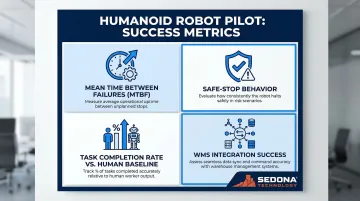
Start with a limited use case (such as end-of-line material handling or overnight restocking) to validate performance, identify edge cases, and build operator familiarity before expanding. Set clear success metrics:
- Mean Time Between Failures (MTBF) as the primary reliability measure
- Safe-stop behavior when encountering unexpected obstacles
- Task completion rates compared to human baseline
- Integration success with existing warehouse management systems
Evaluate Flexible Acquisition Options to Manage Upfront Cost and Risk
Purchasing humanoid robots outright is not the only path—rental and leasing arrangements allow factories to deploy and test robots without the capital commitment of full ownership.
Sedona Technology, for example, offers sales, rental, and leasing options with free installation, training, and ongoing support included. Their KEENON S100 heavy-duty transport robot rents for $575/month (2-month minimum), giving operations a low-commitment way to pilot material handling automation before scaling.
Plan for Integration, Training, and Change Management
Robots don't operate in isolation—factories need to account for:
- Connect robots to existing ERP, MES, and warehouse management systems early in the deployment plan
- Train staff on robot operation, safety protocols, and basic troubleshooting before go-live
- Address workforce concerns about automation and job security with a clear communication strategy
- Establish maintenance protocols for routine servicing and emergency support from day one
The most successful deployments involve cross-functional teams—operations, IT, safety, and HR—working together from the pilot stage, not just at rollout.
Frequently Asked Questions
What are some examples of robots in factories?
Common factory robots include articulated arms for welding and assembly, SCARA robots for precision placement, delta robots for fast pick-and-place operations, and Cartesian gantry systems for heavy material handling. Newer humanoid models like Boston Dynamics Atlas and Agility Robotics Digit are now joining them for multi-task material handling.
What are the big 4 industrial robots?
The four most widely recognized categories are articulated robots (welding, complex assembly), SCARA robots (high-speed electronics assembly), delta (parallel link) robots (packaging, food processing), and Cartesian/gantry robots (heavy material handling, CNC routing).
Are robots working in factories?
Yes, robots are actively working in factories worldwide. The IFR reports over 4.6 million operational industrial robots as of 2024, with 542,000 new installations in 2024 alone. Humanoid robots are now beginning to join them in commercial deployments, though most remain in pilot or early production phases.
What do you call robots in factories?
Factory robots are called industrial robots, with humanoid variants referred to as humanoid robots or bipedal robots. Collaborative models working alongside humans are called cobots (collaborative robots), designed for safe human-robot interaction within shared workspaces.
How do humanoid robots differ from traditional industrial robots?
Traditional industrial robots are fixed, single-purpose machines with factory layouts built around them. Humanoid robots navigate existing workspaces and handle multiple task types — trading peak performance for flexibility, which makes them suited to variable workflows rather than high-volume repetitive lines.
Will humanoid robots replace human factory workers?
Near-term deployment focuses on augmentation, not replacement — humanoids take on physically demanding, repetitive, or hazardous tasks while human workers move into supervisory and quality control roles. With 1.9 million manufacturing jobs projected unfilled through 2033, robots are more likely to close labor gaps than displace existing workers.