Introduction
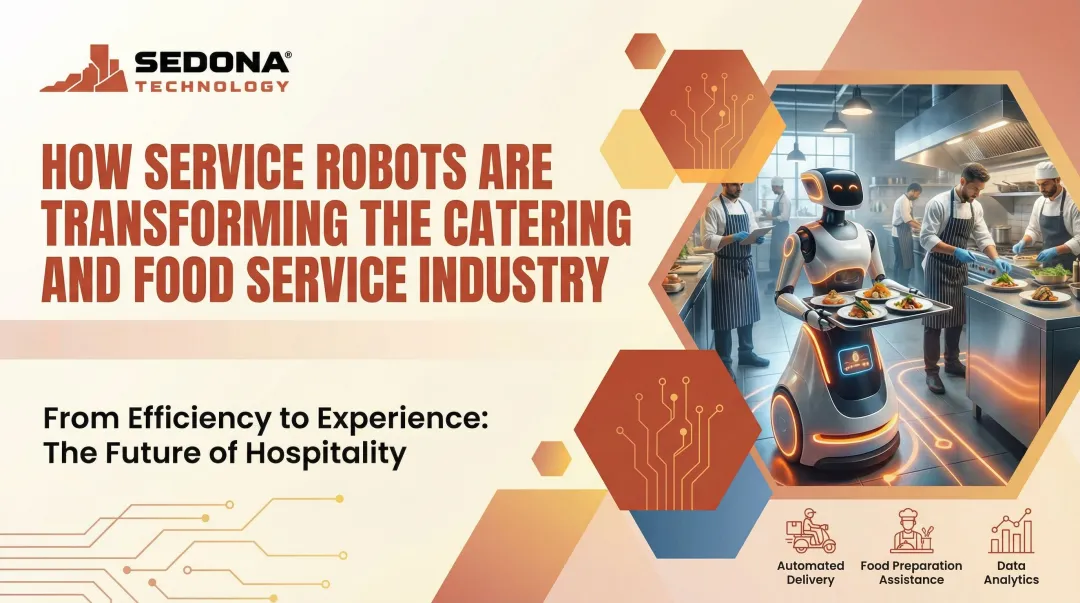
Picture this: a sleek, wheeled robot glides across a bustling hotel lobby, delivering fresh towels directly to a guest's room without a single human touch. Across town, an autonomous server navigates a packed restaurant floor, balancing trays of steaming dishes while smoothly avoiding diners and wait staff. In a sprawling warehouse, a heavy-duty transport robot moves pallets of inventory through narrow aisles designed for human workers—no facility redesign required.
All three scenarios are happening right now, in real businesses. The humanoid robot market is projected to grow from $4.04 billion by 2030 (Grand View Research) to as high as $15.26 billion by 2030 (MarketsandMarkets)—representing annual growth rates between 17.5% and 39.2%.
Goldman Sachs estimates the total addressable market could reach $38 billion by 2035 as hardware costs drop and AI capabilities accelerate.
Businesses across hospitality, food service, logistics, and manufacturing are deploying these robots as competitive necessities, not novelties. Labor shortages aren't easing—82% of hotels reported staffing shortages in 2023, according to the American Hotel & Lodging Association—and humanoid robots offer a practical path to extended operating hours and consistent service quality.
What follows covers what humanoid service robots actually are, the technology behind them, the industries seeing the most impact, and how businesses can approach adoption—including flexible options like rental and leasing.
Key Takeaways
- Humanoid service robots mimic human form and behavior, allowing them to navigate restaurants, hotels, warehouses, and factories without infrastructure overhauls
- They combine AI, computer vision, and advanced sensors to perform tasks autonomously, from delivering food to moving warehouse inventory
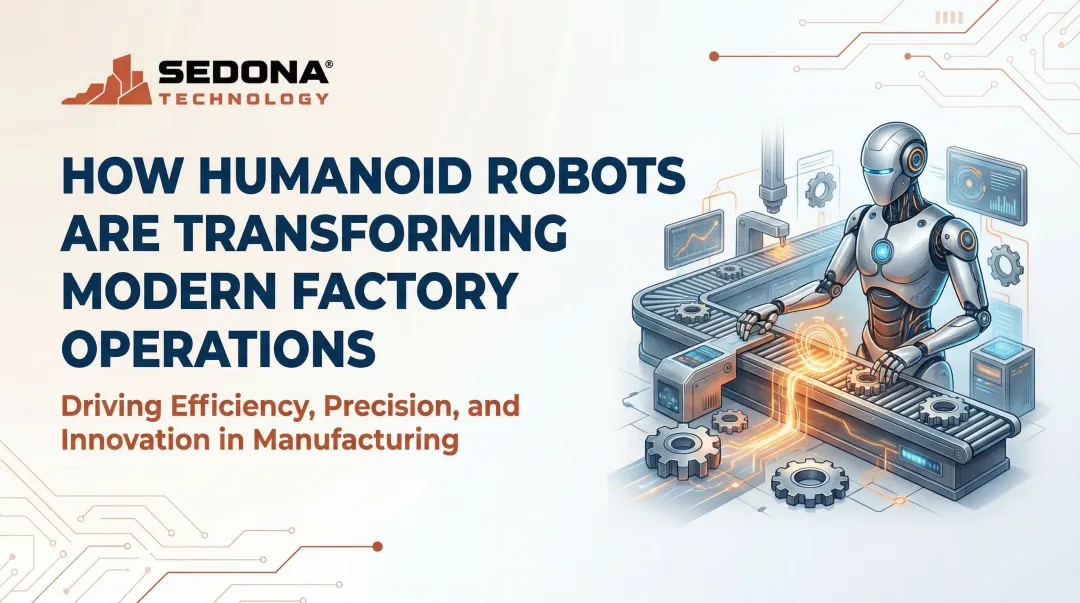
- Industries like hospitality, logistics, manufacturing, and retail are deploying these robots to address labor shortages and boost efficiency
- Unlike rigid industrial robots, humanoid models adapt to unstructured environments and handle diverse tasks with minimal reconfiguration
- Flexible acquisition options—including rental starting at under $350/month and leasing—make it practical for businesses to pilot and scale without heavy upfront commitment
What Is a Humanoid Service Robot?
Humanoid robots are machines designed to resemble and move like humans. They typically feature a torso, arms, head, and either legs or a wheeled base. The key distinction: they're built to operate in environments designed for people—using human-height counters, navigating standard doorways, and working with tools and workflows originally intended for human hands.
Humanoid vs. Humanoid Service Robot
Not all humanoid robots serve the same purpose. A humanoid service robot is a subset focused on performing tasks that directly benefit people in commercial settings. These include greeting hotel guests, serving food and beverages, delivering items to rooms, restocking shelves, or transporting materials in warehouses. This contrasts with research humanoids (built for labs) or entertainment robots (designed for exhibitions).
Form Factor Spectrum: Bipedal vs. Wheeled
Humanoid service robots come in two primary form factors:
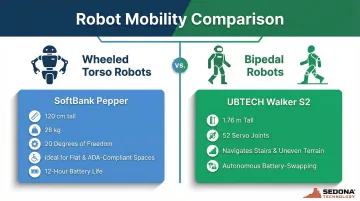
Wheeled Torso Robots:
- Stable and fast on flat surfaces
- Ideal for ADA-compliant hospitality and retail spaces
- SoftBank's Pepper (120 cm tall, 28 kg, 20 degrees of freedom) is deployed in hotels, airports, and retail stores
Bipedal Robots:
- Navigate stairs, uneven terrain, and varied elevations
- Better suited for dynamic industrial environments
- UBTECH Walker S2 (1.76 meters tall, 52 servo joints) runs in smart factories with autonomous battery-swapping for 24/7 operation
| Robot Platform | Form Factor | Primary Environments | Key Strengths |
|---|---|---|---|
| SoftBank Pepper | Wheeled Torso | Retail, Hotels, Airports | 12-hour battery, stable, approachable design |
| UBTECH Walker S2 | Bipedal | Manufacturing, Logistics | 15kg payload, autonomous battery swap |
| Apptronik Apollo | Bipedal | Warehouses, Factories | 55 lb payload, hot-swappable batteries |
| Agility Digit | Bipedal | Logistics, Distribution | Self-recovers from falls, navigates human spaces |
Why Humanoid Form?
Businesses already operate in environments designed for human workers. Counter heights, doorways, aisles, and tools are all built to human scale. Humanoid robots can integrate into these environments without expensive infrastructure redesigns—unlike traditional industrial robots that require dedicated setups, safety cages, and fixed mounting.
That infrastructure compatibility is exactly what makes solutions like the KEENON BUTLERBOT W3 from Sedona Technology practical for hotels. The wheeled hospitality robot delivers items directly to guest rooms, integrating with existing elevators and room call systems—operating 24/7 without requiring facility modifications.
What Humanoid Service Robots Are NOT
Humanoid service robots are purpose-built tools—not autonomous general intelligence. They operate within defined parameters, augmenting human teams by handling repetitive tasks, covering off-hours shifts, and taking on physically demanding work that causes fatigue or injury when done by people. Strategic decisions stay with humans; execution is where these robots deliver value.
Key Technologies That Power Humanoid Service Robots
Modern humanoid service robots run on three core technology layers — perception, intelligence, and movement — each one essential to functioning in real-world environments alongside people.
AI and Machine Learning
AI enables decision-making and task adaptation. Modern humanoid robots use large language models (LLMs) and Vision-Language-Action (VLA) models to understand verbal instructions and adapt to new tasks without reprogramming.
For example, Figure AI's Helix VLA model translates semantic knowledge into continuous robot actions at 200 Hz, controlling the entire upper body. Following a collaboration with OpenAI, Figure's robots can process natural language requests — such as "pick up the red cup" — and execute them without pre-scripted routines.
Tesla's Optimus takes a similar approach, using end-to-end AI where the system executes tasks from original commands under AI-generated rules rather than rigid scripts.
This shift from scripted to instructed behavior means robots can handle novel situations and improve performance over time. Where older systems required days of programming for each new task, a modern robot can receive a verbal instruction and act on it immediately.
Computer Vision and Sensors
Humanoid robots "see" their environment through a combination of cameras, depth sensors, and other perception systems. These enable them to recognize objects, navigate obstacles, and interact safely with people.
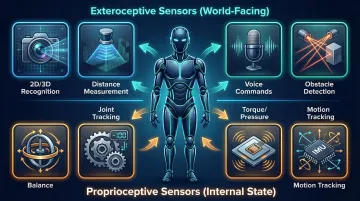
Exteroceptive Sensors (World-Facing):
- 2D/3D cameras for object recognition
- Depth sensors (LiDAR, Intel RealSense) for distance measurement
- Microphones for voice commands
- Infrared and laser sensors for obstacle detection
Proprioceptive Sensors (Internal State):
- Gyroscopes and accelerometers for balance
- Encoders to track joint position and speed
- Force sensors to measure torque and pressure
- IMUs (Inertial Measurement Units) for motion tracking
For example, SoftBank's Pepper uses 2D cameras, a 3D depth sensor, sonars, infrared sensors, and lasers to perceive crowded public spaces safely. UBTECH's Walker S2 uses RGB binocular stereo vision for human-like depth perception, combined with force-feedback joints for precise manipulation.
Actuators and Movement Systems
Perception only matters if the robot can act on it. Actuators — the motors that replicate human joint movement — translate sensor data into physical action, using servo motors with precise torque control to grasp delicate objects, maintain balance on uneven surfaces, and move smoothly through tight spaces.
Apptronik's Apollo features a force-control architecture that allows it to operate safely alongside human workers, sensing resistance in real time and adjusting movements to prevent collisions or excessive force.
| Robot Platform | Vision/Audio Sensors | Motion/Force Sensors | Task Implications |
|---|---|---|---|
| SoftBank Pepper | 2D/3D cameras, sonars, lasers, mics | Gyroscope, accelerometer, encoders | Safe navigation in crowded public spaces |
| UBTECH Walker S2 | RGB binocular stereo vision | Force-feedback joints | High-precision industrial manipulation |
| Apptronik Apollo | Vision systems | Advanced torque sensors | Force-control for safe human interaction |
| Agility Digit | LiDAR, Intel RealSense depth cameras | MEMS IMU, encoders | Warehouse navigation, tote handling |
Industries Being Transformed by Humanoid Service Robots
Hospitality and Food Service
Humanoid robots are proving their value in guest-facing roles and high-throughput beverage service, addressing acute labor shortages while enhancing customer experience.
Restaurant Service Robots:
Sedona Technology offers a lineup of dining service robots purpose-built for restaurants, cafes, and food service establishments. Models scale to fit any operation:
- KEENON DINERBOT T10 — premium option with built-in promotional display, autonomous route planning, and voice interaction
- DINERBOT T9 Pro — delivers to multiple tables simultaneously with enhanced load capacity
- DINERBOT T9 — suited for mid-sized operations
- DINERBOT T8 — compact option for smaller cafes
All models include free installation, training, and ongoing support, with rental options starting at $369/month.
Hotel Concierge and Room Service:
The KEENON BUTLERBOT W3 exemplifies hotel automation. This autonomous butler robot delivers items directly to guest rooms with contactless delivery, auto elevator integration, and 24/7 operation — freeing front-desk staff for higher-value guest interactions.
SoftBank's Pepper has been deployed at properties like the Mandarin Oriental in Las Vegas and Courtyard by Marriott in Anaheim for guest engagement and wayfinding.
Bartending and Beverage Service:
Macco Robotics' KIME humanoid bartender automates high-volume beverage dispensing. According to the manufacturer, KIME serves 60-180 drinks per hour and can pour two beers every 6-8 seconds. The robot operates 24/7 and integrates with POS systems, making it ideal for bars, events, and high-traffic venues.
Warehousing and Logistics
Logistics represents the most commercially mature sector for bipedal humanoids, with deployments moving from R&D to revenue-generating operations.
Agility Robotics' Digit:
In June 2024, GXO Logistics signed a multi-year Robots-as-a-Service (RaaS) agreement to deploy Digit at a Spanx facility in Georgia. Digit moves totes from autonomous mobile robots and places them onto conveyors, orchestrated by the Agility Arc cloud platform. Amazon also began testing Digit in 2023 for tote recycling — the repetitive process of moving empty totes after inventory is picked. Toyota Motor Manufacturing Canada followed with a commercial agreement in 2026 to deploy Digit across supply chain and logistics operations.
Industrial Transport:
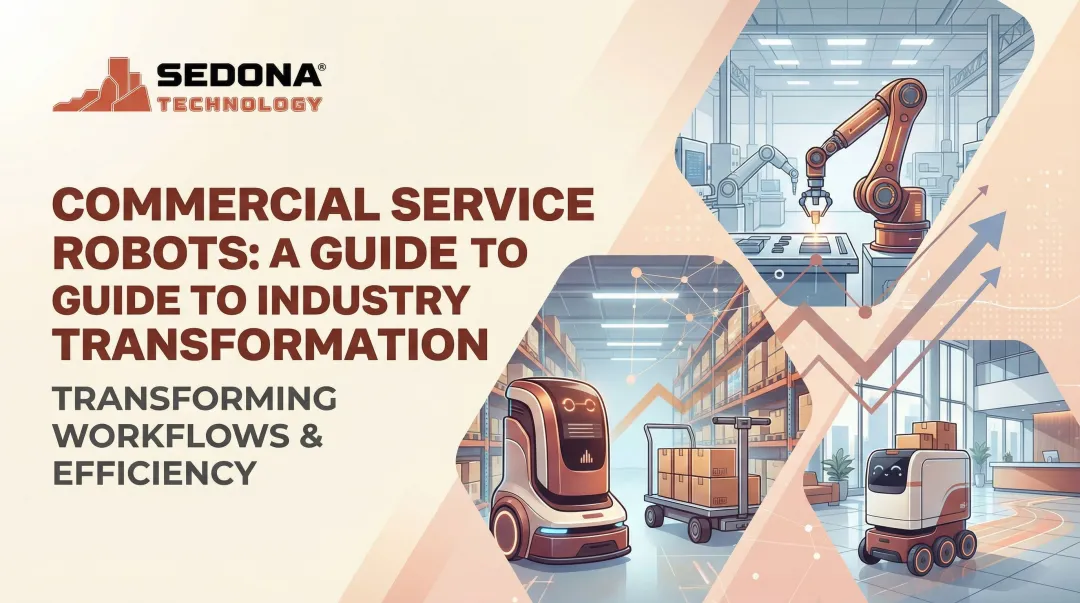
Sedona Technology's KEENON S100 is a heavy-duty transport robot designed for factories and warehouses. It autonomously transports heavy loads with real-time coordination with facility systems, coordinating with existing facility management systems to keep production moving without interruption. Monthly rental is $575, with free installation, training, and support included.
Manufacturing and Production Lines
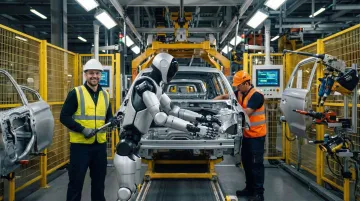
Automakers have moved fastest on humanoid adoption — starting with simple, repetitive, and ergonomically taxing tasks before advancing to complex assembly work.
Mercedes-Benz and Apptronik Apollo:
In March 2024, Mercedes-Benz entered a commercial agreement to pilot Apollo. The robot delivers assembly kits to production lines, inspects components, and transports totes of kitted parts. Apollo's force-control architecture allows it to operate safely alongside human workers.
BMW and Figure 02:
Figure AI completed an 11-month deployment at BMW Group Plant Spartanburg. The Figure 02 robot ran 10-hour shifts, loaded over 90,000 parts, logged 1,250+ hours of runtime, and contributed to the production of over 30,000 vehicles. The robot successfully inserted sheet metal parts into specific fixtures with millimeter precision.
| Manufacturer | Robot Platform | Verified Tasks | Reported Outputs |
|---|---|---|---|
| Mercedes-Benz | Apptronik Apollo | Kitted parts delivery, component inspection | Active pilot in Berlin and Hungary |
| BMW | Figure 02 | Sheet metal insertion, complex grasping | 90k+ parts loaded, 1,250+ hours runtime |
| Tesla | Optimus | Internal factory tasks | Target: 1M unit production line in Fremont |
Retail and Customer-Facing Spaces
Retailers and experience centers are deploying humanoids for guided tours, product demonstrations, and interactive customer assistance.
XPENG Next-Gen IRON:
In late 2025, XPENG unveiled its Next-Gen IRON humanoid, designed for guided tours, shopping guides, and traffic diversion. During a demonstration at an AI Mobility Experience Center, IRON acted as a tour guide, answering impromptu questions. XPENG aims for large-scale mass production by the end of 2026.
Cleaning and Facility Maintenance:
Sedona Technology's KLEENBOT series provides automated cleaning for retail spaces, malls, and airports. The KLEENBOT C30 features laser SLAM navigation for high-traffic environments like airports and warehouses ($349/month rental). The KLEENBOT C25 serves malls and large retail spaces with high-capacity tanks ($499/month), while the KLEENBOT C20 handles offices and smaller retail environments ($425/month). All operate with minimal human intervention and include free installation, training, and support.
Healthcare and Elder Care
Healthcare deployments remain largely in research and pilot phases, requiring strict safety and compliance validation.
Two platforms have received the most attention in peer-reviewed research and vendor pilots:
- SoftBank NAO — used in a 2015 Frontiers in Aging Neuroscience study for dementia therapy sessions, and in separate research for upper-limb rehabilitation training
- Engineered Arts Ameca — positioned for patient interaction, hospital concierge duties, and therapy support, though these remain vendor-stated use cases rather than scaled clinical deployments
Business Benefits of Deploying Humanoid Service Robots
Labor Cost Reduction and Availability
Humanoid service robots operate continuously—nights, weekends, and holidays—without overtime, sick leave, or turnover. That availability directly addresses a structural problem in service industries.
The hospitality sector is under pressure: 82% of hotels reported staffing shortages in 2023, according to the American Hotel & Lodging Association, with 67% still short-staffed in 2024 per SHRM. In food service, 62% of restaurant operators report their restaurant cannot meet customer demand with current staff, according to the National Restaurant Association.
Agility Robotics targets an under-2-year payback period for Digit when compared to a fully loaded human worker costing $30/hour. This ROI calculation factors in the robot's ability to operate multiple shifts without breaks, benefits, or training costs.
Operational Efficiency and Consistency
Robots perform repetitive tasks with consistent quality and speed. For example:
- Macco Robotics' KIME produces 60-180 drinks per hour, providing reliable throughput for high-volume beverage service
- Figure 02 at BMW loaded 90,000+ parts over 1,250+ hours of runtime, demonstrating sustained industrial efficiency
- KEENON BUTLERBOT W3 operates 24/7 without human supervision, enabling hotels to offer room service around the clock
Unlike human workers, robots don't forget steps, get distracted, or slow down based on fatigue or mood. The result: fewer errors and consistent output across every shift, every day.
Enhanced Customer Experience and Competitive Differentiation
Deploying humanoid service robots creates a memorable, modern brand experience—particularly in hotels, restaurants, and retail. The novelty factor drives customer engagement and organic social sharing, while the practical benefits (faster service, extended hours) improve satisfaction.
SoftBank's Pepper deployments at hotels and airports demonstrate this dual value: guests interact with the robot for entertainment and information, while staff benefit from reduced workload on routine inquiries.
Scalability and Flexible ROI
Full ownership isn't the only path in. Rental and leasing models let businesses pilot robots at lower upfront cost, then scale what works—without tying up capital in hardware that's still proving itself.
Sedona Technology structures its offerings with sales, rental (minimum 2 months), and leasing through a trusted partner—each with free installation, training, and ongoing support included. Monthly rental pricing ranges from $349 to $575 depending on the robot model, making it accessible for businesses of all sizes to pilot automation without major capital investment.
What to Consider Before Adopting a Humanoid Service Robot
Assess Task Fit and Environment Readiness
Start by identifying specific repetitive or high-volume tasks where a robot would provide clear value:
- Food delivery runs in restaurants
- Item restocking in warehouses
- Greeter duties in hotels or retail
- Cleaning cycles in malls or airports
Once you've mapped the tasks, evaluate whether your physical environment is compatible:
- Flat, ADA-compliant floors for wheeled robots
- Adequate lighting for computer vision systems
- Clear pathways without excessive clutter
- Network connectivity for cloud-based orchestration
Understand Total Cost of Ownership vs. Acquisition Options
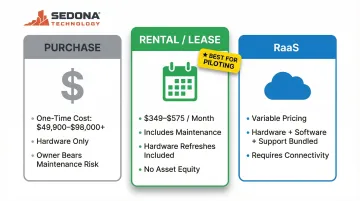
Each acquisition model carries different cost structures and risk profiles. Here's how they compare:
| Model | Typical Pricing | What's Included | Key Trade-off |
|---|---|---|---|
| Purchase | $49,900–$50,000+ (Pepper, Apptronik); KIME at |
Hardware only | You bear maintenance and obsolescence risk |
| Rental/Lease | $349–$575/month (Sedona); KIME at ~€1,500/month | Maintenance + hardware refreshes | No asset equity; minimum term contracts apply |
| RaaS | Varies by provider | Hardware, software, and support bundled | Requires continuous network connectivity |
Sedona Technology's rental and leasing options include free installation and training, so you're not paying extra to get up and running.
Plan for Human-Robot Integration
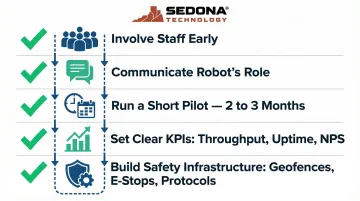
With costs and environment sorted, the final piece is change management. Humanoid service robots work best as complements to existing teams, not replacements. Best practices include:
- Involve staff early in the evaluation and selection process
- Communicate the robot's role clearly — emphasize how it reduces drudgery, not headcount
- Run a short pilot (2–3 months) to optimize workflows before scaling
- Set clear KPIs: throughput per hour, queue time reduction, Net Promoter Score, uptime percentage
- Train staff on how to interact with and troubleshoot the robot
Before expanding to a fully mixed human-robot environment, build out your safety infrastructure first. That means geofences, emergency stops (E-stops), human oversight protocols, and incident playbooks — all in place before day one.
Frequently Asked Questions
What is a humanoid service robot?
A humanoid service robot is a machine designed to resemble human form and perform tasks in service environments like restaurants, hotels, and warehouses. Unlike industrial or research robots, they focus on direct-to-human service functions such as food delivery, guest assistance, and item transport.
How are humanoid service robots different from regular service robots?
Humanoid robots operate in environments and use tools built for humans—standard doorways, counters, and aisles—making them more versatile and deployable without major infrastructure changes. Regular service robots often require custom setups, fixed mounting, or dedicated pathways.
What industries are using humanoid service robots today?
Primary sectors include hospitality and food service (hotels, restaurants), warehousing and logistics (distribution centers), manufacturing (assembly lines), retail (malls, airports), and healthcare (elder care, patient interaction).
How much does a humanoid service robot cost?
Pricing varies widely based on model and capability. Rental options range from $349 to $575 per month, while purchase prices span from $5,000 (used Pepper units) to $90,000+ (KIME bartender).
Can humanoid service robots operate without human supervision?
Many modern humanoid service robots are designed for autonomous or semi-autonomous operation and can run 24/7 with minimal human intervention. The KEENON BUTLERBOT W3, for instance, operates continuously in hotels without supervision.
What is the ROI of deploying a humanoid service robot?
ROI varies by use case but typically comes from reduced labor costs, extended operating hours, improved throughput, and lower turnover-related expenses. Agility Robotics targets under 2 years payback for Digit.