Labor shortages, rising operational costs, and customer experience expectations are pushing businesses across sectors to seek smarter solutions. Cornell University research shows replacing a single hospitality worker costs $5,864, while the U.S. accommodation and food services sector continues to average 890,000 unfilled job openings monthly. Commercial service robots are emerging as a practical answer.
This guide covers what commercial service robots are, which industries are being transformed, the real benefits, common challenges, and how businesses can get started.
TLDR:
- Commercial service robots handle repetitive, customer-facing tasks autonomously in dynamic environments
- 199,000 professional service robots were sold globally in 2024, with 31% growth in rental-based deployments
- Restaurants, hotels, warehouses, and retail spaces achieve measurable ROI through labor cost reduction and efficiency gains
- Modern robots deploy quickly with professional installation and training included
- Flexible rental and leasing options make robotics accessible to small and mid-sized businesses
What Are Commercial Service Robots?
Commercial service robots are autonomous or semi-autonomous machines designed to assist businesses in non-manufacturing, customer-facing or operational environments. The International Organization for Standardization (ISO 8373:2021) defines them as robots that perform "useful tasks for humans or equipment excluding industrial automation applications." This distinguishes them from industrial robots, which work on fixed factory assembly lines performing repetitive production tasks.
Core Technologies Enabling Modern Service Robots
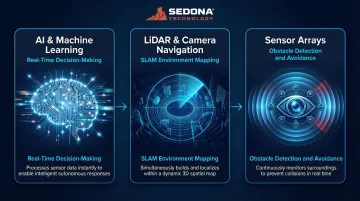
Three foundational technologies make modern service robots practical for real-world business environments:
- AI and machine learning enable real-time decision-making, allowing robots to adapt to changing environments and optimize task execution
- LiDAR and camera-based navigation use SLAM (Simultaneous Localization and Mapping) to map unknown environments while tracking the robot's position in real time
- Sensor arrays including RGB-D cameras, IMUs, and proximity sensors enable safe operation around people by detecting moving obstacles and recalculating collision-free paths
Understanding the Autonomy Spectrum
Service robots operate across a spectrum of autonomy. Fully autonomous robots like delivery and cleaning models operate 24/7 without human supervision, handling tasks independently from start to finish. Semi-autonomous robots work alongside staff, requiring occasional human input for complex or unexpected situations. That range matters practically: businesses can deploy robots for repetitive, time-intensive work while staff focus on customer interaction and judgment calls that machines can't replicate.
Sedona Technology covers both ends of this spectrum — from fully autonomous cleaning robots with SLAM-based navigation to delivery robots that integrate with elevator systems for hands-free, multi-floor operation.
Why Businesses Are Adopting Service Robots Now
Three converging pressures are driving rapid adoption of commercial service robots.
The Labor Crisis and Rising Wage Costs
Persistent labor shortages in hospitality and food service have created operational bottlenecks that traditional hiring cannot solve. With median hourly wages for waitstaff reaching $15.36 and turnover costs averaging $5,864 per employee, operators face a compounding financial drain.
Post-pandemic hygiene expectations have added pressure on top of that, with 71% of guests preferring hotels with self-service technology that minimizes physical contact.
Market Growth and the RaaS Revolution
Robot-as-a-Service (RaaS) fleet deployments grew 31% in 2024, changing the economics of robot adoption. Rather than requiring large upfront capital investments, businesses can now access robotics through subscription or rental models. This shift has opened the market to small and mid-sized businesses that couldn't justify traditional capital expenditures.
Sedona Technology exemplifies this trend, offering flexible rental options starting at a 2-month minimum period, with monthly rates ranging from $349 to $575 depending on the model. All rentals include free installation, training, and ongoing support.
Technology Maturity Has Reached Critical Mass
Today's service robots are a different category than what existed five years ago. Modern systems now offer:
- Deployment in days, not months
- Minimal technical expertise required to operate
- Reliable performance in dynamic, real-world environments
- Accessible pricing through rental and subscription models
That combination has brought robotics within reach for independent restaurants, boutique hotels, and mid-sized warehouses alike.
Key Industries Being Transformed
Restaurants and Food Service
Food delivery robots navigate dining rooms autonomously, reducing strain on wait staff during peak hours. These robots ensure orders arrive promptly while allowing servers to focus on high-value guest interactions.
Research from Bear Robotics shows servers took 428 fewer steps per shift when working alongside delivery robots. One dining manager reported overtime costs dropped from $13,800 to $7,145 in a single month after deployment.
The operational impact extends beyond labor savings. UK restaurant The Modern Table increased table turns from 1.8 to 2.5 and cut labor costs from 42% to 28% of revenue, achieving a 16-month payback period. Robots also handle tray and dish collection between courses, keeping floor operations running without adding headcount.
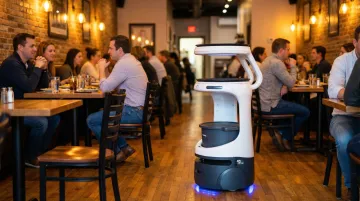
Sedona Technology offers four KEENON DINERBOT models tailored to different restaurant scales, from the compact T8 for small cafes to the premium T10 featuring interactive displays for customer engagement.
Hotels and Hospitality
Service robots cover room service delivery, floor patrol, and concierge assistance across multiple shifts — freeing front-of-house staff to focus on guest relationship management. Marriott Aloft's pilot with delivery robots achieved a 98% delivery success rate and reduced room service times by 40%, dropping from 15 minutes to 9 minutes. The hotel also recorded an 18% increase in Net Promoter Score directly attributed to the robot.
The "wow factor" matters. One guest's TikTok video of a hotel delivery robot generated over 250,000 impressions, translating robot presence into organic marketing value. More importantly, robots enable 24/7 room service without inflating overnight payroll—the single overnight front-desk clerk can remain at their post rather than abandoning the lobby for deliveries.
The KEENON BUTLERBOT W3 from Sedona Technology operates 24/7 without human supervision, features auto elevator and room call integration, and maintains secure compartment access for guest items.
Warehouses and Logistics
Autonomous Mobile Robots (AMRs) handle order picking, goods transport, and inventory movement around the clock — cutting the gap between order placement and shipment.
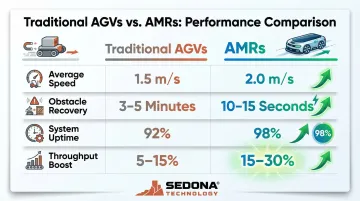
Compared to traditional Automated Guided Vehicles (AGVs), AMRs perform significantly better in dynamic warehouse environments:
| Performance Metric | Traditional AGVs | AMRs |
|---|---|---|
| Average Speed | 1.5 m/s | 2.0 m/s |
| Obstacle Recovery | 3-5 minutes | 10-15 seconds |
| System Uptime | 92% | 98% |
| Throughput Boost | 5-15% | 15-30% |
A case study of 6 River Systems showed a 252% improvement in pick rates, jumping from 40 to 141 lines per hour by reducing unproductive walking time by 71.6%. DHL Supply Chain reported 30–180% increases in units picked per hour with an 80% reduction in training time.
Sedona Technology's KEENON S100 handles heavy loads autonomously with real-time coordination with facility systems, supporting continuous workflow operations.
Retail and Malls
Shelf-scanning robots address a $162.7 billion problem. Simbe Robotics' Tally robot detects up to 10x more out-of-stock items than manual audits and reduces out-of-stocks by 20%, often paying for itself within the first month. At ShopRite, Tally reduced out-of-stocks by 50% in a high-volume store.
Customer-greeting robots at entrances and robots that guide shoppers improve the in-store experience while reducing labor demands.
Offices, Airports, and Industrial Facilities
Autonomous cleaning robots maintain hygiene standards in large-footprint environments. A major grocery retailer saved 33,649 labor hours across 100 stores using Tennant robotic scrubbers, delivering $2.12 million in annual business value. The results scale to larger facilities too: CVG Airport cleans 200,000 square feet weekly with Avidbots, with each robot operating 6 hours per charge.
Sedona Technology's KLEENBOT lineup includes the C30 model specifically designed for airports, warehouses, and industrial buildings, featuring Laser SLAM technology with real-time path adjustment.
Core Benefits for Business Operations
Operational Efficiency
Robots handle repetitive, time-consuming tasks continuously without fatigue. This translates to faster service cycles, higher throughput, and freed-up human staff for complex tasks requiring judgment and empathy.
The efficiency gains are measurable:
- Restaurants see table turn improvements of 30–40%
- Warehouses report pick rate increases exceeding 250%
- Hotels cut delivery times in half
These improvements compound over time as robots operate 24/7 without breaks, shift changes, or overtime pay.
Labor Cost Reduction
Robots supplement rather than simply replace staff. They reduce overtime costs, minimize the impact of high-turnover roles, and maintain consistent service quality during staff shortages.
When calculating ROI, factor in acquisition cost against cumulative labor savings. With rental rates starting at $349 per month and typical payback periods of 16–24 months, the numbers move fast. One restaurant reduced labor costs from 42% to 28% of revenue — a shift that hiring optimization alone couldn't have delivered.
Enhanced Customer Experience
Unlike human staff, robots don't have bad days, forget orders, or leave customers waiting. In hospitality and dining, that consistency shows up directly in satisfaction scores.
The novelty factor adds another layer: 67% of surveyed customers at Skylark Group restaurants expressed satisfaction with anthropomorphic robots featuring cat-like faces. Guests often respond positively to robot interactions, generating word-of-mouth and social media attention that human staff alone rarely trigger.
24/7 Operation
This advantage matters most in warehouses and industrial settings where continuous operation is critical. A robot running 16 hours per day effectively covers two full shifts of human labor — without the associated payroll burden.
Data Collection and Process Optimization
Modern service robots capture operational data including traffic patterns, delivery times, and task completion rates. Manual operations rarely produce this level of visibility. Warehouse AMRs flag bottlenecks in real time, while cleaning robots generate verifiable coverage reports that satisfy health inspection requirements.
Common Challenges and How to Overcome Them
Integration and Setup Concerns
Many businesses worry that robots are difficult to install and require technical expertise. Modern commercial service robots are designed for straightforward deployment, often with professional installation and training included.
Sedona Technology addresses this directly — free installation, training, and ongoing support are included with all sales, rental, and leasing options. Their robots use plug-and-play navigation systems that don't require complex integration with legacy IT infrastructure.
Staff Acceptance and Change Management
Employees may initially resist or feel threatened by robotic co-workers. Successful deployments frame robots as tools that eliminate the least desirable tasks—repetitive delivery runs, floor mopping, heavy lifting—so staff can focus on higher-value, more satisfying work.
A RoboPhil case study found that transparent communication — making clear robots augment rather than replace staff — led to increased employee satisfaction. Workers freed from carrying heavy trays could focus on creative hospitality that builds customer loyalty.
Balancing Automation with Human Touch
Full automation of customer-facing roles rarely works on its own. The most effective implementations use robots for operational tasks while keeping humans at the center of relationship-building and problem-solving moments.
A practical way to think about task allocation:
- Robots: repetitive delivery routes, floor cleaning, inventory transport, 24/7 patrol
- Humans: guest complaints, upselling, nuanced service recovery, emotional support
Start by mapping your team's daily tasks, then identify which are repetitive or physical — those are your strongest candidates for automation.
How to Get Started with Commercial Service Robots
Identify the Right Use Case First
Start by auditing your operations for the highest-friction, most repetitive tasks—the ones that consume staff time without requiring human judgment. These are prime robot candidates.
Examples include:
- Table-to-kitchen delivery and bussing in restaurants
- Floor cleaning in large commercial spaces
- Goods transport between warehouse zones
- Room service delivery in hotels
- Inventory scanning in retail stores
Focus on tasks that are high-volume, physically demanding, and currently underserved by available labor.
Evaluate Your Acquisition Options
Businesses don't have to commit to outright purchase. Rental and leasing options allow organizations to pilot robotics with lower upfront commitment.
Sedona Technology offers three ways to get started:
- Sales — full ownership with free installation, training, and ongoing support
- Rental — monthly rates from $349 to $575 (2-month minimum), ideal for pilots
- Leasing — available through trusted partners for longer-term flexibility
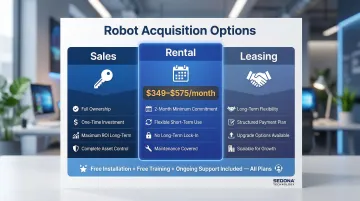
Every option includes free installation, training, and ongoing support — so there's no large upfront investment required to get up and running.
Plan for Integration and Training
Once you've chosen your acquisition path, the next step is preparing your space and your team.
Work through these steps before go-live:
- Assess your floor layout, traffic patterns, and potential obstacles
- Brief your team on the robot's role as a collaborative tool, not a replacement
- Run hands-on training so staff know how to work alongside the robot
- Set clear performance benchmarks for the first 30–90 days
Modern robots with SLAM navigation can map environments autonomously, reducing pre-deployment preparation. Professional installation handles the technical setup so your team can focus on day-one operations.
Measure ROI and Scale
Track key metrics after deployment:
- Labor hours saved per week
- Order delivery times or task completion rates
- Customer satisfaction scores
- Error rates and system uptime
- Overtime cost reductions
Use this data to justify expanding to additional robots or locations. Most deployments show clear ROI within 3–6 months and reach full payback in 16–24 months.
Frequently Asked Questions
What is the difference between a commercial service robot and an industrial robot?
Industrial robots work on fixed manufacturing lines performing repetitive production tasks in controlled environments. Commercial service robots operate in dynamic, people-facing environments like restaurants, hotels, and warehouses, designed to assist with operational and service tasks rather than manufacturing.
Can small or mid-sized businesses afford commercial service robots?
Yes. Flexible acquisition models including rental starting at 2-month minimum periods and leasing options have made service robots attainable for businesses that cannot justify large capital purchases. Monthly rental rates start at $349, with all installation, training, and support included.
Do service robots replace human employees?
Service robots are most effectively deployed to handle repetitive, low-judgment tasks, freeing human staff for more complex, customer-facing work. Most businesses report that robots supplement rather than eliminate their workforce, reducing turnover costs and overtime while improving job satisfaction.
How long does it take to deploy a commercial service robot?
Most modern service robots are operational within days of installation, with professional setup and training included. Staff typically reach full comfort with the system within 1-2 weeks.
Which industries benefit most from commercial service robots?
Food service, hospitality, warehousing/logistics, retail, and large commercial facilities (airports, malls) see the highest impact, given the combination of high labor costs, repetitive task volume, and customer-facing service demands.
How do service robots navigate and avoid obstacles safely?
Most modern commercial service robots use LiDAR sensors, cameras, and SLAM technology to map their environment in real time, detect obstacles, and navigate safely around people and objects without human intervention. Advanced models recover from unexpected obstacles in 10-15 seconds.