Introduction
The U.S. Accommodation and Food Services sector had 809,000 open jobs as of December 2025 — and operators aren't waiting for that number to shrink. Restaurants, hotels, and retail businesses are deploying customer service robots to fill the gap, handling guest interactions, deliveries, and routine service tasks with minimal human intervention.
These AI-powered machines free up staff to focus on guest complaints, upselling, and relationship-building — the work that actually requires a human.
This article covers a breakdown of the best customer service robots in 2026, along with the key benefits and challenges businesses should weigh before adopting them. Whether you're exploring purchase, rental, or leasing options, understanding which models fit your specific use case—and what support infrastructure you'll need—is essential for successful deployment.
Key Takeaways
- Customer service robots are AI-powered machines designed to handle guest interactions, deliveries, and routine service tasks autonomously
- Top 2026 options include SoftBank Pepper, Bear Robotics Servi, Keenon T9, Pudu BellaBot, and LG CLOi ServeBot, each built for different environments and industries
- Businesses gain 24/7 availability, lower long-term labor costs, consistent service quality, and a stronger guest experience
- Main challenges include high upfront costs, limited empathy in complex situations, integration hurdles, and mixed customer acceptance
- The right robot depends on your industry, specific application, and whether buying, renting, or leasing fits your budget
What Are Customer Service Robots?
Customer service robots are AI-driven machines—physical or virtual—that assist customers with inquiries, deliveries, navigation, check-ins, or routine service tasks. Rather than replacing human staff entirely, these robots work alongside employees, handling high-frequency, low-complexity tasks while humans manage emotionally sensitive interactions and escalations.
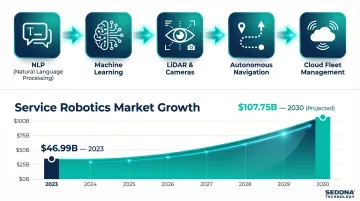
The core technologies that power these robots include:
- Natural language processing (NLP) for real-time conversation with customers
- Machine learning for continuous performance improvement over time
- LiDAR, RGB-D cameras, and visual SLAM for obstacle detection and spatial mapping
- Autonomous navigation systems for safe movement through dynamic environments
- Cloud fleet management for centralized monitoring and control across multiple units
Adoption has accelerated across restaurants, hotels, airports, retail stores, and healthcare facilities. The global service robotics market, valued at $46.99 billion in 2023, is projected to reach $107.75 billion by 2030. The models covered below represent the strongest performers across these categories heading into 2026.
Best Customer Service Robots in 2026
These robots were selected based on real-world deployment track record, AI capability, industry versatility, and value for businesses in hospitality, food service, retail, and healthcare. Each entry covers standout features, ideal use cases, and deployment options.
SoftBank Robotics Pepper
Pepper is one of the most recognized humanoid service robots globally, deployed in retail stores, hotel lobbies, banks, and airports to greet customers, answer FAQs, and guide visitors. Its interactive touchscreen and multilingual support make it ideal for high-traffic information desks.
What sets Pepper apart is its emotion recognition technology — it reads customer sentiment and adjusts its responses in real time. Combined with expressive social interaction and a proven enterprise deployment history across major hospitality and retail brands, it's built for environments where first impressions count.
| Attribute | Details |
|---|---|
| Best For | Retail, hotel lobbies, airport information desks |
| Key Features | Emotion recognition, touchscreen interface, multilingual NLP, autonomous navigation |
| Deployment Model | Available for rental or leasing through authorized suppliers |
Bear Robotics Servi
Servi is a food and beverage delivery robot purpose-built for restaurants, hotels, and large dining venues. Known for its tray-carrying capacity, autonomous table navigation, and intuitive setup, Servi has become a go-to solution for operators facing staffing shortages.
Operators choose it for its native POS integration with systems like Toast, the ability to carry multiple dishes in a single run, and growing adoption across U.S. and Asian restaurant chains. Servi also integrates with most modern elevator systems, making it practical for multi-floor venues.
| Attribute | Details |
|---|---|
| Best For | Restaurants, hotel dining, cafes, food courts |
| Key Features | Multi-tray delivery, LiDAR-based navigation, POS integration, low-profile design |
| Deployment Model | Available via subscription/rental model |
Keenon T9 (Delivery Robot)
Keenon is a leading robotics brand with broad global reach. The T9 is a compact, high-capacity food delivery robot used in thousands of restaurants, hotels, and care facilities worldwide — deployed across more than 600 cities, it has a strong track record in high-demand, diverse environments.
The T9 stands out on specs: an 88 lb payload capacity, up to 18 hours of battery life, and a multi-layer tray system for simultaneous multi-stop deliveries. Competitive pricing also makes it one of the more accessible options for mid-sized operations.
| Attribute | Details |
|---|---|
| Best For | High-volume restaurants, hotel room service, assisted living facilities |
| Key Features | Multi-layer tray system, autonomous obstacle avoidance, long battery life, voice interaction |
| Deployment Model | Sales and rental options available |
Pudu Robotics BellaBot
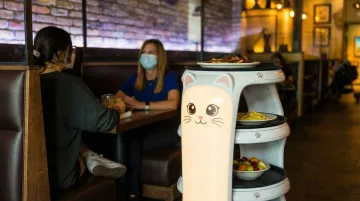
BellaBot is Pudu Robotics' flagship delivery robot, recognized for its distinctive cat-themed design and advanced AI interaction features. Deployed widely in restaurants, malls, and hotels across Asia, Europe, and North America, BellaBot has shipped over 100,000 cumulative units globally.
BellaBot's emotional expression display and reactive touch sensors make it a guest favorite — people interact with it, photograph it, and remember it. Multi-point delivery routing keeps service efficient even during peak hours. With over 100,000 units shipped, its real-world reliability at scale is well established.
| Attribute | Details |
|---|---|
| Best For | Themed restaurants, malls, hospitality venues seeking a memorable guest experience |
| Key Features | SLAM navigation, multi-point delivery, facial expression display, touch interaction |
| Deployment Model | Available for purchase or rental through regional distributors |
LG CLOi ServeBot
LG CLOi ServeBot is a commercial-grade service robot from LG Electronics, designed for hotels, airports, offices, and healthcare settings. Capable of autonomous delivery of items like food, amenities, and documents, the CLOi ServeBot excels in upscale environments requiring professional aesthetics.
The CLOi ServeBot is built for premium environments where appearance matters. Its advanced LiDAR and 3D camera navigation handles autonomous elevator use across multiple floors, while LG's cloud fleet management supports up to 20 units from a single dashboard — a practical edge for larger properties.
| Attribute | Details |
|---|---|
| Best For | Hotels, airports, corporate offices, healthcare facilities |
| Key Features | Autonomous elevator use, 3D LiDAR mapping, touchscreen interface, up to 30 kg payload |
| Deployment Model | Enterprise sales with ongoing technical support |
Key Benefits of Customer Service Robots
24/7 Availability Without Fatigue
Unlike human agents, robots operate continuously without sick leave, breaks, or staffing gaps. This ensures customers are never left waiting during peak hours, late nights, or holidays, which directly improves satisfaction scores. In environments like hotels and airports, this round-the-clock capability is especially valuable for international guests arriving at all hours.
Consistent Service Quality at Scale
Robots deliver the same standard of interaction on every task, every shift, eliminating the variability that comes with staff mood, training gaps, or high turnover common in food service and hospitality. This consistency builds predictable guest experiences and protects brand reputation across multiple locations.
Long-Term Cost Reduction
Upfront investment can be significant, but businesses offset it through:
- Reduced labor hours and overtime costs
- Lower recruitment and onboarding expenses
- Higher throughput without adding headcount
A deployment of four Pudu robots at Bae Hospitality saved $116 per hour based on minimum wage equivalents, with robots running 16 hours daily. Industry analysis puts payback periods at 18 to 24 months for successful deployments.
Enhanced Guest Experience Through Speed and Novelty
Robots reduce wait times for deliveries, check-ins, or information queries, while also creating a memorable brand moment that differentiates businesses in competitive markets. A study on indoor robot delivery found that user satisfaction and reuse intention are highly dependent on actual delivery time, with robots delivering 15-25% efficiency gains in hotel room service.
Scalability Across Locations
Once a robot model is integrated into one location's workflow, replicating it across branches or scaling up during busy seasons is far simpler compared to hiring and training new staff. Cloud fleet management systems allow operators to monitor multiple robots across different sites from a single dashboard.
Main Challenges of Deploying Customer Service Robots
High Initial Investment and Total Cost of Ownership
Hardware, software licensing, integration, and maintenance costs can be substantial for small to mid-sized businesses. Purchase prices range from $14,000 to $32,000 depending on the model, making this the biggest barrier cited by operators. Flexible acquisition models—rental or leasing—can reduce the entry barrier, with monthly rates ranging from $300 to $850.
Inability to Handle Complex or Emotionally Sensitive Interactions
Robots currently lack the nuanced empathy required for complaints, escalations, or emotionally charged customer situations. A clear human escalation pathway is essential in any deployment. When a guest becomes frustrated or needs personalized attention, staff should be able to step in without creating additional friction.
Integration and Operational Disruption
Technical and workflow challenges arise when integrating robots into existing POS systems, floor layouts, or staff processes. Poorly planned rollouts can frustrate both customers and employees rather than improve operations. Successful deployments typically require:
- API integration with existing POS or property management systems
- Network infrastructure upgrades
- Physical threshold leveling for robot navigation
- Elevator API integration in multi-floor environments
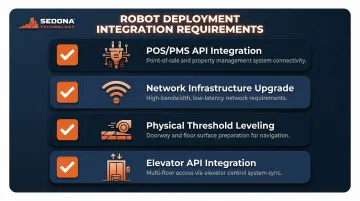
Each of these adds to the total cost of ownership and should be budgeted upfront.
Customer Acceptance and Trust
Some customer segments, particularly older guests or first-time users, may feel uneasy interacting with robots. The National Restaurant Association's 2024 Tech Landscape Report found that only 37% of full-service customers would be comfortable ordering food delivered by robots. Building trust requires transparent communication, intuitive interfaces, and a seamless fallback to human staff when needed.
How to Choose the Right Customer Service Robot for Your Business
Match the Robot's Function to Your Specific Use Case
A restaurant needs a delivery robot with multi-tray capacity and POS integration, while a hotel lobby needs a greeter with NLP and wayfinding capability. Start with function, not features. A 70cm minimum aisle requirement (Keenon T9) will fail in a restaurant designed for 55cm clearances (Bear Servi). Getting this right upfront avoids costly hardware swaps later.
Evaluate Total Cost of Ownership Versus Acquisition Flexibility
Outright purchase is not the only path. Rental and leasing options allow businesses to test a robot's ROI in their specific environment before committing, with some suppliers offering minimum rental periods as short as 2 months. Sedona Technology offers sales, rental, and leasing options with free installation and training — a straightforward way to adopt robotics without heavy upfront costs.
Prioritize Vendors Who Offer Ongoing Support and Training
The best customer service robot is only as good as the team deploying it. Before signing, confirm your vendor covers the full deployment lifecycle — not just the hardware sale. Key things to verify:
- Installation support and hands-on staff training included in the package
- Post-deployment technical assistance to reduce downtime and protect your investment
- Existing protocols for your specific elevator manufacturer and POS system
Conclusion
Customer service robots in 2026 offer real, measurable advantages for businesses in hospitality, food service, retail, and beyond. Successful deployment hinges on choosing the right robot for the right use case, backed by proper training and ongoing support infrastructure.
With labor shortages persisting and customer expectations rising, robots have shifted from novelty to operational necessity for businesses that want to maintain consistent service levels.
Move beyond brand recognition and evaluate robots based on operational fit, scalability, and acquisition flexibility. Whether you're considering a humanoid greeter, a food delivery robot, or a multi-floor service bot, matching the technology to your specific workflow and floor plan is essential. Sedona Technology works with restaurants, hotels, warehouses, and retail spaces to find the right fit — offering sales, rental, and leasing options with free installation and ongoing support included.
Frequently Asked Questions
How much is a customer service robot?
Prices vary widely—from around $14,000–$32,000 for purchase, to monthly rental fees ranging from $300 to $850 depending on the model and supplier. Leasing and rental options significantly lower the barrier to entry, allowing businesses to test ROI before committing to full purchase.
What is a customer service robot?
A customer service robot is an AI-powered machine—physical or software-based—designed to assist customers with tasks like deliveries, greetings, information queries, and check-ins. Most models work alongside human staff, freeing them from repetitive tasks to focus on higher-value interactions.
What are the main benefits of customer service robots for businesses?
The core advantages are:
- 24/7 availability without fatigue or shift gaps
- Consistent service quality across all hours of operation
- Labor cost savings with typical payback periods of 18–24 months
- Ability to scale routine interaction volume without adding headcount
Which industries benefit most from customer service robots?
Restaurants, hotels, retail stores, airports, hospitals, and corporate offices are the leading adopters. Food service and hospitality see the strongest uptake, driven by high interaction volumes and persistent labor shortages that robots directly offset.
Can customer service robots replace human employees?
Customer service robots are built to augment human staff, not replace them. They take over predictable, high-frequency tasks—food delivery, bussing, wayfinding, basic check-ins—while employees handle escalations, complaints, and interactions that require genuine judgment and empathy.
Do customer service robots require technical expertise to operate?
Most modern customer service robots are designed with user-friendly interfaces and no-code setup options. Reputable suppliers typically include installation, training, and ongoing support to ensure smooth operation, making technical expertise unnecessary for day-to-day use.