Introduction
Restaurants are getting squeezed from multiple directions at once. Labor costs keep climbing, open positions go unfilled for months, and customers now expect faster service and cleaner environments as a baseline—not a bonus. Employee turnover alone costs restaurants an average of $5,864 per worker, and 47% of operators still can't fill open positions. Service robots have moved from novelty to operational tool precisely because they address all of these pressures in one deployment.
This post breaks down the main use cases, the trends behind adoption, real-world operational impact, and what to expect from the technology over the next few years.
Key Takeaways
- Adoption is accelerating across QSRs, casual dining, and hospitality globally; restaurant robots are now mainstream
- Most common uses: food delivery, hosting, bussing, cooking assistance, and drink preparation
- Robots handle repetitive tasks so human staff can focus on customer engagement and complex service
- Flexible buying, renting, or leasing options make robots accessible to smaller operators
- Key drivers: persistent labor shortages, falling robot costs, post-COVID hygiene standards, and smarter navigation technology
Key Use Cases of Service Robots in Restaurants
Service robots cover a wider range of restaurant functions than most operators realize—from the front door to the kitchen pass. Here's where they're making the biggest impact.
Serving and Food Running
Delivery robots like BellaBot, Servi by Bear Robotics, and KettyBot carry food from kitchen to table autonomously, reducing the physical load on servers and cutting delivery errors during peak hours. Chili's Grill & Bar expanded its test of "Rita the Robot" (a rebranded Servi) to 51 locations after proving the robot's reliability in hosting, running food, and even singing birthday songs. Denny's deployed Servi units to 15 locations to alleviate all-night staffing shortages.
Measurable impact:
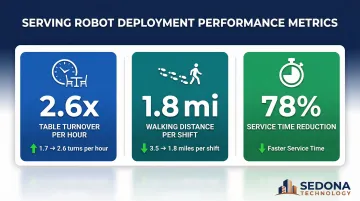
- A case study of Keenon's W3 robots in a 70-seat bistro improved table turnover from 1.7 to 2.6 per hour
- Server walking distance dropped from 3.5 miles to 1.8 miles per shift
- Another study showed 78% reduction in food-to-table service time with semi-automated layouts
Hosting and Greeting
Robot hosts greet arriving guests, manage waitlists, and guide customers to their tables, freeing human staff for more complex interactions. The novelty also drives measurable foot traffic: operators report social media buzz and repeat visits tied directly to robot deployments.
Key operational benefits include:
- Reduces host labor during peak entry periods
- Handles waitlist management without errors or delays
- Creates a shareable guest experience that drives organic marketing
Table Bussing and Clearing
Bussing robots collect used dishes and transport them to the dish station, cutting table turnover time and reducing repetitive strain injuries for staff. Automating this task lets restaurants redeploy workers to guest-facing roles, where they generate tips and build customer relationships.
Cooking and Food Preparation Assistance
Robotic kitchen arms handle repetitive cooking tasks (grilling, frying, assembling bowls), delivering consistent portion sizes and reliable food safety compliance. Miso Robotics' "Flippy" was piloted by White Castle in 2020, and following successful tests, White Castle announced plans to install Flippy 2 in 100 standalone locations to take over entire fry stations.
Nala Robotics deployed "The Wingman" at Re-Up convenience stores to prepare customizable fried chicken and fries without human intervention. Flippy's next-generation Fry Station can process more than 100 baskets per hour—almost twice as many as human employees.
Bartending and Drink Preparation
Cocktail and coffee robots produce consistent, high-volume drinks. Richtech Robotics deployed its dual-arm ADAM robot at the Texas Rangers' Globe Life Field, marking the first humanoid bartender in a major league sports arena. Makr Shakr's "Bionic Bar" has been deployed on nine Royal Caribbean vessels, using two robotic arms to mix a wide range of cocktails.
Adoption is strongest in venues with high ticket volume and limited bar staffing—hotel lobbies, cruise ships, and stadium concourses where a single robot can serve hundreds of guests per event.
Sedona Technology offers food service robots suited to these same environments, with free installation and training included and flexible acquisition options (sales, rental, or leasing) so operators can evaluate ROI before committing long-term.
Key Trends Shaping Restaurant Robotics Today
Several overlapping trends are reshaping how restaurants think about and deploy service robots—moving the category from early-adopter experiment to mainstream operational strategy.
Trend 1: Front-of-House Robots Going Mainstream
Server and host robots that were once limited to a handful of tech-forward chains are now appearing in independent restaurants, mid-scale chains, and international hotel F&B operations. Better navigation technology—sensors that map rooms in real time and detect obstacles—has made them reliable enough for daily commercial use without constant staff intervention.
Why it's growing:
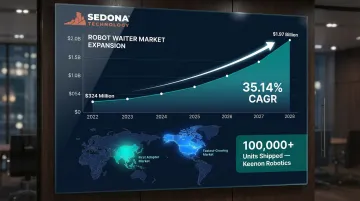
- The global robot waiter market was valued at $324.12 million in 2022 and is projected to reach $1.97 billion by 2028, growing at a CAGR of 35.14%
- Asia-Pacific (Japan, China, South Korea) led adoption first, with North America now the fastest-growing market
- Chinese manufacturer Keenon Robotics alone has shipped over 100,000 service robots globally
Trend 2: AI-Powered Personalization and Interaction
Newer robots use AI not just for navigation but for customer interaction—recognizing repeat guests, adapting communication style, and even suggesting menu items. Richtech Robotics' ADAM upgrades enable sophisticated conversation, with the robot using NVIDIA-powered AI vision to detect when customers approach, initiate proactive engagement, and explain its beverage preparation steps in real time.
For restaurant operators, this means robots are no longer just labor-saving tools—they're part of the guest experience. That changes how you justify the investment: less about cutting headcount, more about what customers remember when they leave.
Trend 3: Flexible Acquisition Models Lowering the Entry Barrier
Of course, even the most capable robot is irrelevant if the price puts it out of reach. That's where acquisition model flexibility changes things: rental and leasing options mean restaurants no longer need large upfront capital to get started.
Current pricing ranges:
- Purchase: $10,000–$20,000 upfront
- Rental: $750–$1,500/month (varies by model and vendor)
Smaller independents and regional chains—previously priced out—can now pilot robots for a defined period, assess return on investment, and scale. That opens the door for far more restaurants to adopt robotics—not just large enterprise chains with deep capital budgets.
What's Driving the Rise of Service Robots in Restaurants
The acceleration in restaurant robot adoption comes down to several converging, industry-specific pressures that are unlikely to reverse.
Labor Shortages and Cost Pressures
The restaurant industry faces a structural labor deficit. 47% of restaurant operators still have job openings that are difficult to fill, and employee turnover costs restaurants an average of $5,864 per worker.
Robots address both the availability gap and wage inflation simultaneously by handling high-turnover, repetitive roles. As labor costs keep climbing, the financial case for automation only gets harder to ignore.
Falling Technology Costs and Improved Reliability
Robot hardware costs have dropped significantly over the past decade. Boston Consulting Group notes that robotics hardware and software prices are around 40% lower than they were a decade ago, and ARK Invest corroborates this trend, noting that robot prices have dropped by roughly 50% while performance has improved 33-fold.
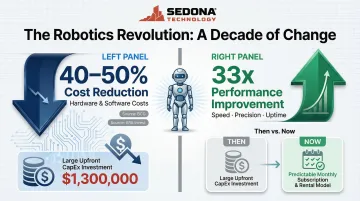
Subscription and rental pricing models extend this further, turning robots into a predictable monthly operating cost rather than a large upfront bet.
Post-COVID Hygiene and Contactless Dining Demand
The pandemic fundamentally changed customer expectations around contactless service, surface sanitation, and minimized human-to-food contact. A 2023 National Restaurant Association survey found that 72% of adults are likely to use contactless or mobile payment options if offered, and 46% stated they would be likely to order food prepared by automated systems or robots.
Robots naturally satisfy these expectations, giving operators a hygiene-forward story to tell customers.
AI, Sensor, and Navigation Advances
Modern service robots can now operate safely in dynamic, crowded restaurant environments—something that wasn't reliably possible just a few years ago. Key technology improvements driving this include:
- LiDAR and RGBD cameras for precise spatial awareness and obstacle detection
- Machine learning models that adapt to changing floor layouts and foot traffic patterns
- Real-time mapping that lets robots reroute on the fly without manual reprogramming
Together, these advances address the reliability concerns that once kept operators on the sidelines.
How Service Robots Are Impacting the Restaurant Industry
Service robots are changing how restaurants manage people, costs, and customer experience at the same time — and the effects show up across three distinct areas.
Operational Impact
Measurable improvements include:
- Faster table turnover
- Reduced order delivery errors
- Consistent output during peak periods
- 24/7 availability without breaks or sick days
Miso Robotics' next-generation Flippy Fry Station can process more than 100 baskets per hour—almost twice as many as human employees. At White Castle, reallocating human labor away from the fryer resulted in 15% to 25% faster drive-thru order times.
Business and Financial Impact
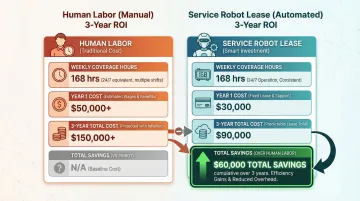
When modeled over a multi-year period, the ROI of service robots becomes clear. Culinary Services Group conducted a 3-year ROI analysis comparing the cost of human diet aides to robotic food servers:
| Expense Category | Human Labor (2 Part-Time Aides) | Bear Robotics Servi Lease |
|---|---|---|
| Weekly Coverage | 42 Hours | 91 Hours |
| Year 1 Cost | $33,100 | $11,700 |
| 3-Year Total Cost | $93,300 | $33,300 |
| Total Savings | N/A | $60,000 (80% ROI) |
Some operators also report increased revenue from novelty-driven traffic and positive social media attention — a secondary benefit that's harder to quantify but consistently mentioned by early adopters.
Workforce Impact
Beyond the financial case, robots are also changing how restaurant staff spend their time. They primarily take over physically demanding, repetitive tasks — carrying trays, bussing tables, working the fryer — which reduces injury risk and frees human staff for guest-facing roles.
Most operators report redeployment rather than reduction of headcount, especially given existing labor shortages. At White Castle, Flippy frees up workers from the hazardous fryer to work at the "hospitality door," greeting customers and handing off food. The general manager of Sugar Mediterranean Bistro stated: "It's not replacing anyone. It's making everything more efficient".
Future Signals: What's Next for Restaurant Robots
The restaurant robotics category is in its early-growth phase. The most significant changes are still ahead, and operators who understand where the technology is heading can act early to build a real edge.
Early signals and developments to watch in the next 1–3 years:
- Deeper AI integration enabling robots to handle real-time menu customization, allergy flagging, and upselling
- Humanoid-form robots capable of a broader range of tasks beyond current single-function designs—China Mobile showcased a robot-only restaurant concept utilizing humanoid "Lingxi" robots to autonomously pour tea, plate dumplings, and retrieve items from fridges
- Cross-system integration where robots sync with POS, KDS, and inventory management platforms to create fully automated service loops—Bear Robotics has partnered with Toast to showcase a complete POS-to-food-running solution
- Regulatory developments around robot safety standards in commercial food environments—UL Solutions introduced UL 3320, a comprehensive set of requirements addressing the risk of personal injury due to collaboration with robots in commercial kitchens
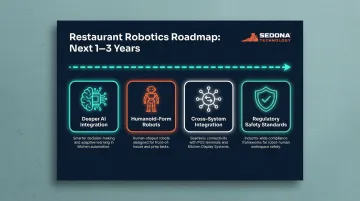
Each of these developments compounds on the others. Operators who deploy robots now build institutional knowledge — how to integrate systems, what workflows break down, where robots genuinely save time — before those lessons become table stakes. Early movers come away with lower labor dependency, better operational data, and a clearer picture of where to automate next. Waiting for a "mature" version of this technology means starting that learning curve later than your competitors already did.
Frequently Asked Questions
What are some examples of robots in restaurants?
The most common types include delivery/server robots (BellaBot, Servi by Bear Robotics), kitchen robots (Flippy by Miso Robotics), bartender robots (ADAM by Richtech), and host robots. Use cases span front-of-house through kitchen, covering food running, bussing, cooking, and drink preparation.
What restaurants use robots to serve?
Recognizable chains deploying serving robots include Chili's and Denny's using Bear Robotics' Servi, White Castle piloting Flippy for frying, and independent restaurants like Red Ginger using BellaBot-type server robots. Royal Caribbean has deployed Makr Shakr's Bionic Bar on nine cruise vessels.
Are robot waiters worth the investment for restaurants?
Over a 2-3 year horizon, robots typically cost significantly less than equivalent human labor once payroll taxes, benefits, and turnover are factored in. A 3-year analysis found that leasing a service robot saves $60,000 compared to two part-time workers—and rental options lower the barrier to entry further.
Will service robots replace human workers in restaurants?
Robots handle high-volume, repetitive work—carrying trays, bussing tables, frying—while human staff shift toward customer engagement. Most operators and industry analysts see this as complementary, especially given persistent labor shortages.
How much does a restaurant service robot cost?
Purchase prices range from roughly $10,000–$20,000, while rental options run $750–$1,500/month depending on the model and vendor. Leasing through financing partners is also available, keeping upfront costs low for businesses of any size.
What is the future of service robots in restaurants?
Robots will take on more complex, AI-driven tasks including personalized interaction, predictive inventory, and end-to-end service automation. As costs fall and technology matures, adoption will spread from large chains to independent restaurants, with humanoid robots eventually handling multi-step kitchen work.