Introduction
Picture this: a guest walks into a hotel lobby and is greeted by name by a humanoid robot that already knows their preferred room temperature and floor. This is already happening in properties across the U.S. As staffing shortages persist, hotels are deploying humanoid robots not as novelties but as working operational assets.
In February 2025, 65% of U.S. hotels reported staffing shortages, with housekeeping cited as the most critical need. Robots are filling the operational gap left by chronic understaffing, freeing existing employees to spend more time on direct guest service.
This article covers what hospitality humanoid robots are, where they're being deployed, the real business impact they deliver, the challenges operators face, and what the next generation of hotel robots looks like.
Key Takeaways
- Humanoid and service robots handle check-in, delivery, cleaning, concierge, and security roles in hotels, restaurants, and airports
- These robots reduce labor costs, address staffing shortages, and operate 24/7 without supervision
- Real-world adopters include Hilton, Aloft, Crowne Plaza, Yotel, and Hotel EMC2
- The most effective model pairs robots on routine tasks with staff focused on meaningful guest interaction
- Rental, leasing, and purchase options are available — with rentals starting at a 2-month minimum for easy piloting
What Are Humanoid Robots in Hospitality?
Hospitality robots are autonomous machines built to interact with guests, answer questions, and deliver services. Humanoid robots take this further — their human-like design lets them navigate spaces built for people, setting them apart from wheeled delivery bots or stationary kiosk machines.
Unlike check-in kiosks or apps, robots handle unstructured interactions and recover from guest errors on the fly. They can guide someone through an entire service journey the way a human employee would — which makes them far more flexible than any fixed-screen interface.
That flexibility spans several distinct robot types, each built for a specific role in the hospitality environment:
- Concierge robots — Answer guest questions, offer local recommendations, and provide directions
- Delivery robots — Transport room service, amenities, or food orders without staff involvement
- Cleaning robots — Vacuum hallways, sanitize high-traffic areas, and run overnight without supervision
- Reception robots — Manage check-in, verify bookings, and issue room keys
- Security patrol robots — Monitor lobbies, corridors, and parking areas around the clock
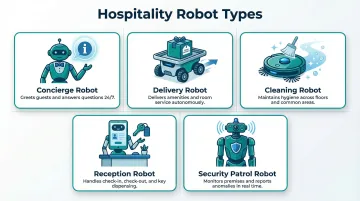
Humanoid robots are specifically designed to feel approachable in guest-facing roles, while functional wheeled bots excel at back-of-house tasks.
Key Use Cases: Where Humanoid Robots Are Transforming Hospitality
Guest Check-In and Front Desk
Robot receptionists handle passport scanning, booking verification, room key creation, and language translation. Henn na Hotel in Japan, recognized by Guinness World Records as the first robot-staffed hotel, deployed robots at check-in in July 2015. Hilton and Yotel properties have since piloted AI-powered kiosks and robotic systems.
Guest benefits:
- Faster check-in during peak hours
- Reduced wait times
- Contactless processing for guests who prefer minimal human interaction
Nearly 80% of travelers are now willing to stay at a hotel with a completely automated front desk, with 82% of Gen Z travelers preferring app or kiosk check-in over traditional front desks.
Concierge and Guest Information Services
AI-powered concierge robots like Hilton's "Connie" (powered by IBM Watson) answer guest questions about local attractions, dining, and hotel amenities. Deployed in March 2016 at the Hilton McLean in Virginia, Connie used Watson's Dialog, Speech to Text, and Natural Language Classifier to provide personalized recommendations.
Multilingual capability makes these robots especially valuable for international properties. Most modern concierge robots support English, Chinese, and other major languages through intelligent speech recognition — serving global guests without language barriers.
Room Service and In-Room Delivery
Delivery robots navigate hallways, call elevators, and phone guests upon arrival—delivering towels, snacks, toiletries, and amenities on demand.
Real-world deployments:
- Aloft's A.L.O "Botlr" — Deployed in August 2014 at Aloft Cupertino, manufactured by Savioke
- Crowne Plaza's "Dash" — Deployed in August 2015 at Crowne Plaza San Jose-Silicon Valley
- Hotel EMC2's Cleo and Leo — Deployed in May 2017 in Chicago, completing approximately 400 deliveries per week
Revenue-generating angle: Hotel EMC2 reported that in-room dining sales increased almost two-fold in the first two weeks of deploying Cleo and Leo. Delivery robots can drive ancillary revenue by acting as a roving minibar with high-margin on-demand convenience items.
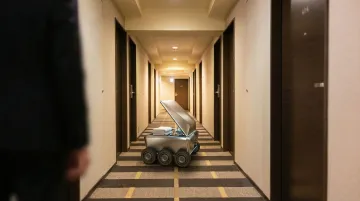
Hotels exploring this model can deploy purpose-built delivery robots like the KEENON BUTLERBOT W3 — designed for guest room delivery with auto elevator integration and 24/7 autonomous operation, available through Sedona Technology on a rental or purchase basis.
Housekeeping and Cleaning
Autonomous cleaning robots can already vacuum hallways, sanitize rooms with UV-C technology, scrub floors, and run scheduled or on-demand cleaning routes in high-traffic areas—operating at night without disturbing guests.
Current capabilities:
- Vacuuming corridors and lobbies
- Sanitizing public areas with UV-C disinfection
- Scrubbing floors autonomously
- Scheduled cleaning routes in high-traffic zones
Tasks like making beds or cleaning bathrooms still require human hands. Industry experts note that while robots can vacuum, the technology required to make a bed, clean a toilet, and replenish minibars is not yet affordable or mainstream. Fully autonomous room turnover remains 3–5 years out.
Security and Surveillance
AI security robots patrol hotel lobbies, corridors, and parking lots 24/7, equipped with cameras and real-time anomaly detection—providing consistent surveillance without fatigue.
Deployments include:
- Knightscope K5 at luxury hotels in Georgia and Pennsylvania
- Knightscope K5 at San Antonio International Airport
- RAD ROAMEO at Red Hawk Casino for autonomous property patrols
For large hospitality properties — hotels with sprawling grounds, casino floors, or resort complexes — robotic patrols offer consistent coverage that human teams alone can't sustain around the clock.
Business Impact: ROI, Cost Savings, and Guest Experience
The staffing crisis is driving adoption. With 65% of U.S. hotels reporting chronic staffing shortages in 2025 and 48% of accommodation businesses considering staffing their biggest operational risk, robots aren't replacing staff—they're filling the operational gap.
Cost efficiency case:
Robots don't require overtime, sick days, or benefits—they operate 24/7 with minimal supervision. Academic research shows payback periods under 12 months for most successful deployments. A 2026 case study on kitchen automation robots in a full-service hotel showed net annual savings of $292,000, achieving payback in 4-5 months.
Guest satisfaction impact:
Younger, digitally savvy travelers now expect technology-enabled convenience. Recent data shows:
- Nearly 80% of travelers would stay at a hotel with a fully automated front desk
- 82% of Gen Z travelers prefer app or kiosk check-in over a traditional front desk
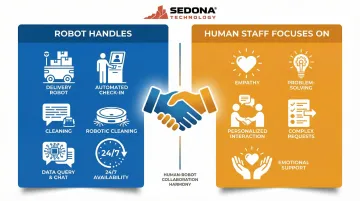
The human-robot collaboration model:
Robots handle the repeatable, physically demanding, or data-intensive tasks; humans concentrate on empathy, problem-solving, and personal guest interactions. Richtech Robotics' ADAM (which has served over 16,000 drinks at Clouffee & Tea in Las Vegas) and ToDo Robotics' server robots demonstrate this division of labor in practice.
Flexible acquisition paths:
Sedona Technology offers sales, rental, and leasing options, with free installation, training, and ongoing support included across all plans. Rentals start at a 2-month minimum, making it practical for hotels and restaurants to pilot robots without a large upfront commitment. Rental pricing ranges from $369/month for entry-level dining robots to $575/month for premium hospitality service robots.
Challenges and Limitations to Consider
Guest Acceptance Challenges
Some guests experience discomfort or the "uncanny valley" effect with humanoid robots, while older guests may need more time to adapt. Research shows an inverted-U shaped relationship regarding perceived human-likeness, where highly humanoid robots trigger fear and discomfort among employees and guests.
Properties introducing robots gradually alongside human staff see significantly better acceptance. Positioning robots as a novelty or service enhancer (not a replacement) shapes perception positively.
Implementation and Workforce Concerns
Staff may fear job displacement, so clear internal communication matters. Frame robots as tools that make jobs easier — not replacements. Pairing the rollout with hands-on training and dedicated support gives teams the confidence to adapt without feeling left behind.
Data Privacy and Technical Constraints
Robots collect guest behavioral data and preferences, which requires clear policies on data capture, storage, and deletion. The European Data Protection Board calls for a ban on remote biometric identification in publicly accessible spaces, while Illinois' BIPA imposes strict penalties on private entities collecting biometric data without written consent.
Hard technical limits persist as well. Robots currently cannot reliably handle:
- Complex emotional interactions or guest distress situations
- Unexpected problems requiring on-the-spot judgment
- Highly tactile tasks like making a bed or providing physical assistance
Human oversight remains non-negotiable for these scenarios.
The Future of Humanoid Robots in Hospitality
Near-Term Trajectory
Smarter, more context-aware robots are coming — systems that recognize returning guests by face, recall past preferences, and proactively anticipate needs, making the interaction feel less like a transaction and more like a personalized service.
Hybrid Human-Robot Teams
This will become the dominant service model across hotels, restaurants, airports, and malls. The split typically looks like this:
- AI handles: availability checks, pricing queries, scheduling, and FAQs
- Human staff manages: consultative conversations, emotional support, and creative service decisions
Expansion Beyond Traditional Hotels
MarketsandMarkets projects the global hospitality robots market will grow from $566.7 million in 2023 to $2.2 billion by 2030, at a CAGR of 21.5%. Robotics is reaching beyond full-service hotels into casual dining restaurants, airport lounges, retail malls, and corporate office cafeterias.
The cost barrier is dropping fast. Delivery robots now lease for $1,000 to $2,000 per month, shifting the investment from a capital expense to an operating one — and putting adoption within reach for smaller and mid-size operators.
Frequently Asked Questions
What are hospitality robots?
Hospitality robots are autonomous or semi-autonomous machines deployed in hotels, restaurants, airports, and similar venues to handle guest-facing and back-of-house tasks—check-in, concierge services, delivery, cleaning, and security patrol.
What tasks can humanoid robots perform in hotels?
Humanoid robots handle greeting and check-in, room service and amenity delivery, concierge information, housekeeping support (vacuuming, sanitizing), and security patrol. Tasks requiring fine motor skills or emotional nuance still rely on human staff.
Do hotel guests prefer robot service or human service?
Guest preference is split by context: robots are preferred for quick, transactional, or contactless interactions (late-night delivery, routine requests), while humans are preferred for complex, emotional, or high-touch situations. The best hotels offer both.
Can robots replace human hotel staff?
Robots take over repetitive, physically demanding tasks—freeing human staff to focus on relationship-building, problem-solving, and the moments that guests actually remember. The goal is a stronger team, not a smaller one.
How much do robot maids typically cost?
Costs vary by robot type and capability—from mid-range cleaning units to premium humanoid models. Rental and leasing options (with minimum periods as short as 2 months) make adoption far more accessible than outright purchase, often with installation and training included.
What are the main challenges of implementing robots in hospitality?
The three main hurdles are upfront investment and integration complexity, staff buy-in and retraining, and guest acceptance. Starting with a pilot deployment in one area—rather than a full rollout—tends to reduce friction on all three fronts.