This article explores what robot butlers are, what they can reliably do today, how the underlying technology works, who is adopting them first, and what they cost. Whether you're a business owner evaluating operational automation or a tech enthusiast tracking the humanoid robotics market, this guide provides the clarity you need to make informed decisions about when and how to adopt.
Key Takeaways
- Robot butlers are real, AI-powered machines performing physical tasks in homes and businesses today
- Leading models like 1X NEO and Quanta X2 clean surfaces, fetch items, and handle tasks requiring manual dexterity like sorting objects or opening doors
- Today's service robots handle routine tasks autonomously, with remote human oversight available for complex or unexpected situations
- Commercial settings—hotels, restaurants, warehouses—are leading adoption ahead of residential use
- Commercial robots typically start at $15,000–$20,000+, with rental and leasing options making them accessible for businesses of all sizes
What Is a Robot Butler?
A robot butler is an AI-powered, physically mobile machine designed to perform domestic or service tasks with minimal human intervention. Unlike simple smart home devices—voice assistants that answer questions or robot vacuums that clean floors—robot butlers combine advanced mobility, dexterous manipulation, and AI-driven decision-making to replicate service-oriented human tasks like fetching, cleaning, and serving.
Several models are already commercially available or accepting pre-orders as of 2025–2026:
- 1X NEO — a bipedal humanoid robot designed for domestic chores, priced at $20,000 or available via $499/month subscription
- Quanta X2 by X Square Robot — a wheeled humanoid with 62 degrees of freedom and dexterous hands, built for service and industrial environments
- Sunday AI's Memo — a semi-humanoid home robot focused on repetitive household tasks
Beyond the home, butler automation is gaining traction in commercial environments — hotels, restaurants, and warehouses — where robots handle tasks like clearing tables, delivering orders, and transporting goods that traditionally required dedicated staff.
What Can Robot Butlers Actually Do Today?
Current leading models cover a wider range of physical tasks than most people expect:
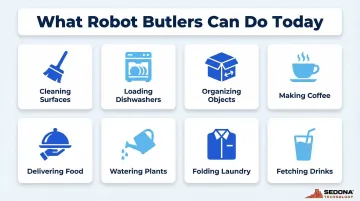
- Cleaning surfaces and floors
- Loading and unloading dishwashers
- Picking up and organizing objects
- Making coffee and fetching drinks
- Delivering food and room service items
- Watering plants and folding laundry
How Far Dexterity Has Come
The Quanta X2 exemplifies how far manipulation has come, featuring 20-degree-of-freedom dexterous hands, 765mm arm reach, and 6kg single-arm payload capacity (25kg dual-arm maximum). These specifications enable the robot to handle standard hospitality trays, manipulate fragile objects, and perform cleaning tasks with modular tool attachments.
The Reality of Autonomy
Most consumer robots currently rely on a hybrid model combining autonomous operation with remote human assistance. 1X Technologies explicitly states that for tasks the NEO robot doesn't know, owners can "schedule a 1X Expert to guide it through unknown tasks." BBC reporting confirms NEO utilizes a mix of autonomous action and human operation, with remote operators taking control when the robot becomes confused.
That hybrid model exists for good reason — today's robots hit a clear ceiling on fully independent operation.
Robot butlers cannot yet reliably:
- Handle completely novel objects without prior training
- Navigate extremely cluttered or unpredictable spaces
- Perform multi-step tasks entirely independently without supervision
- Recover from unexpected failures without human intervention
Companies are closing that gap through large-scale data collection. Sunday AI uses "Skill Capture Gloves" (costing roughly $400 a pair) worn by human operators to record millions of household routines. 1X leverages real-world data collected from its robot fleet to continuously update the NEO's skill set. As more units deploy and more tasks are demonstrated, the entire fleet gets smarter — each robot benefits from every interaction logged across the network.
How Do Robot Butlers Work?
The Technology Stack
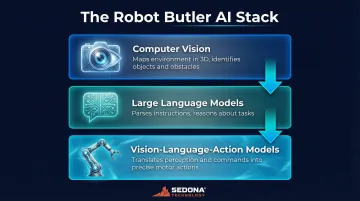
Robot butlers rely on three core AI technologies working together:
- Computer Vision uses cameras and depth sensors to map the environment in 3D — identifying objects, people, and obstacles in real time
- Large Language Models (LLMs) parse natural language instructions and reason about tasks, so robots understand what you're asking them to do
- Vision-Language-Action (VLA) Models close the loop by translating visual inputs and language commands into precise motor actions — the bridge between perception and physical execution
Embodied AI vs. Chatbot AI
The AI powering robot butlers differs fundamentally from text-based chatbots. While a chatbot can tolerate a 1-2 second response delay, a walking robot experiencing the same delay risks dropping objects or colliding with people. Embodied AI must process real-time physical data—depth sensors, pressure feedback, camera feeds—and convert it into precise motor commands within milliseconds.
Google DeepMind's RT-2 model demonstrates this in practice, adapting web-scale vision-language models by representing robot actions as text tokens. By co-fine-tuning on both internet data and robotic trajectories, RT-2 translates visual and language inputs directly into low-level robotic control commands.
Open-Source Acceleration
The development timeline for capable robots is compressing rapidly thanks to open-source infrastructure. OpenVLA, a 7B-parameter model trained on 970,000 real-world robot demonstrations, proves that open models can outperform proprietary systems in generalist manipulation tasks. X Square Robot's Wall-OSS, an open-source embodied foundation model available on GitHub and Hugging Face, leverages large-scale multimodal pretraining to accelerate community-driven innovation.
Faster development cycles make one thing more critical, not less: safety. As capable robots reach homes and public spaces sooner, the standards governing how they behave around people carry real weight.
Safety Mechanisms
Robot butlers operating near people incorporate critical safety features:
- Human detection systems that identify people in their path
- Force-limiting controls that prevent injury during physical contact
- Safety-rated monitored stops that halt operation when unexpected obstacles appear
- Compliance with ISO 13482:2014 safety requirements for personal care robots
ISO 13482:2014 sets the baseline — but individual manufacturers often exceed it, particularly for robots deployed in high-traffic commercial settings like hotels, restaurants, and warehouses.
Robot Butlers in Commercial Settings
Commercial environments are adopting robot butlers ahead of residential homes, and the reasons are straightforward.
Why Commercial Settings Lead Adoption
Structured Layouts: Hotels, restaurants, and warehouses feature predictable floor plans and consistent workflows, making autonomous navigation more reliable.
Repetitive Tasks: Delivering room service, bussing tables, and transporting materials are highly repetitive tasks with clear performance metrics.
Clear ROI: BCG reports that leading businesses have unlocked 20% to 50% improvements in service levels and 25% to 50% reductions in fulfillment costs through targeted warehouse automation.
Specific Commercial Use Cases
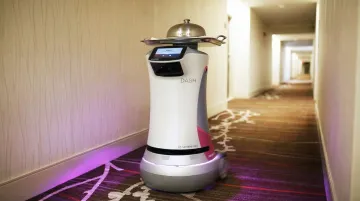
Hotels and Hospitality: Relay Robotics robots have completed over 1.5 million deliveries globally in hotels like Marriott's Aloft brand and Dream Hollywood, handling autonomous room service and amenity delivery. These deployments relieve labor shortage bottlenecks while maintaining 24/7 service availability.
Restaurants: Chili's expanded testing to 51 locations using Bear Robotics' Servi for food running and bussing. Denny's deployed similar robots to multiple sites to assist staff and reduce customer interaction during labor shortages. The Servi leases for approximately $999 per month, translating to roughly $2.75 per hour—highly competitive against rising labor rates.
Airports and Large Facilities: Heathrow Airport deployed 32 autonomous cleaning robots through Mitie. Each cleans 4,800m² daily, recycles water using just 18 liters per day, and frees human staff for deep cleaning tasks.
Warehouses: Amazon is piloting Agility Robotics' Digit, a bipedal humanoid robot, for highly repetitive tote recycling tasks in spaces designed for humans.
The Business Case for Adoption
These deployments share a pattern. Success comes down to a clear match between the robot's capabilities and the business environment. When evaluating adoption, the key questions are:
- Task fit: Does the robot handle tasks that are repetitive, time-consuming, or difficult to staff?
- Environment compatibility: Is the facility layout structured enough for reliable autonomous navigation?
- Workflow integration: Can the robot integrate with existing systems (elevators, POS, facility management)?
- Support and maintenance: Does the vendor provide installation, training, and ongoing technical support?
For businesses not ready to commit to a purchase, short-term rental programs — some starting at two months — let operators test robots in their actual environment before scaling. Sedona Technology, for instance, provides sales, rental, and leasing options with installation and training included, so the operational learning curve doesn't fall entirely on internal staff.
How Much Does a Robot Butler Cost?
Consumer humanoid robots currently range from roughly $13,500 to $20,000+. The 1X NEO runs $20,000 for early access (or $499/month), while Unitree's G1 starts at $13,500 for research use. For commercial settings — restaurants, hotels, warehouses — the pricing picture looks different, with rental and leasing models making adoption far more accessible.
Factors Affecting Cost
Several variables drive the final price tag:
- Hardware complexity — More degrees of freedom and advanced sensors push costs up. The Quanta X2's 62-DoF body and 20-DoF dexterous hands reflect substantial engineering investment.
- AI and software sophistication — Robots running larger training datasets with stronger task generalization carry premium pricing.
- Support and onboarding — Installation, training, and ongoing technical support add to total cost of ownership.
- Duty cycle — Robots built for continuous 24/7 commercial operation cost more than units designed for lighter residential use.
Rental and Leasing Options
For businesses, outright purchase is just one option. Robot-as-a-Service (RaaS) models allow organizations to access robot butler technology at lower upfront cost. In 2024, the RaaS fleet grew by 31%, driven by businesses seeking to avoid depreciation risk as technology improves rapidly.
Rental pricing varies by robot type and application:
| Robot Type | Monthly Rental |
|---|---|
| KLEENBOT commercial cleaning series | $349–$499/mo |
| KEENON BUTLERBOT W3 (hospitality) | $575/mo |
All rental options include free installation, training, and ongoing support — eliminating upfront capital risk while keeping operations running on current technology.
Challenges and What to Expect Next
Three Main Adoption Barriers
Reliability in Unstructured Environments: Robots struggle with handling novel objects and navigating highly cluttered spaces. MIT Technology Review notes that getting robots to function in unseen environments typically requires extensive, time-consuming data training.
High Unit Cost: Morgan Stanley estimates the cost of a humanoid robot in 2024 was around $200,000, though Goldman Sachs notes manufacturing costs have dropped 40% year-over-year, currently ranging between $30,000 and $150,000.
Human Oversight Requirements: Most consumer robots still require remote operators for complex operations, limiting true autonomy.
The Trajectory of Improvement
Massive capital investment signals rapid progress ahead. Figure AI raised over $1 billion in Series C funding at a $39 billion valuation, while Apptronik closed $935 million in Series A funding. These investments are compressing AI learning cycles and pushing manufacturing costs down faster than most analysts predicted.
That momentum translates directly into market scale. Goldman Sachs projects the humanoid market will reach $38 billion by 2035, driven by AI progress and falling component costs. Morgan Stanley's forecast is more dramatic: a $5 trillion market by 2050, with gradual adoption through the mid-2030s before accelerating sharply.
Realistic Timeline Framing
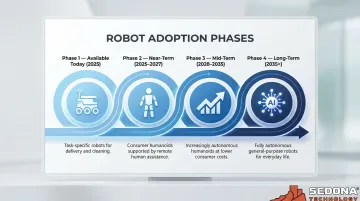
Available Today: Task-specific service robots for delivery, cleaning, and simple transport in structured commercial environments.
Near-Term (2025–2027): Consumer humanoid robots with remote operator assistance for complex tasks, suitable for early adopters willing to work within current limitations.
Mid-Term (2028–2035): Increasingly autonomous humanoids with broader task capabilities, declining costs, and wider commercial adoption across hospitality, healthcare, and light industrial settings.
Long-Term (2035+): Fully autonomous general-purpose robots capable of handling novel tasks in unstructured environments without human oversight.
For businesses, the practical path is straightforward: deploy proven RaaS solutions for delivery and cleaning now, while piloting humanoids in structured, back-of-house workflows. Building that internal experience today positions your operation well ahead of mass-market maturity.
Frequently Asked Questions
How much does a robot butler cost?
Consumer humanoid models like the 1X NEO start around $20,000, while commercial-grade service robots vary widely depending on capability and application. Rental and leasing options are available, which significantly reduces upfront costs for businesses.
Do robot butlers exist?
Yes, robot butlers are real and commercially available today. Models like 1X NEO and Quanta X2 are shipping or accepting pre-orders, though capabilities vary and full autonomy is still evolving. Many current systems rely on remote human operators for complex tasks.
What is butler automation?
Butler automation uses robotics and AI to handle service-oriented physical tasks—fetching, cleaning, serving—that human staff would otherwise perform. It's applied across hotels, restaurants, warehouses, and other commercial environments.
What tasks can a robot butler perform?
Current models handle a range of tasks, including:
- Cleaning surfaces and floors
- Delivering food, drinks, and items
- Loading dishwashers and making beverages
- Patrolling spaces for security or monitoring
Performance depends on the model and environment. Most robots excel at repetitive tasks but struggle with novel situations.
Are robot butlers suitable for businesses like restaurants or hotels?
Yes, commercial environments are the leading use case today. Businesses in hospitality, food service, and warehousing deploy robots to reduce labor costs, improve consistency, and handle repetitive tasks. Structured layouts and clear ROI make these settings ideal for current technology.