Introduction
Airports handle tens of millions of passengers each year, creating one of the most demanding environments to maintain. Traditional cleaning methods—large crews, manual equipment, overnight schedules—are struggling to keep pace with rising passenger volumes, heightened hygiene expectations, and chronic labor shortages.
The numbers illustrate the gap:
- Global passenger traffic reached 9.4 billion in 2024 — an 8.4% jump from 2023
- Facility services face a 61% annual turnover rate among cleaning staff
- U.S. janitorial workforce growth is projected at just 2% through 2034
Cleaning robots have moved from experimental pilots to mainstream airport infrastructure — handling floor scrubbing, disinfection, and real-time reporting while freeing staff for higher-priority work. This post covers the types of robots now in use, the operational benefits, real-world deployments, and what airports should consider before adopting the technology.
Key Takeaways
- Labor shortages and 9.4 billion annual passengers make robotic cleaning essential for modern airports
- Solutions include autonomous floor scrubbers, carpet vacuums, UV-C disinfection robots, and antimicrobial spray units
- Autonomous robots run 24/7, generate verifiable data logs, cut labor costs, and boost passenger satisfaction scores
- Zurich Airport's 26-robot fleet achieves sub-2-year ROI while cleaning 120 square kilometers daily
- Purchase, rent from $349/month, or lease to lower the barrier to entry
Why Airports Are Rethinking Cleanliness
The Scale of the Challenge
Airports must maintain cleanliness across millions of square feet of terminals, concourses, restrooms, jet bridges, and employee areas — 24 hours a day, 365 days a year. High foot traffic means floors, surfaces, and high-touch points degrade quickly between cleaning cycles.
With 9.4 billion passengers moving through global airports annually, the sheer volume creates relentless pressure on cleaning teams.
The Permanent Shift in Cleanliness Expectations
COVID-19 permanently elevated cleanliness standards. A RetailWire/Brain Corp survey found that 72% of consumers expect elevated cleanliness to persist even after widespread vaccination—a signal that applies directly to air travel. Airports have deliberately shifted cleaning to visible daytime hours to reassure passengers, moving away from hidden night-shift operations.
The financial impact is measurable: J.D. Power's 2025 study reveals that passengers rating their airport experience as "perfect" spend $42.39 in terminals — $16.54 more than those rating experiences as "just OK."
The Labor Crisis
Janitorial roles are physically demanding, hard to fill, and plagued by turnover. The numbers tell the story:
- The facility services sector sees a 61% annual turnover rate
- The janitorial workforce is projected to grow just 2% through 2034
- Demand at major airports consistently outpaces available labor
Airports cannot hire their way out of this gap. Automation has shifted from a nice-to-have to an operational requirement.
The Need for Verifiable Standards
The labor shortage compounds another problem: traditional cleaning is nearly impossible to measure or verify. Airports must now demonstrate documented cleaning standards to regulators, airlines, and passengers — something manual operations struggle to deliver without a data layer. Robots generate real-time logs, cleaning maps, and performance metrics that make compliance visible and auditable.
Types of Cleaning Robots Deployed at Airports
Autonomous Floor Scrubbers
Robotic scrubbers use LIDAR, cameras, and ultrasonic sensors to map terminal environments, plan cleaning routes, and navigate around obstacles and passengers. They scrub, squeegee, and vacuum simultaneously, covering large hard-floor areas—concourses, food courts, check-in halls—with consistent pressure and solution dosing.
Leading models include:
- TASKI Ecobot 50 Pro: 1,800 m²/hr coverage, 30L tank, 2D LiDAR + 3D depth cameras
- Peppermint Robotics SD45: Up to 8 hours runtime, 45L tank, LIDAR + ultrasonic sensors
- KLEENBOT C30: Laser SLAM navigation, real-time path adjustment, engineered for airports and warehouses
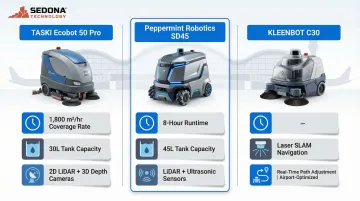
Sedona Technology carries the KLEENBOT C30 for airport and large-venue deployments, with purchase, rental (starting at $349/month, 2-month minimum), and leasing options — all including free installation and training.
Autonomous Vacuum and Carpet Cobots
Carpet-focused cobots handle soft flooring in gate areas and lounges. These robots work alongside human staff rather than fully replacing them—staff manage oversight, restrooms, and high-touch surfaces while robots handle repetitive floor coverage.
Models like the Whiz and Vacuum 40, deployed by Flagship/SoftBank Robotics at U.S. airports, exemplify this approach — designed so human staff and robots each handle what they do best.
UV-C Disinfection Robots
UV-C robots emit ultraviolet-C light to damage viral and bacterial cell structures on surfaces and in the air. Real-world deployments include:
- Pittsburgh International Airport: First U.S. airport to use UV-C robotic cleaning, partnering with Carnegie Robotics
- Hong Kong International: Intelligent Sterilization Robot autonomously sterilizes up to 99.99% of bacteria in public toilets
- San Antonio International: First airport worldwide to purchase and deploy the Xenex LightStrike robot
- Heathrow Airport: Piloted UVD Robots that patrol terminal buildings autonomously at night
Critical constraint: UV-C light is harmful to human skin and eyes, so areas must be cleared of passengers and staff before operation—typically running overnight or in sectioned-off zones.
Disinfectant-Spray Robots and Drones
Where UV-C requires cleared zones and overnight windows, spray-based robots offer more flexible coverage. They apply antimicrobial or disinfectant solutions that reach surface crevices traditional manual methods often miss. United Airlines uses the NovaRover in aircraft cabins, applying Zoono Microbe Shield in a 12-foot radius during overnight deep cleanings.
The same approach translates well to seating areas, jet bridges, and food courts — high-contact surfaces that need rapid, repeatable disinfection between passenger waves.
Key Operational Benefits of Airport Cleaning Robots
Consistent, Verifiable Cleanliness
Unlike human cleaning—which varies by shift, fatigue, and staff skill—robots execute the same cleaning pattern with the same parameters every cycle. Robots generate real-time data logs, cleaning maps, and performance metrics that airport operators can review, report, and use to validate compliance with hygiene standards.
The Zurich Airport TASKI deployment integrates robots into a fully digitalized cleaning management platform, providing complete operational transparency.
24/7 Operation Without Supervision
Robots don't require rest, breaks, or shift changes. Autonomous floor scrubbers can be scheduled to run during off-peak hours, overnight, or continuously during operating hours with minimal human supervision.
The Flagship/SBRA deployment logged nearly 10,000 autonomous operating hours and cleaned over 35 million square feet across its airport locations.
Reduced Labor Costs and Better Staff Utilization
Robots don't eliminate janitorial jobs—they redeploy staff toward higher-value tasks: restroom maintenance, customer-facing service, deep cleaning high-touch surfaces, and managing/supervising the robots themselves. This shift also reduces workers' compensation exposure by removing staff from repetitive, physically demanding tasks.
At GMR Hyderabad Airport, Peppermint Robotics SD45 units achieved a reported 75% manpower reduction, reallocating staff to specialized cleaning tasks.
Extended Asset Life and Sustainability
Consistent, calibrated cleaning—proper solution dosing, correct pad pressure—extends the life of expensive airport flooring assets like carpets and polished concrete. Key results from active deployments include:
- TASKI/Zurich recycles water up to 3 times, with ROI estimated at under 2 years
- Peppermint Robotics deployments achieved up to 20% water savings alongside labor reductions
Improved Passenger Perception and Airport Ratings
Passengers notice when an airport is actively being cleaned—and robotic units operating on the floor make that visible. Passengers and staff have welcomed cobots rather than resisting them, and the operational data backs that up.
Flagship's cobot program resulted in increased passenger satisfaction scores. Airport rankings increasingly factor in cleanliness, and that connection is measurable: Zurich Airport, with its fully integrated robotic cleaning program, ranks among the top 10 cleanest airports globally.
Airport Cleaning Robots in Action: Real-World Deployments
These aren't pilot programs or press releases — airports around the world are running cleaning robots at scale, with measurable outcomes.
Zurich Airport / TASKI: 26 robots (20 Ecobot 50 + 6 Phantas) cover up to 120 square kilometers of cleaning per day. They operate from a fully autonomous workstation that handles recharging, filling, and emptying, and communicates directly with infrastructure like automated doors. The deployment achieved ROI in under two years — one of the largest single-site robotic cleaning programs in Switzerland.
Flagship Facility Services / SoftBank Robotics: Nearly 100 cobots (Scrubber 50, Vacuum 40, Phantas, Whiz) deployed across approximately 10 U.S. airports at around 15 locations, logging close to 10,000 operating hours and cleaning over 35 million square feet. Rather than replacing janitorial staff, the program shifted their roles toward higher-value tasks.
Additional global deployments:
- Pittsburgh International: First U.S. airport to deploy UV-C robotic cleaning
- Hong Kong International: UV-C disinfection robots in public areas achieving 99.99% bacteria elimination
- GMR Airport Hyderabad: Peppermint Robotics floor scrubbers supporting India's top cleanliness rankings for the facility
- Frankfurt Airport: Tennant AMRs cleaned over 1.6 million square meters in 6 months without disrupting passengers
- Singapore Changi: Avidbots Neo robots managed by a Robotic Middleware Framework that orchestrates diverse robot fleets
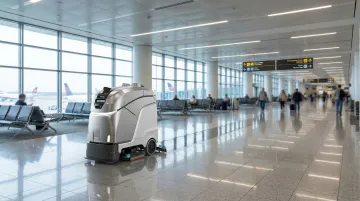
Taken together, these deployments show a consistent pattern: measurable ROI, staff redeployment rather than elimination, and operations that scale without adding headcount.
What Airports Should Know Before Deploying Cleaning Robots
Infrastructure and Environment Preparation
Robots need dedicated charging stations, water-fill/waste-dump stations, and storage space. Initial deployment requires environment mapping—robots must learn the layout of terminals, gates, and obstacle patterns before operating independently.
Important consideration: Fully autonomous docking stations require plumbing contractors to dig channels through concrete floors for sewer lines, run new water supply lines, and modify electrical panels. Total renovation costs can reach tens of thousands of dollars, meaning labor savings from automated water swaps may take years to offset.
Airport operators should assess floor surface types (hard vs. carpet), layout complexity, and peak traffic windows to determine which robot types and scheduling windows are most suitable.
Staff Training and Change Management
The biggest adoption barrier is often staff anxiety about job displacement. Successful deployments—including Flagship Facility Services and TASKI's rollout at Zurich Airport—treated robots as tools that expand staff roles, with training programs that teach cleaning crews to supervise, troubleshoot, and schedule robot operations.
Union environments have generally accepted robotic cleaning more readily than expected—particularly when framed around safety improvements and role expansion rather than headcount reduction.
At Frankfurt Airport, Tennant AMRs support rather than replace human staff, freeing cleaning teams to focus on specialized tasks like sanitizing high-contact surfaces and responding to spills.
Choosing the Right Acquisition Model
Airports don't have to purchase outright. They can acquire robots through purchase, rental, or leasing depending on budget, trial scope, and long-term commitment.
Sedona Technology provides three acquisition paths for airport operators:
- Purchase: Custom quotes available upon inquiry
- Rental: Starting at $349/month for the KLEENBOT C30, minimum 2-month period
- Leasing: Available through a trusted partner with terms customized to fleet size and commitment length
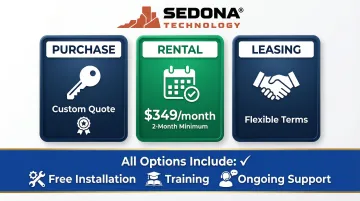
All three options include free installation, training, and ongoing support—making it practical to run a pilot program before scaling to a full fleet.
Frequently Asked Questions
What robots are used in airports?
Airports deploy four main categories: autonomous floor scrubbers for concourses and hard floors, carpet-cleaning cobots for gate areas and lounges, UV-C disinfection robots for chemical-free sanitization, and disinfectant-spray robots for surface treatment. The right mix depends on floor types, traffic volume, and disinfection requirements.
How much does a cleaning robot cost?
Costs vary widely by robot type and capability. Airports can access robots through outright purchase (custom quotes), rental starting at $349/month with 2-month minimums, or leasing programs. All three options make deployment more accessible than a single large capital purchase.
Is it worth buying a cleaning robot?
For most large facilities, yes — especially when labor costs are high and floors require continuous coverage. Flagship's program cleaned 35+ million square feet across U.S. airports, demonstrating consistent value at scale. ROI improves with higher utilization rates and larger floor areas.
Can airport cleaning robots operate around passengers?
Autonomous floor scrubbers and cobots are designed with obstacle detection and safe navigation to operate in occupied spaces. UV-C light robots must be used in cleared areas due to potential harm to human skin and eyes, typically running overnight or in sectioned-off zones.
Do cleaning robots replace human airport staff?
Robots reallocate rather than eliminate janitorial roles. Staff shift toward supervision, restroom and high-touch cleaning, and robot management. Some programs expand staff responsibilities rather than reducing headcount, elevating roles to include technology management.
What is the ROI of using cleaning robots at airports?
Zurich Airport achieved estimated sub-2-year payback with 26 robots, while GMR Hyderabad reported 75% manpower reduction and 20% water savings. Total cost of ownership calculations should include labor savings, reduced chemical and water usage, and lower asset wear.