Introduction
Supermarket managers face an unrelenting operational reality: high-traffic floors accumulate spills, debris, and grime within hours of opening, while staffing reliable cleaning crews has become increasingly difficult. The U.S. retail sector sees a 42.0% annual turnover rate, and 351,300 janitorial job openings go unfilled each year. The traditional cleaning model is no longer sustainable.
Intelligent autonomous cleaning robots are emerging as a practical solution —proven in real retail environments— that addresses labor shortages, improves floor safety, and delivers consistent results without constant supervision. This article covers how the technology works, what measurable results operators can expect, and which acquisition options fit different budgets.
Key Takeaways
- AI-powered robots use LiDAR and SLAM mapping to scrub floors continuously — no human supervision required
- Reallocate staff to customer-facing work while robots maintain around-the-clock cleaning schedules
- Lower slip-and-fall liability with timestamped cleaning logs and consistent floor maintenance
- Real-time data on coverage, water usage, and high-traffic zones helps operators fine-tune store operations
- Flexible rental, leasing, and purchase options make adoption accessible for stores of any size
The Cleaning Challenges Modern Supermarkets Can't Ignore
Labor Shortages Make Consistent Floor Cleaning Nearly Impossible
The retail cleaning workforce is in crisis. The U.S. retail sector faces a 42.0% annual voluntary turnover rate, making it nearly impossible to maintain stable cleaning teams.
The Bureau of Labor Statistics projects approximately 351,300 job openings for janitors and building cleaners each year over the next decade — driven primarily by workers leaving the field entirely or moving to other occupations.
For supermarket managers, this constant churn means:
- Difficulty filling overnight and early-morning cleaning shifts
- Inconsistent floor cleanliness throughout store hours
- Increased supervisory burden to train and manage new hires
- Higher wage pressure to attract and retain staff
Slip-and-Fall Incidents Create Massive Liability Exposure
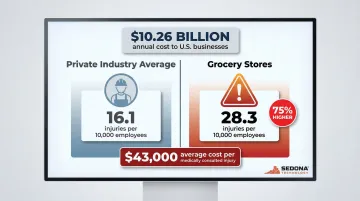
Supermarkets are particularly vulnerable to slip-and-fall incidents given wet produce sections, refrigeration condensation, and high customer volumes. "Falls on the same level" cost U.S. businesses $10.26 billion annually, ranking as the second leading cause of disabling workplace injuries.
The risk is even higher in grocery environments: employees in grocery stores experience a 75% greater incidence rate for slip, trip, and fall injuries compared to the private industry average (28.3 vs. 16.1 per 10,000 employees). With the average medically consulted work injury costing $43,000, a single incident can wipe out months of operational profit.
Post-Pandemic Cleanliness Expectations Have Permanently Shifted
Shoppers now judge stores differently. When entering a store, 39% notice cleanliness first — far outpacing layout (19%) or temperature (10%).
That perception has real revenue consequences: 78% of consumers have walked out of a store due to environmental issues, with cleanliness being the top reason cited (54%).
85% of consumers will bypass a closer grocery store if they know another location is better maintained, and 86% say upkeep directly influences their brand loyalty. At this point, store cleanliness drives customer retention and basket size just as much as pricing or product selection.
How Intelligent Autonomous Cleaning Robots Work
Advanced Navigation: LiDAR Sensors and SLAM Technology
Autonomous floor scrubbers use Simultaneous Localization and Mapping (SLAM) algorithms combined with 3D LiDAR sensors to navigate dynamic retail environments. These robots build a real-time map of the store floor, tracking their position relative to shelves, displays, and moving obstacles like shoppers and restocking carts.
The navigation system continuously scans 360 degrees, detecting obstacles up to several meters away and calculating optimal detour routes in real time. When a shopper steps into an aisle or a pallet blocks the planned path, the robot adjusts its route autonomously—without stopping the cleaning session or requiring manual intervention.
Floor Scrubbing Mechanics: Superior to Manual Mopping
The cleaning mechanism combines rotating scrub brushes, water and cleaning solution dispensing, and onboard suction/squeegee systems that lift debris and liquid in a single pass. The performance difference over manual mopping is significant:
Cleaning Performance Comparison:
| Metric | Manual Mopping | Autonomous Scrubber |
|---|---|---|
| Coverage Rate | ~3,000 sq ft/hour | 10,000+ sq ft/hour |
| Floor Dry Time | 15-30 minutes | Immediate (vacuum-dry) |
| Hygiene Efficacy | Spreads dirty water | Uses fresh water each pass |
| Microbial Reduction | 84.2% ATP reduction | 90.1% ATP reduction |
The vacuum-dry system leaves floors immediately safe to walk on, eliminating the slip hazard created by wet floors from traditional mopping. Robotic scrubbers achieve a 90.1% reduction in ATP (microbial load) compared to 84.2% for manual chemical scrubbing—a critical advantage in food-safe retail environments.
AI Path Planning Optimizes Cleaning Routes
AI-powered route optimization enables robots to adapt cleaning schedules based on store layout and traffic patterns. The system can:
- Prioritize high-traffic zones like produce, checkout, and entrance areas during peak hours
- Adjust routes when aisles are blocked by restocking activity or promotional displays
- Learn the most efficient cleaning sequence over time
- Return to the charging dock autonomously when the battery runs low
In practice, this means a single robot can complete a full store pass during restocking hours—before the first customer arrives—without a staff member directing its path.
Real-Time Hazard Detection and Staff Alerts
Embedded cameras and sensors identify spills, wet floors, and debris in real time. When the robot detects a hazard outside its cleaning path, it can alert store staff via SMS or mobile app notifications—enabling faster response than traditional visual walkthroughs would allow.
Staff get a pinned location on their app, so they can address the spill directly rather than spending time locating it on the floor.
Onboard Data Collection Creates Digital Cleaning Records
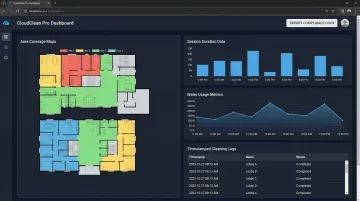
Each cleaning session generates detailed logs that managers can review via cloud-based dashboards. Typical data includes:
- Area coverage maps showing which zones were cleaned and when
- Session duration and total square footage covered
- Water usage and cleaning solution consumption
- Missed zones or areas requiring follow-up
- Timestamped records for compliance and liability documentation
For supermarkets facing health inspections or insurance audits, these logs serve as verifiable proof that cleaning schedules were followed—something a mop and bucket can never provide.
Key Operational Benefits for Supermarkets
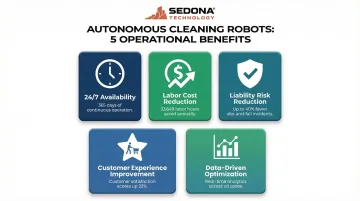
Autonomous cleaning robots deliver operational improvements across five areas that directly affect labor costs, liability exposure, and customer satisfaction. Here's how they translate to real-world supermarket value.
24/7 Availability Without Staffing Constraints
Autonomous robots can run overnight during restocking hours, during low-traffic windows, or continuously throughout the day—without fatigue, absenteeism, or supervision. This means floors are consistently cleaned on schedule regardless of staffing levels or shift coverage gaps.
In practice, a single staff member can deploy the robot at the start of a shift and retrieve it when done—freeing that employee for customer service, restocking, or other high-priority work.
Measurable Labor Cost Reduction
Deploying cleaning robots delivers quantifiable labor savings by reducing dedicated floor-care staff hours per shift. A 100-store grocery deployment of robotic scrubbers saved 33,649 labor hours cumulatively in one year, unlocking $2.12 million in annual value.
Rather than eliminating cleaning staff entirely, supermarkets reallocate those hours to:
- Spill response and spot cleaning
- Restroom maintenance and deep cleaning
- Customer assistance and service
- Inventory management and restocking support
This reallocation model improves overall operational efficiency while maintaining—or improving—cleaning quality.
Risk Reduction Through Documented Floor Maintenance
Consistent, documented cleaning reduces both the frequency and severity of slip-and-fall incidents. Timestamped cleaning logs provide verifiable evidence of floor maintenance that can serve as critical documentation in liability claims.
Cloud-based dashboards generate exportable reports showing exactly when and where floors were cleaned, how long the cleaning session lasted, and which areas were covered. This documented history demonstrates consistent duty of care and gives legal and operations teams reliable evidence when responding to incident claims.
Customer Experience and Brand Perception Impact
Visible cleanliness signals to shoppers that hygiene is a priority. The sight of a cleaning robot actively working reinforces this perception, creating a tangible demonstration of the store's commitment to maintaining safe, clean shopping environments.
Research shows that store cleanliness directly correlates with increased shopper dwell time, larger basket sizes, and higher return rates. That makes consistent floor care a measurable contributor to revenue, not just an overhead line item.
Data-Driven Operational Optimization
Management can use cleaning performance metrics to:
- Identify problem zones with frequent spills or high debris accumulation
- Adjust cleaning frequency based on actual traffic patterns
- Make evidence-based decisions about store layout or floor surface changes
- Track cleaning compliance for health inspections and audits
Over time, these metrics give facility managers a clearer picture of where maintenance resources are needed most—helping stores run tighter operations with fewer reactive fixes.
How Cleaning Robots Fit Into Your Store's Existing Operations
Human-Robot Collaboration: Reallocation, Not Replacement
Autonomous scrubbers are designed to handle repetitive, scheduled floor cleaning—not to eliminate the cleaning team. Staff are freed to focus on tasks that robots cannot perform:
- Immediate spill response and spot cleaning
- Restroom sanitation and deep cleaning
- Customer interaction and assistance
- Detail work around fixtures and displays
This setup requires staff to deploy the robot, perform basic maintenance (emptying tanks, cleaning sensors), and handle exceptions. If the robot encounters an impassable obstacle, it sends an alert via SMS or mobile app, allowing staff to remotely assist or manually clear the path.
Implementation Process: From Setup to Daily Operation
Getting there is straightforward. Initial deployment typically follows this timeline:
Days 1-2: Floor Mapping and Programming
- Technician walks the store with the robot to program cleaning routes
- Define exclusion zones (tight end-caps, produce service areas, fragile displays)
- Set up charging dock location and establish cleaning schedules
Days 3-5: Staff Training
- "Train the Trainer" approach for managers and supervisors
- Covers manual and auto-mode cleaning operations
- Robot maintenance procedures (tank emptying, brush cleaning)
- Cloud dashboard navigation and report interpretation
Weeks 2-4: Optimization Period
- Robot learns the space and refines routes
- Staff become comfortable working alongside the robot
- Management reviews baseline cleaning performance data
- Adjustments made based on initial results
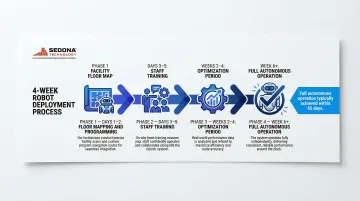
Sedona Technology includes free installation and training with every purchase or rental, so stores can get up and running without needing in-house technical staff.
Integrating Cleaning Data Into Management Routines
Managers can review weekly cleaning reports to:
- Identify high-spill zones requiring additional attention
- Verify that scheduled cleaning windows are being completed
- Use coverage maps during team briefings to discuss problem areas
- Export timestamped logs for compliance audits and safety reviews
Over time, these reports make it easier to spot patterns—like a produce aisle that consistently needs an extra pass on weekends—and adjust schedules before issues escalate.
Choosing and Acquiring a Supermarket Cleaning Robot
Key Evaluation Criteria
When selecting a cleaning robot for your supermarket, evaluate:
Facility Requirements:
- Total floor area and layout complexity (aisles, end-caps, open spaces)
- Floor surface types (tile, sealed concrete, vinyl)
- Hours of operation and available cleaning windows
- Traffic patterns and peak customer volume periods
Technical Capabilities:
- Navigation technology (LiDAR, SLAM, obstacle avoidance)
- Safety certifications for public-space operation
- Data reporting and integration with existing management systems
- Battery life and charging time relative to cleaning needs
Supplier Support:
- Installation and training included
- Ongoing technical support and maintenance
- Response time for service issues
- Software updates and feature enhancements
Three Acquisition Models: Purchase, Rental, and Leasing
Outright Purchase: Mid-size robotic scrubbers suitable for supermarkets typically range from $30,000 to $55,000 per unit, while larger industrial models cost $60,000 to $85,000+. Purchase provides full ownership and the fastest ROI—typically 12 to 24 months depending on labor rates and utilization.
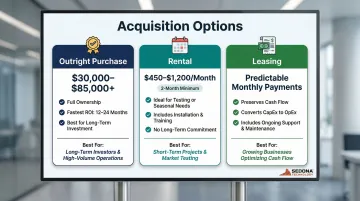
Rental: Rental offers a lower-commitment entry point with monthly rates ranging from $450 to $1,200 depending on the model. Sedona Technology offers rental options with a minimum period of just two months, making it ideal for testing the technology or managing seasonal cleaning demands. All rentals include free installation, training, and ongoing support.
Leasing: Leasing converts a large upfront purchase into predictable monthly payments, which helps individual store locations maintain positive cash flow from day one. Sedona Technology facilitates leasing through partner financing companies. Key benefits:
- Shifts capital expenditure to a manageable operating expense
- Preserves budget for other store investments
- Free installation, training, and ongoing support included
What to Expect in the First 30-60 Days
Once you've selected your acquisition model, here's how a typical deployment unfolds.
Week 1-2: Initial Setup
- Floor mapping and route programming completed
- Staff trained on robot interaction and basic maintenance
- First cleaning sessions supervised to identify any route adjustments
Week 3-4: Baseline Performance
- Robot operates on regular schedule with minimal supervision
- Management reviews initial cleaning data and coverage reports
- Staff adjust to working alongside the robot during store hours
Week 5-8: Optimization
- Routes fully optimized for store-specific layout and traffic patterns
- Cleaning schedules adjusted based on performance data
- Staff fully comfortable with deployment, maintenance, and exception handling
Most supermarkets reach full autonomous operation within 45 days. At that point, staff intervention typically drops to fewer than 10 minutes per shift—limited to consumable refills and occasional exception handling.
Frequently Asked Questions
How much does a supermarket cleaning robot cost?
Costs vary by robot model, store size, and acquisition method. Outright purchases range from $30,000 to $55,000 for mid-size units suitable for most supermarkets. Rental options start as low as $349 to $499 per month with a two-month minimum, significantly lowering the barrier to entry and allowing stores to test the technology before committing to purchase.
Is it worth buying a supermarket cleaning robot?
Labor savings, reduced liability exposure, and consistent cleaning outcomes typically offset the investment within 12-24 months. A 100-store deployment saved 33,649 labor hours and unlocked $2.12 million in annual value. Rental and leasing options also remove the need to commit full purchase capital upfront.
How does an autonomous cleaning robot navigate a busy supermarket?
Robots use 3D LiDAR sensors and AI-powered SLAM mapping to detect and avoid obstacles—including moving shoppers, restocking carts, and temporary displays—in real time. The navigation system adjusts routes autonomously without stopping the cleaning session, ensuring continuous operation even in dynamic, high-traffic environments.
Can cleaning robots operate while the store is open to customers?
Yes, most autonomous floor scrubbers are designed to operate safely alongside customers during store hours, utilizing multi-layered safety systems including virtual safety zones, bumpers, and visual/audible beacons. Many retailers also schedule overnight or early-morning runs for full-floor coverage based on store layout and foot traffic.
Do cleaning robots replace human cleaning staff?
No—robots handle scheduled floor scrubbing, freeing staff to focus on spill response, restroom maintenance, detail cleaning, and customer-facing duties. It's a reallocation model: repetitive tasks go to the robot, while staff focus on work that requires judgment and direct customer interaction.
How long does it take to set up a cleaning robot in a supermarket?
Initial setup and floor mapping typically takes 1-2 days, with staff training taking an additional 2-3 days using a "Train the Trainer" approach. Sedona Technology provides free installation and training, so the robot is operational fast with no onboarding costs.